https://www.metmuseum.org/art/collection/search/465951
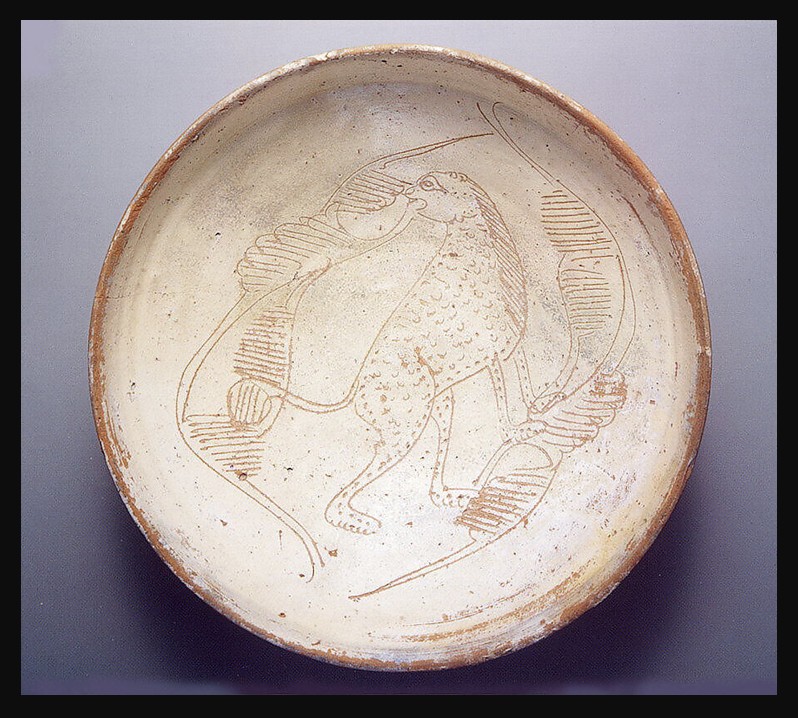
It doesn’t look like much at first. A shallow clay bowl, barely the diameter of a dinner plate, its surface scratched with the image of a spotted cat. No gold. No jewels. No monumental scale. Yet it is precisely through this restraint that what a clay bowl with a cheetah reveals about the Byzantine world comes into focus. And yet this modest piece of Byzantine pottery, now sitting quietly at the Metropolitan Museum of Art in New York, holds inside it an entire world, a world of imperial ambition, cross-cultural exchange, and remarkable craft. In its understated form, it offers a refined glimpse into the rhythms of everyday life within an empire defined as much by connection as by power.
The Object Itself: Humble Clay, Sophisticated Technique
The bowl dates to somewhere between the 11th and 13th centuries and was made using a technique known as sgraffito, from the Italian word for “scratched.” Potters would coat the red clay body of the vessel with a layer of white liquid clay called slip, then use a sharp tool to cut through it, revealing the contrasting red beneath. The lines and shapes of the cheetah emerge from that act of cutting, not by adding decoration, but by taking it away.
The result was then fired and often finished with colour washes in greens and browns. It’s a technique that requires genuine skill: the image must be planned, the hand must be confident, and there is no erasing. What you scratch is what you keep.
Sgraffito slipware was widely produced across the Byzantine world for domestic use, these were, in a sense, the decorated dinnerware of their day. But the patterns and images chosen for these bowls were rarely accidental. They spoke to the values, aspirations, and conversations of the people who used them.
The Cheetah: More Than Decoration
Here is where the bowl becomes genuinely fascinating. Why a cheetah? In the Byzantine world, a cheetah was not simply a wild animal. It was a symbol of aristocratic power. Trained hunting cheetahs, known as hunting leopards in contemporary texts, could belong only to emperors or people in the highest imperial favour. They were prestigious gifts exchanged between rulers, prized possessions listed in noble dowries alongside hawks and falconers.
The MET’s own label for this bowl quotes from Digenis Akritas, a Byzantine epic poem written down around the year 1000, describing a noblewoman’s dowry: “Twelve well-proven hunting leopards, twelve snowy hawks from Abasgia, twelve falconers, and the same number of falcons.” Hunting cheetahs were currency of a very particular kind, the currency of imperial prestige.
Hunting itself was deeply serious business in Byzantine culture. It was regarded as excellent preparation for military action, a physical discipline fit for warriors and emperors. Treatises on hunting were copied and circulated in the 11th and 12th centuries, signalling a renewed aristocratic enthusiasm for the sport. Emperor John II Komnenos, one of Byzantium’s most celebrated rulers, died in a hunting accident in 1143.
Royalty even staged public displays of their trained hunting cheetahs as performances of power. A cheetah on a bowl at your dinner table, then, was not mere decoration. It was a conversation starter, a statement of aspiration, perhaps even a memory of such spectacles.
Clay That Crosses Civilisations
There is another layer to this object that rewards attention in the classroom. Byzantine slipware did not develop in isolation. Despite the often hostile political relationship between Byzantium and the Islamic world, ceramic technology and decorative ideas moved fluidly across that divide.
Some Byzantine bowls were directly influenced by similar works produced in the early Islamic world. Patterns borrowed from metalwork designs, themselves shared across Byzantine and Islamic craft traditions, appeared on clay vessels, suggesting that potters were consciously imitating the look of more precious silver and bronze objects. A ceramic bowl engraved to look like beaten metalwork was an affordable luxury, a democratic echo of wealth.
This cross-cultural flow is a remarkable teaching point. The Mediterranean in the 11th to 13th centuries was not a series of sealed civilisations at war. It was a connected world where objects, images, techniques, and ideas moved along trade routes, through diplomatic gifts, and across workshop traditions. A bowl made somewhere in the Byzantine Empire could end up as cargo in a ship sailing the Aegean, and we know this not as speculation but as archaeological fact. A plate decorated with a cheetah attacking a deer was recovered from a Byzantine shipwreck in the northern Aegean, part of a cargo of ceramic tableware that documents the pottery trade in action.
Objects like this one do several things at once. They make the Byzantine world tangible, not mosaics on a distant ceiling, but clay in a hand, a bowl on a table, a cheetah scratched by a craftsperson whose name we will never know. They invite questions rather than closing them down: Who made this? Who owned it? What did they talk about at the table where it was used?
Classroom Activity: Bring Byzantine history to life in your classroom with this hands-on student activity inspired by the Byzantine Bowl with Cheetah at the Metropolitan Museum of Art in New York city. Explore the full Student Activity →
Continue Exploring on Teacher Curator: Expand your understanding of Byzantine Table Art with the following related article… Byzantine Silver Bucket
Sources and further Reading: To dive deeper into the world of Byzantine Pottery and decorative arts, visit the MET, NY site… https://www.metmuseum.org/art/collection/search/465951 and Learn more about the history and craftsmanship of The Roman and Byzantine Pottery in an American School of Classical Studies at Athens article… https://www.ascsa.edu.gr/uploads/media/hesperia/146512.pdf