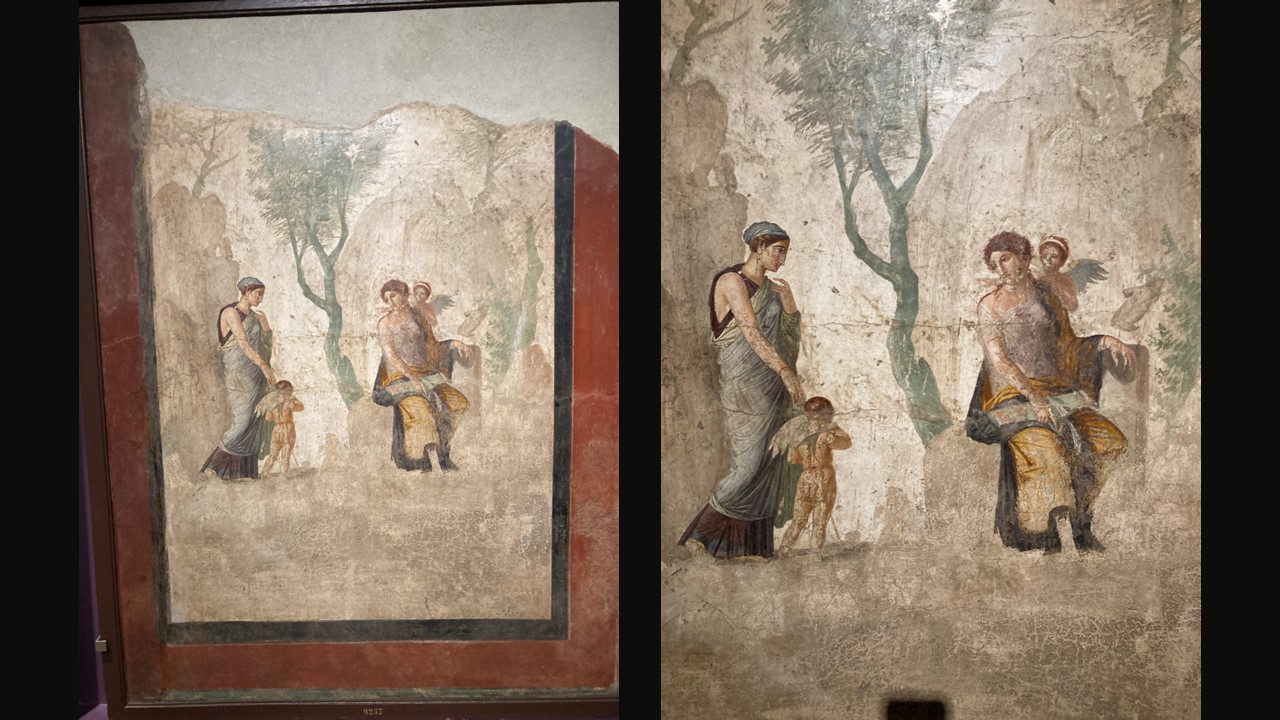
Eros Punished, 1st century AD, Fresco, 126x162.3 cm, from the House of Punished Eros in Pompeii

Eros Punished

Eros Punished, 1st century AD, Fresco, 126x162.3 cm, from the House of Punished Eros in Pompeii
Eros Punished, 1st century AD, Fresco, 126×162.3 cm, from the House of Punished Eros in Pompeii, National Archaeological Museum of Naples, Italy – Photo Credit: Amalia Spiliakou, February 18, 2024, ‘Meanings’. Personifications and Allegories from Antiquity to Today Exhibition, Acropolis Museum, Athens, Greece

On February 17, 2024, in Athens, attending an exceptional exhibition, titled ‘NοΗΜΑΤΑ’: Personifications and Allegories from Antiquity to Today, held at the Acropolis Museum, I came face to face with an adorable Pompeiian fresco titled Eros Punished. It is now part of the Museo Archaeologico Nazionale di Napoli, but back in the 1st century AD, adorned the wall of a triclinium in the House of Love Punished in Pompeii.

The fresco’s narrative unfolds amidst the timeless strokes of fine ancient artistry. Peithò, (Persuasion Personified), leads Eros to his mother Aphrodite, terribly crossed with him, for an impending punishment. Eros used his arrows to kindle Ares’s passion for another woman, and Aphrodite is unwilling to forgive such mischief. Peithò, Persuasion personified, affectionately holds Eros’s hand, who bearing the weight of his misdeed, seems like crying, hesitant to proceed. Aphrodite, seated regally upon a rugged perch, emanates an aura of solemnity. She holds Eros’s bow and cuirass and looks at him sadly, but firmly. Anteros, the younger sibling of Eros, lurks behind her, poised to witness the unfolding consequence with a mixture of anticipation and childish delight. This tableau, frozen in time, capturing the intricate interplay of familial bonds, divine intervention, and the immutable consequences of love’s transgressions, delights me!
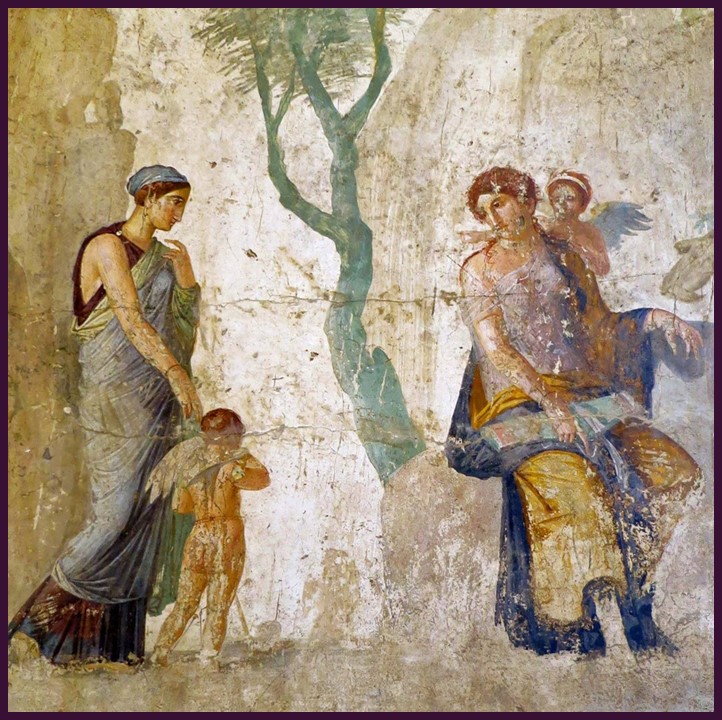
Eros Punished, 1st century AD, Fresco, 126x162.3 cm, from the House of Punished Eros in Pompeii
Eros Punished (detail), 1st century AD, Fresco, 126×162.3 cm, from the House of Punished Eros in Pompeii, National Archaeological Museum of Naples, Italy
https://www.planetpompeii.com/en/blog/eros-and-anteros-the-love-needs-to-be-reciprocated-to-grow.html
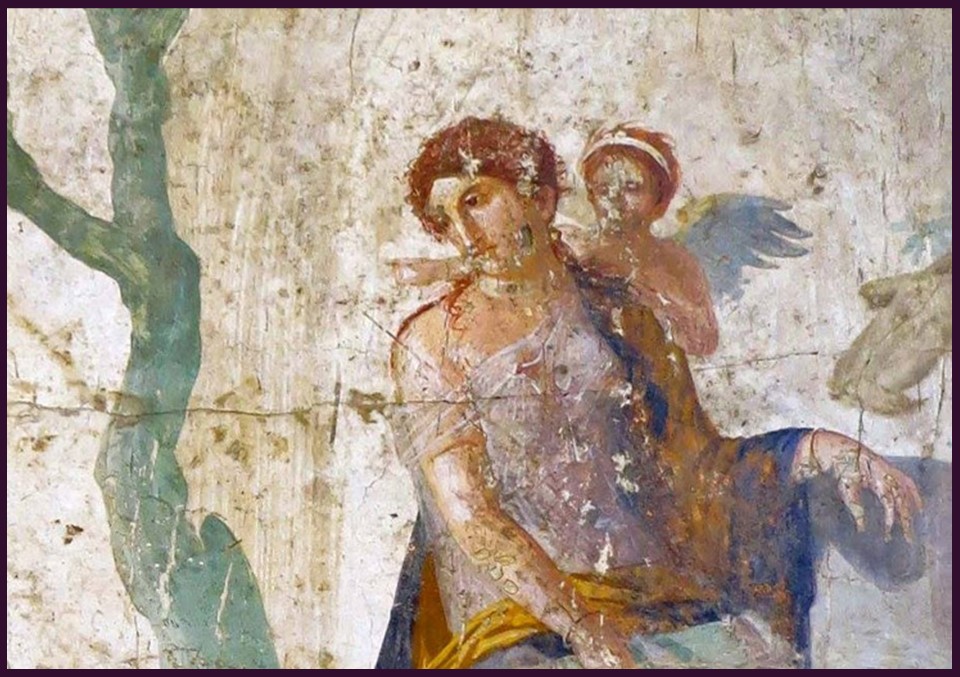
Eros Punished, 1st century AD, Fresco, 126x162.3 cm, from the House of Punished Eros in Pompeii (detail)
Eros Punished (detail), 1st century AD, Fresco, 126×162.3 cm, from the House of Punished Eros in Pompeii, National Archaeological Museum of Naples, Italy
https://www.planetpompeii.com/en/blog/eros-and-anteros-the-love-needs-to-be-reciprocated-to-grow.html

In exploring this scene, I cannot overlook the intriguing presence of God Eros and his younger brother Anteros within the same composition. The relationship between Eros and Anteros, symbolizing the two counterparts of reciprocal love, finds its vivid portrayal in a fanciful myth recounted by the fourth-century rhetorician Themistius. Through Themistius’s narrative, we glimpse into the depths of brotherly affection and the profound consequences it entails…

When Aphrodite gave birth to Eros, the child was beautiful and befitted his mother in any respect but one: he did not grow to a size appropriate to his beauty… The baby’s mother and the Graces, his nurses, did not know what to do when confronted with this situation. They went to Themis… and asked her to find some means by which they might be delivered from their strange and astonishing misfortune. Themis said: “I shall put an end to your predicament. The problem is that you do not yet know the true nature of the baby. Eros, your genuine offspring, may perhaps have been born alone but he cannot grow up in any part of the body: you need Anteros if you want Eros to grow. These brothers will have the same nature; each will be responsible for the other’s growth. For when they see each other, they will both shoot up equally; but if one of them is deprived of the other, they will both shrink in size.” And so Aphrodite conceived Anteros, and Eros immediately had a spurt of growth and sprouted wings and was tall. Since this is Eros’s fortune, he often endures strange transformations, now sprouting up, now shrinking, then growing again. He always needs his brother’s presence. If he sees that his brother is of sizable stature, he is eager to appear bigger himself; but he often shrinks in size, against his own will, once he has discovered that his brother is shrunken and small.
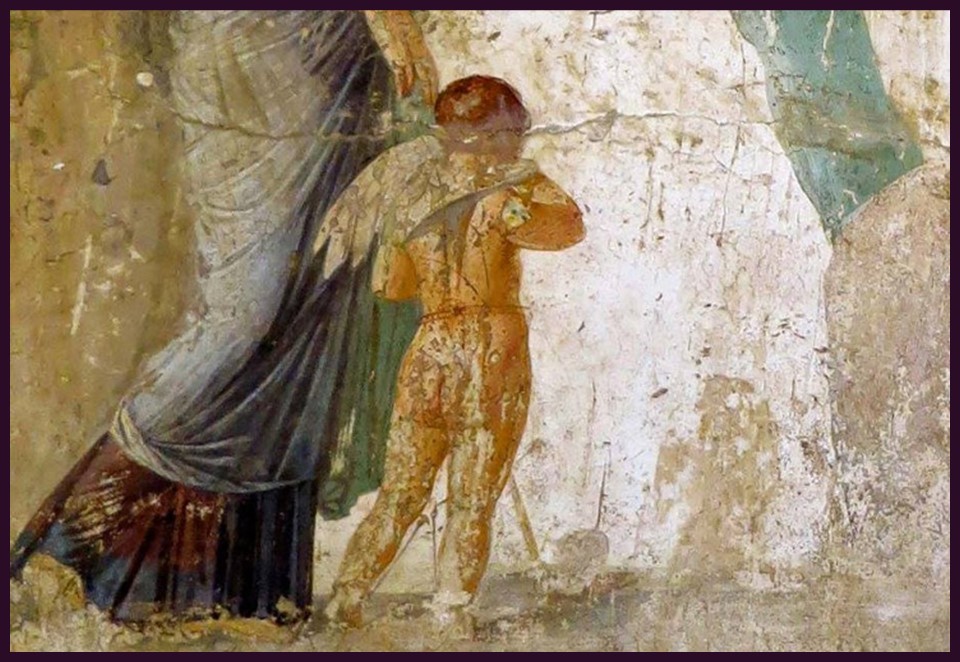
Eros Punished, 1st century AD, Fresco, 126x162.3 cm, from the House of Punished Eros in Pompeii (detail)
Eros Punished (detail), 1st century AD, Fresco, 126×162.3 cm, from the House of Punished Eros in Pompeii, National Archaeological Museum of Naples, Italy
https://www.planetpompeii.com/en/blog/eros-and-anteros-the-love-needs-to-be-reciprocated-to-grow.html

For a PowerPoint on Eros and Anteros in Art, please… Check HERE!

Bibliography on Eros and Anteros: Eros and Anteros or Reciprocal Love in Ancient and Renaissance Art by Guy de Tervarent, Journal of the Warburg and Courtauld Institutes, Vol. 28 (1965), pp. 205-208 p.272 https://www.jstor.org/stable/2853330?read-now=1&seq=8#page_scan_tab_contents  and Grecian and Roman mythology by Dwight, M. A. (Mary Ann), 1806-1858, p. 266 https://archive.org/details/cu31924029135651/page/n269/mode/1up and Anteros: On Friendship Between Rivals and Rivalry Between Friends p. 9 file:///C:/Users/aspil/Downloads/Post_columbia_0054D_11776.pdf
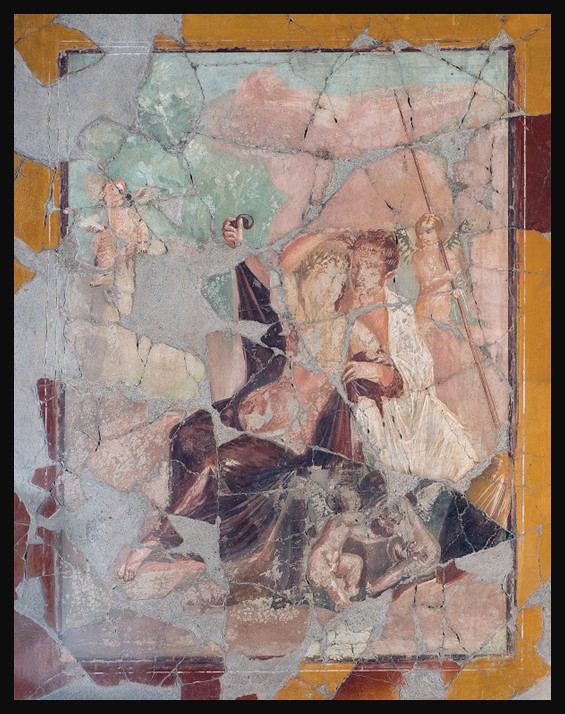
The Bicentenary House, the fresco of Aphrodite and Aris, Herculaneum

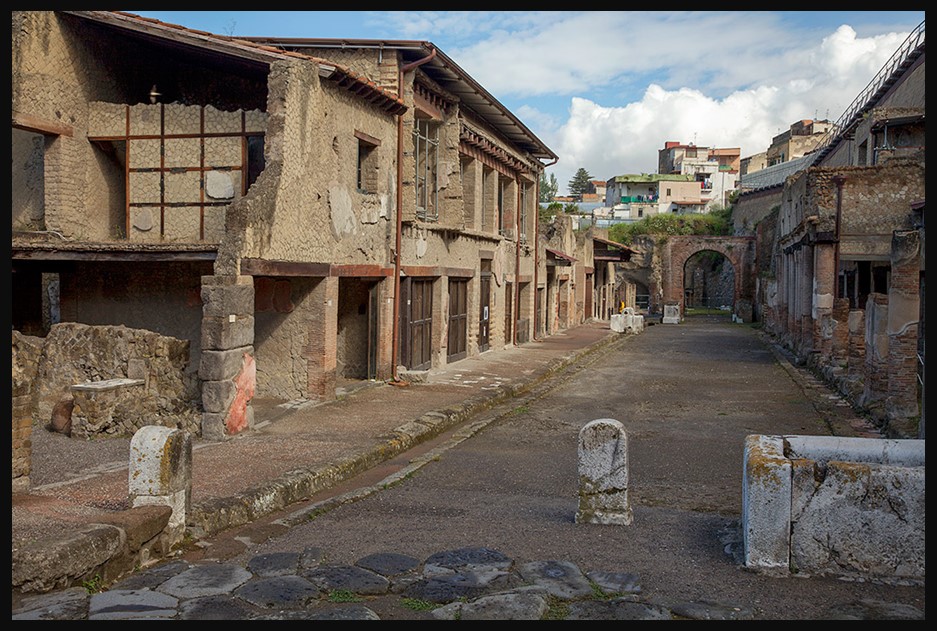
The House of the Bicentenary in Herculaneum

The Bicentenary House, the fresco of Aphrodite and Aris, Herculaneum
The Bicentenary House, the fresco of Aphrodite and Aris, 1st century AD, Tablinum, Herculaneum, Italy https://minervamagazine.com/grand-designs-at-herculaneum.html

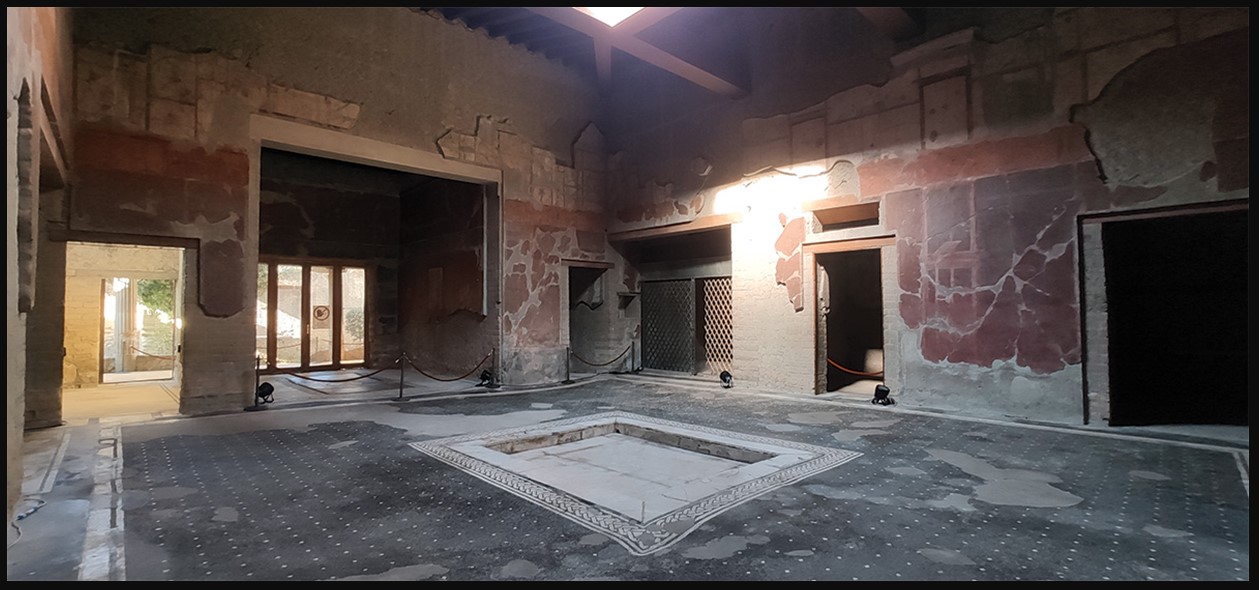
The House of the Bicentenary in Herculaneum is one of the site’s jewels. Back in the 1930s, archaeologist Amedeo Maiuri described it as a sumptuous noble house of elegant proportions. It is one of Herculaneum’s largest townhouses, as would be expected for a property with such a prominent location on the main street of the town, close to the theatre, the law courts, and the forum. The stately 1st-century BC house was built on two storeys and its façade was decorated with a brightly coloured green-and-red chequerboard pattern, with a balcony looking over the street. Inside, a large atrium with a central marble pool led to an elegant room for receiving guests. Both were covered with lavish mosaic pavements and wall paintings, all indicating that this was a noble house that belonged at some point to prosperous owners… https://minervamagazine.com/grand-designs-at-herculaneum.html

The Bicentenary House, Herculaneum
The House of the Bicentenary is one of the best preserved noble houses at Herculaneum, with highly refined wall paintings and mosaic pavements, 1st century AD, Herculaneum, Italy https://www.getty.edu/conservation/our_projects/field_projects/herculaneum/overview.html

History of the Archaeological Site

The House of the Bicentenary was unearthed under the direction of archaeologist Amedeo Maiuri, in 1938, amidst the bicentennial celebrations of the excavations at Herculaneum. Concurrently, efforts were made to stabilize, restore, and exhibit the site, with artefacts showcased in the atrium’s left hall and a preserved wood screen displayed in the right hall. By 1983, however, the house faced severe deterioration, worsened by exposure to the elements and heavy tourist traffic. Structural instability, deteriorating wall paintings, crumbling tuffa walls, flaking paint layers, and lifting mosaics plagued the once-grand villa, necessitating urgent restoration efforts.

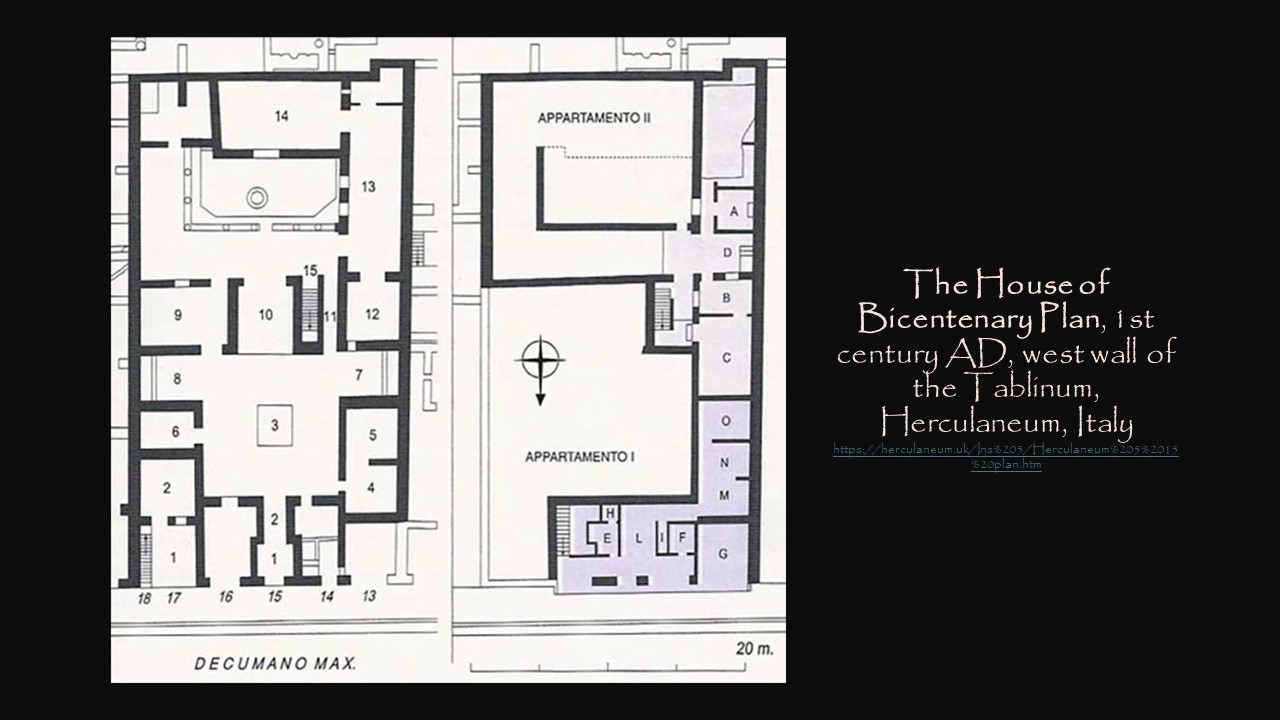
Plan of the Bicentenary House in Herculaneum

In a decisive move, the House underwent closure to visitors, heralding a transformative period in 2011. A collaborative effort ensued, with the participation of the Getty Conservation Institute (GCI), the Archaeological Park of Herculaneum, and the Herculaneum Conservation Project, united in a mission to comprehensively research, analyze, document, and stabilize the edifice’s architectural framework, wall surfaces, frescoes, and mosaic pavements. Particular focus was directed towards the restoration of the remarkable Tablinum area. The outcome of this concerted effort has been nothing short of remarkable. Such was the extent of the achievement that Domenico Camardo, the chief archaeologist at the Herculaneum Conservation Project, expressed the endeavour as not only a pivotal moment in the house’s preservation but also an opportunity for pioneering advancements in conservation methodologies and materials, with implications reaching far beyond the site itself. https://www.thehistoryblog.com/archives/56824

An Overview of the House of the Bicentenary…

Nestled along Herculaneum’s bustling main thoroughfare, the city’s Decumanus Maximus, the Bicentenary House once hosted Gaius Petronius Stephanus and his wife Calantonia Themis within its exquisite confines. Renowned as one of the city’s most opulent residences, sprawling across over 600 square meters and boasting an upper floor, its halls were adorned with meticulously preserved mosaic floors and frescoes breathing life into mythological narratives and intricate architectural and animal motifs. Particularly noteworthy is the Tablinum (Room 10 on the Plan), adorned with a collection of 4th Pompeian Style paintings renowned for their beauty and craftsmanship, offering visitors a glimpse into the peak of artistic expression within the site.

The Bicentenary House in Herculaneum
The Bicentenary House, 1st century AD, Tablinum, Herculaneum, Italy https://minervamagazine.com/grand-designs-at-herculaneum.html

On the Tablinum Frescoes…

The decoration of the Tablinum is superb. The room’s ensemble of wall paintings exhibits artistic and archaeological importance portraying mythological scenes, cupids in a variety of activities, and portraits of Dionysiac figures of the utmost elegance and sophistication. Finally, the unique mosaic pavement in opus sectile and opus tessellatum, creates a unique mosaic floor, blending opulent reds, yellows, and blacks in a sophisticated scheme.

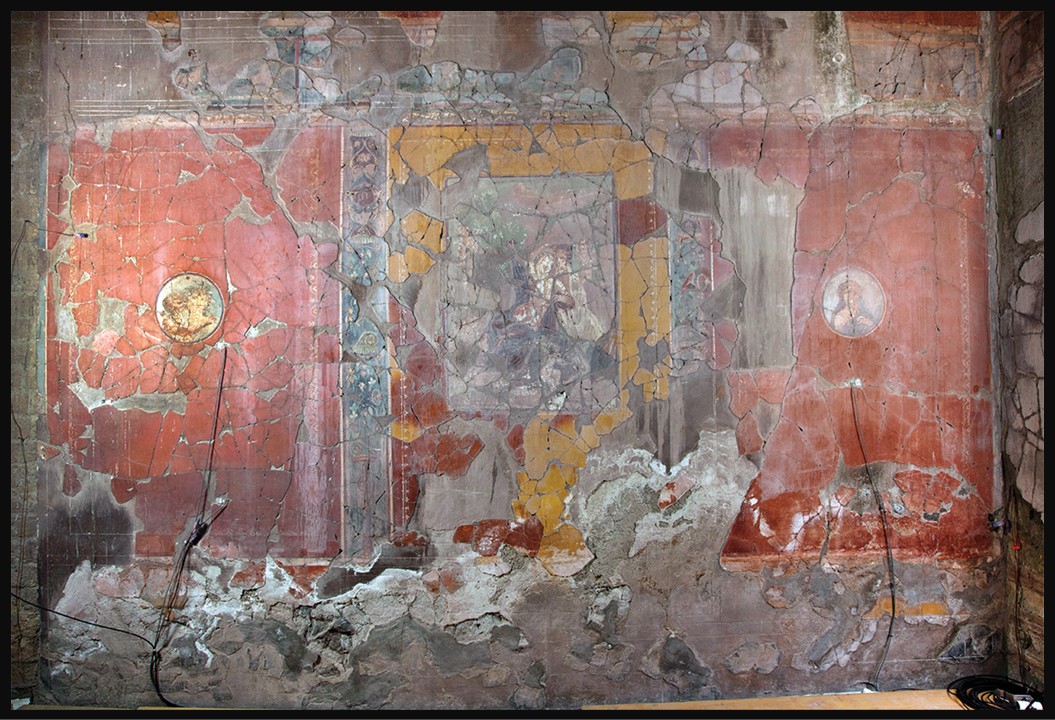
The Bicentenary House, the fresco of Aphrodite and Aris with medallions of Dionysiac portraits, Herculaneum
The Bicentenary House, the fresco of Aphrodite and Aris with medallions of Dionysiac portraits, 1st century AD, Tablinum, fresco, Herculaneum, Italy https://minervamagazine.com/grand-designs-at-herculaneum.html

According to Amedeo Maiuri… The tablinum preserves a rich, sparkling marble pavement, like a polychrome carpet, and on the walls, paintings, medallions, and a frieze; in the panels are represented the myths of Daedalus and Pasiphae and of Venus and Mars; in the medallions are busts of Satyrs, Sileni and Maenads. On the upper part of the walls runs a frieze with cupids. From the tablinum, we reach the little portico with the garden and the rustic rooms on the ground floor. https://herculaneum.uk/Ins%205/Herculaneum%205%2015%20p3.htm

For a PowerPoint on the House of the Bicentenary, please… Check HERE!

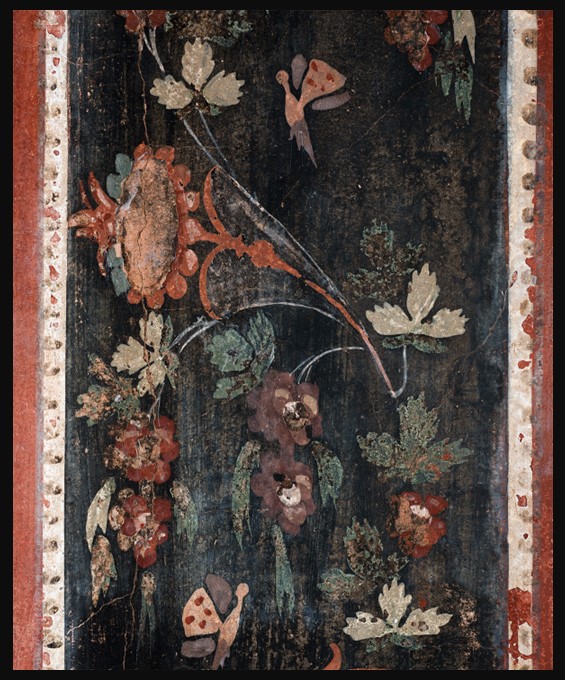
The Bicentenary House, the fresco of Aphrodite and Aris with medallions of Dionysiac portraits, Herculaneum (detail)
The Bicentenary House, the fresco of Aphrodite and Aris with medallions of Dionysiac portraits, 1st century AD, Tablinum, fresco, Herculaneum, Italy https://minervamagazine.com/grand-designs-at-herculaneum.html