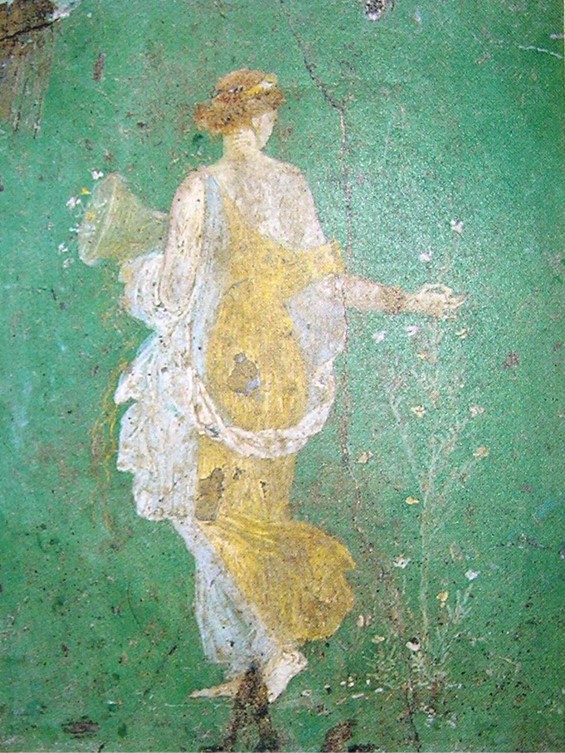
The fresco of Flora from Stabiae captures Toru Dutt’s floral rivalry in paint, transforming myth into elegance, where spring, beauty, and nature’s abundance merge in delicate harmony.
Astragaloi Players
Ovid’s Niobe, turned to stone by grief after Apollo and Artemis punish her pride, finds an unexpected prelude in the Herculaneum Astragaloi Players, where myth, innocence, and fate quietly converge before catastrophe.
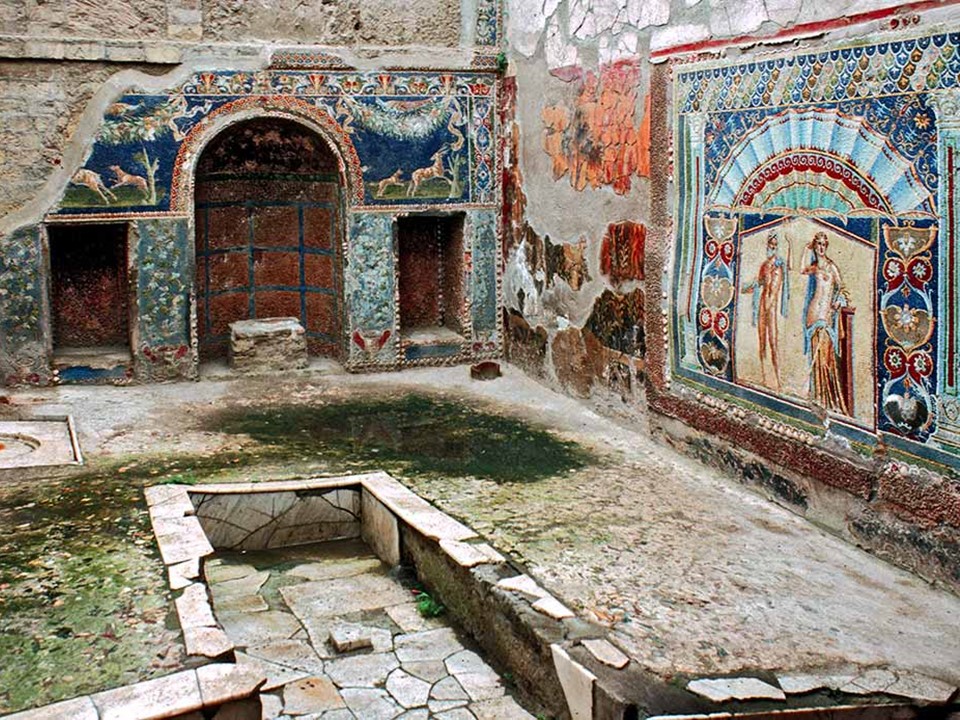
House of the Deer in Herculaneum
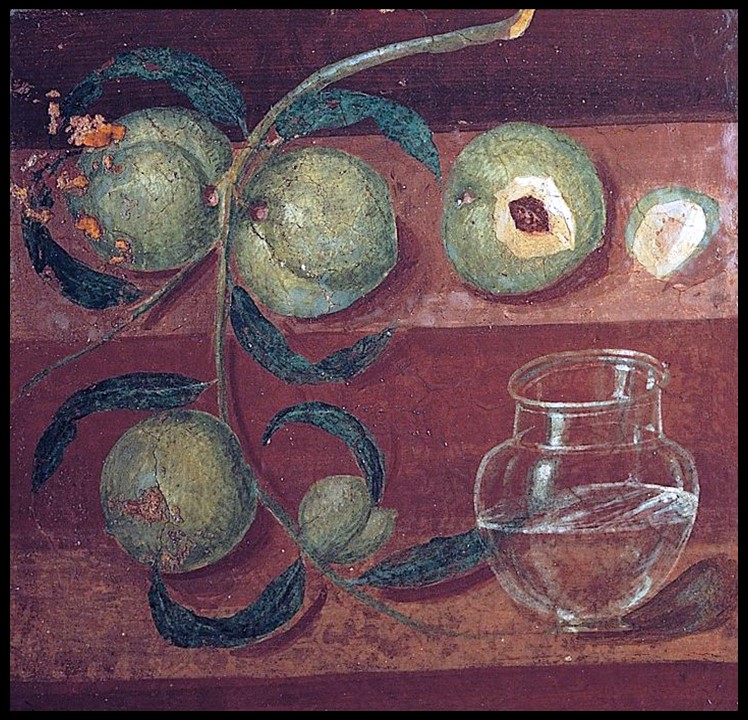
Herculaneum’s luminous Still Life with Peaches and Water Jar — frozen since 79 CE — reminds us on World Food Day that sharing food with others is humanity’s most ancient, generous impulse.
Painter at Work!

Pompeii in Color: The Life of Roman Painting Exhibition at the New York University Institute for the Study of the Ancient World (through May 29, 2022) presents thirty-five frescoes from the National Archaeological Museum of Naples. Among these important works, all originally from Roman homes is a favorite painting of mine, titled Painter at Work! It comes from the Pompeian House of the Surgeon, and it is a Gem! https://isaw.nyu.edu/exhibitions/pompeii-in-color
The amazing Pompeian fresco of a female painter immersed in her work… observed and admired… “bathed” in “aubergine” tones, attracts our attention, and captivates our eyes. The Questions and Answers that follow, will hopefully help us solve hidden clues, understand the fresco’s importance, and enjoy its charm!
Where was the Fresco titled Painter at Work discovered?
The fresco was found in the House of the Surgeon, in the ancient city of Pompeii, located in the Bay of Naples, or as Cicero would call it, the “the crater of all delights.” Pompeii was the favorite vacation spot of the Roman elite. Roman Emperors and their wives, members of the old aristocracy, and representatives of the new money elite were all, more than enthusiastic to live or vacation on the Neapolitan coast. The name of the House’s owner may not be known, but a toolkit of bronze and iron surgical instruments discovered during excavations is responsible for its modern name. https://www.smithsonianmag.com/arts-culture/roman-splendor-in-pompeii-59083755/

https://en.wikipedia.org/wiki/House_of_the_Surgeon
https://sites.google.com/site/ad79eruption/pompeii/regio-vi/reg-vi-ins-1/house-of-the-surgeon
Specific facts about When and Where the House of the Surgeon was built: The House of the Surgeon or Casa del Chirurgo is one of the oldest Italic Houses in the city. It was excavated back in 1771 by the Spanish military architect and archaeologist Francesco La Vega. It is located on the East side of the ancient city (Regio VI, Insula i, Doorway 10), about 50 meters inside the Herculaneum Gate, and dates from the Samnite period, between the 3rd and the early 2nd century BC. At the time of the eruption of 79 AD, the House had fallen into a poor state and was undergoing considerable repair work. https://intarch.ac.uk/journal/issue23/3/case_study.html and https://interactive.archaeology.org/pompeii/field/11.html

https://www.storieparallele.it/la-casa-del-chirurgo-di-pompei/
Where was the fresco of the female Painter at Work discovered? The House of the Surgeon was, once, lavishly decorated with frescoes of the 4th Pompeian Style. Room L, next to the House’s Hortus (Garden), seems special. This is the Room where the Painter at Work fresco was discovered in 1771. The painting was detached, it was considered a protection procedure at the time, and is now exhibited in the National Archaeological Museum of Naples, as a framed panel.

Le pitture antiche d’Ercolano, Tomo Setimo, Tabola LXXXII, pag. 365, Napoli : nella regia stamperia, 1757, TH-Bibliothek Zürich https://commons.wikimedia.org/wiki/File:Delle_antichit%C3%A0_di_Ercolano,_1757-1779_(T._I-VII)_70388_(23839904461).jpg
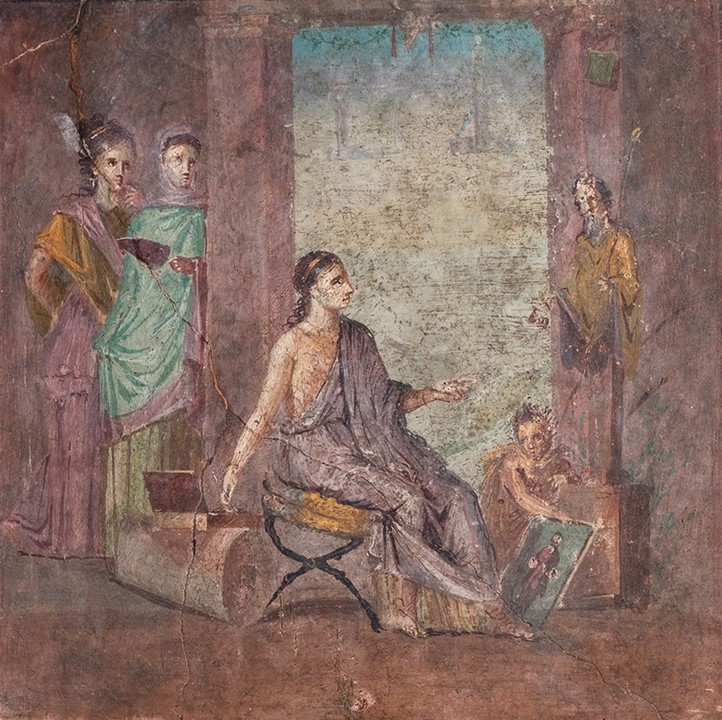
Describe the Composition: Painter at Work is a wall decoration of a seated woman absorbed in the art of painting! It was discovered in 1771, during the early excavations, in Room L of the House of the Surgeon, in Pompeii. The painting was, at the time, removed, and now is exhibited in the Archaeological Museum in Naples. We do not know the name of the artist who created it, nor the name of the depicted female painter… they are both anonymous, but they both strike us as talented and unique! The portrayed artist sits comfortably on a stool, dramatically framed by a window opening to the sky. The window is bordered by two pillars/posts and is decorated with garlands and a Bucranium. In a faint distance, we can discern a Herm and a Vase standing on a pillar, both typical Hellenistic landscape motives.
The portrayed artist is about to finish her painting of a sculpture that stands in front of her. Her hand reaches back with her paintbrush to a box of pigments balancing on a cylindrical stand… is it the drum of a column? She is looking at the statue of a bearded man… is he God Dionysus as some scholars have suggested? Immersed in her work she is about to put the final touches on her painting placed on the floor directly beneath its model, held by a wreathed boy… is he Cupid? Behind the left Pillar, two richly dressed women stand, looking interested… are they friends, admirers, or sponsors? We can only guess…
There is so much I admire in this small painting! The noble theme of a painting dedicated to the Art of Painting, and thee, by a female artist… The idea of a painting within a painting, with the extra addition of a second small painting hanging on the right pillar… The amazing color scheme employed by the artist, muted aubergine tones and soft sky blues…the atmospheric perspective… and the fainted Hellenistic landscape. This is a grand painting in small size! http://www.pompeiiincolor.com/theme/the-fantastic-and-the-familiar
For more Questions and Answers, please… Check HERE!
Villa Arianna’s Dionysus and Ariadne Fresco

https://commons.wikimedia.org/wiki/Category:Triclinio_3_di_Villa_Arianna#/media/File:Affresco_particolare_23.jpg
https://commons.wikimedia.org/wiki/Category:Triclinio_3_di_Villa_Arianna#/media/File:Mito_ri_Arianna.jpg
Lying in the shadow of Mount Vesuvius… Stabiae is home to a group of enormous, sea-edge, Villae Marittimae, which are set on a cliff above the modern town of Castellammare di Stabia. We know of at least six of these villas, built directly next to one another—a sort of Roman high-rent resort district next to the small town of Stabiae. They were beautifully preserved by the eruption of 79 A.D., with standing walls, some of the highest quality frescoes surviving from antiquity, and some of the most innovative garden architecture in the Roman world. On the 13th of October I presented you with information on Villa Arianna, today, on the 11th of December… let’s discuss Villa Arianna’s Dionysus and Ariadne Fresco. https://www.baslibrary.org/archaeology-odyssey/8/1/5

https://commons.wikimedia.org/wiki/Category:Triclinio_3_di_Villa_Arianna#/media/File:Mito_ri_Arianna.jpg

https://www.stabiaholidayhouse.it/en/visit-to-the-ancient-stabiae/
Villa Arianna Plan, Stabiae (after Kockel 1985 with corrections by Allroggen-Bedel A. and De Vos M.) https://www.pompeiiinpictures.com/pompeiiinpictures/VF/Villa_102%20Stabiae%20Villa%20Arianna%20plan.htm
Villa Arianna was lavishly decorated with frescoes and portable furnishings, an undisputed testimony of the expensive lifestyle the owners enjoyed, and evidence of their refined taste and style. One such high-quality fresco, drawing inspiration from the myth of Dionysus and Ariadne, gave the Villa its modern name.
Ιmagine the scene… Theseus and Ariadne flee Crete in a hurry. With the help of Ariadne, Theseus had just killed the horrible Minotaur in the depths of Knossos’s palace maze. Their first stop to rest on their way to Athens is the island of Naxos… where the story unfolds dramatically and excitingly. God Dionysus, in love with Ariadne, appears to Theseus in his sleep and convinces him to abandon Ariadne at Naxos and continue his trip alone. Ariadne, unaware of divine intervention disembarks at Naxos enchanted by the beauty of the island, happily explores it, and tired falls asleep on the beautiful islet of Palatia. When she wakes up… god Dionysus, the son of Zeus and Dione, looks at her adoringly and a new love affair is in the making. A glorious wedding follows and an eternal gift is still with us to admire… the constellation known as Corona Borealis is said to be Dionysus’s wedding gift to Ariadne, a special ornament to adorn her beautiful head.
Please take the time to look at the Villa’s Plan, locate Room 3, and imagine a December Symposium night two thousand years ago…
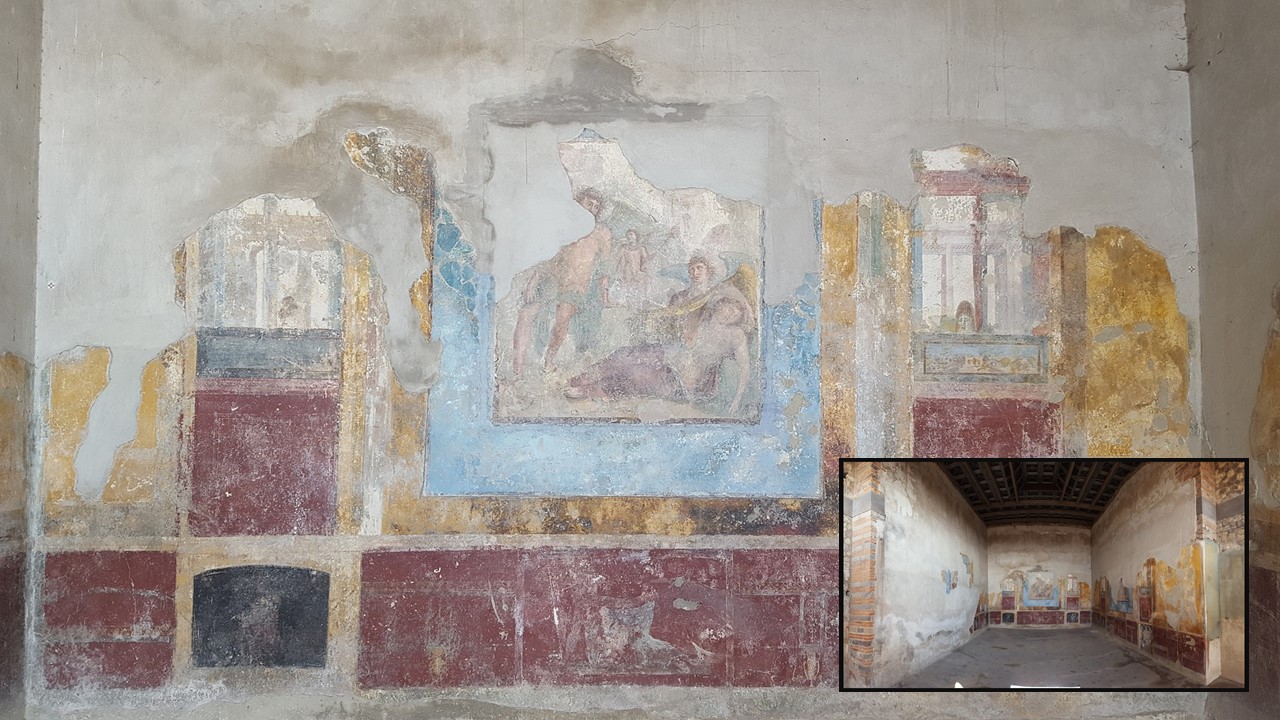
Villa Arianna’s Dionysus and Ariadne Fresco is a small part of Villa’s grand Triclinium decoration. Room 3 is decorated in the 4th Pompeian Style, elaborate and complex as it can be, combining large-scale Narrative Painting, small Panoramic Vistas, and Still Lifes, within an architectural fantasy of pedestals, aediculae, columns, entablatures, and… theatrical masks! The Villa’s grand Triclinium decoration doesn’t resemble any believable space but instead consists of a variety of architectural elements arranged in an unrealistic manner with an unrealistic perspective, set against a flat background. The three large mythological scenes framed in blue on a yellow and red ground above a lower red and black decorative frieze are the room’s main artistic attraction. A panel presenting the myth of Dionysus and Ariadne decorates the South Wall, a rare scene of Lycurgus and Ambrosia is presented on the West Wall, and on the East Wall, the unknown master painter of the grand Triclinium presented the myth of Zeus and Ganymede. https://depts.washington.edu/hrome/Authors/ninamil7/TheFourStylesofRomanWallPaintings/pub_zbarticle_view_printable.html
Room number 3 was Villa Arianna’s grand Triclinium… the main dining room of a luxurious Roman residence, so-called because of the three banqueting couches (klinai) arranged around the walls. All you have to do is… imagine a warm summer night, overlooking the Bay of Naples, in the company of good friends, bathed in the flickering light, and content with scrumptious food… If you were the owner of Villa Arianna, life was good!
For a Student Activity, please… Check HERE!

https://en.wikipedia.org/wiki/Stabiae#/media/File:Villa_Arianna_(Stabia)_WLM_099.JPG

https://commons.wikimedia.org/wiki/Category:Triclinio_3_di_Villa_Arianna#/media/File:Affresco_particolare_7.jpg
Villa Arianna at Stabiae

https://commons.wikimedia.org/wiki/Category:Terrazza_B_di_Villa_Arianna#/media/File:Arianna_terrazza_B.JPG
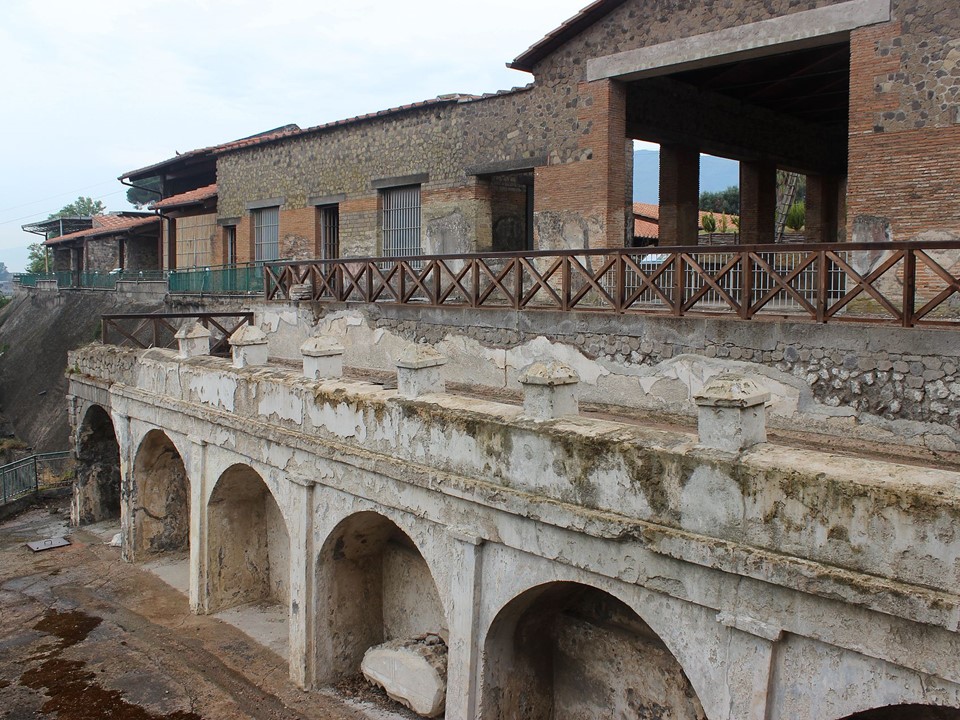
During the Archaic period (8th century BC) Stabiae already played an important strategic and commercial role. The city reached its highest population density between its destruction by Sulla (89 B.C.) and the eruption of Mount Vesuvius (79 A.D.). During this period, on the northernmost edge of the Varano hill, many villae were built taking advantage of the panoramic views. They were mainly residential villas, with beautifully decorated large apartments, thermal baths, porticoes and nymphaea. At present, only some of these villas, not entirely excavated yet, can be visited: …Villa Arianna at Stabiae, the most ancient, named after a large mythological fresco on the far wall of the triclinium is one of them… writes Archaeologist Silvia Martina Bertesago. All I can say is… let’s explore it! http://pompeiisites.org/en/stabiae/
Excavations in Villa Arianna started in 1757 and were conducted by the Swiss engineer Karl Weber, until 1762. At the time, the archaeological site of the Villa was seen more like a treasure hunt exploration site. The Weber team dug underground tunnels, explored the excavated areas, and whatever was discovered and considered of value, like furnishings and frescoes, were detached and taken to the Bourbon Museum at the Royal Palace of Portici. A lot, deemed unworthy or ruined, were left behind and much was ruined by the methods employed by the “archaeologists” of the time. Today, parts of the Villa nearest the sea have collapsed down the cliff and perished forever, extended areas of the site are still buried awaiting excavations, but thanks to a Bourbon-period map showing where tunnels dug and thereafter re-buried, archaeologists resumed excavations in 1950, and proceed with proper scientific research.

On the western hills of Varano, and overlooking the Bay of Naples, Villa Arianna, is impressive, to say the least. It is estimated that it covered an area of over 11,000 sq.m., whereas its excavated parts cover only 2,500 sq.m. The villa has an unconventional layout, due in part to its continuous development but also to the sloping nature of the site. As much of the building is still buried, the original floor-plan is quite difficult to interpret. Certainly, the main range of rooms was at the front of the highest of a series of terraces; some of these rooms featured views both of the sea on one side and of the mountains on the other. There was also a long tunnel (B) leading from the stables and farm court under the residential quarters to the shore. https://sites.google.com/site/ad79eruption/stabiae/villa-arianna

The oldest section of the Villa dates back to the late Republican period (2nd century BC), and develops around its Atrium (24) and the surrounding rooms. The Thermal Baths (6), the grand Triclinium (3), the summer Triclinium (A), and the surrounding rooms date from the middle of the 1st century AD. The large Palestra, located at the west end of the Villa was added to the complex shortly before the eruption, probably between 60 and 70 AD.

https://commons.wikimedia.org/wiki/Category:Atrio_24_di_Villa_Arianna#/media/File:Impluvium.jpg
Villa Arianna was lavishly decorated with frescoes and portable furnishings, an undisputed testimony of the expensive lifestyle the owners enjoyed, and evidence of their refined taste and style. One such high-quality fresco, drawing inspiration from the myth of Dionysus and Ariadne, gave the Villa its modern name.
A presentation of the amazing Frescoes discovered in Villa Arianna will be part of another BLOG POST… Villa Arianna, Part 2
For a Student Activity on Villa Arianna at Stabiae, please… Check HERE!
The Samnite House in Herculanium

Herculaneum was a peaceful seaside town which was struck by a succession of pyroclastic flows during the eruption of Vesuvius in 79 CE. It was then covered with 25 metres of volcanic mud. Approximately one third of the town has been excavated. It is notable for the high standard of preservation of the houses and the public baths as well as perishable material such as wood, textiles and papyri. A significant number of high quality painted walls may be seen. The Roman seashore has been exposed during the excavations and a Roman boat has been preserved in a special museum. What a remarkable place to visit… and don’t forget, The Samnite House in Herculanium is a must! https://www.herculaneum.ox.ac.uk/links/visit
If you wonder why… Herculaneum has been preserved like no other site in the world, not even nearby Pompeii. Volcanic ash and mud saved two-story domus homes with the internal architecture and décor intact, including features in wood and marble, decorations, jewelry, and even organic remains like food, providing a unique view into the daily lives of the ancient population of Herculaneum. Among the finest and oldest houses that survived is the Samnite House we will attempt to explore. https://www.visitpompeiivesuvius.com/en/herculaneum
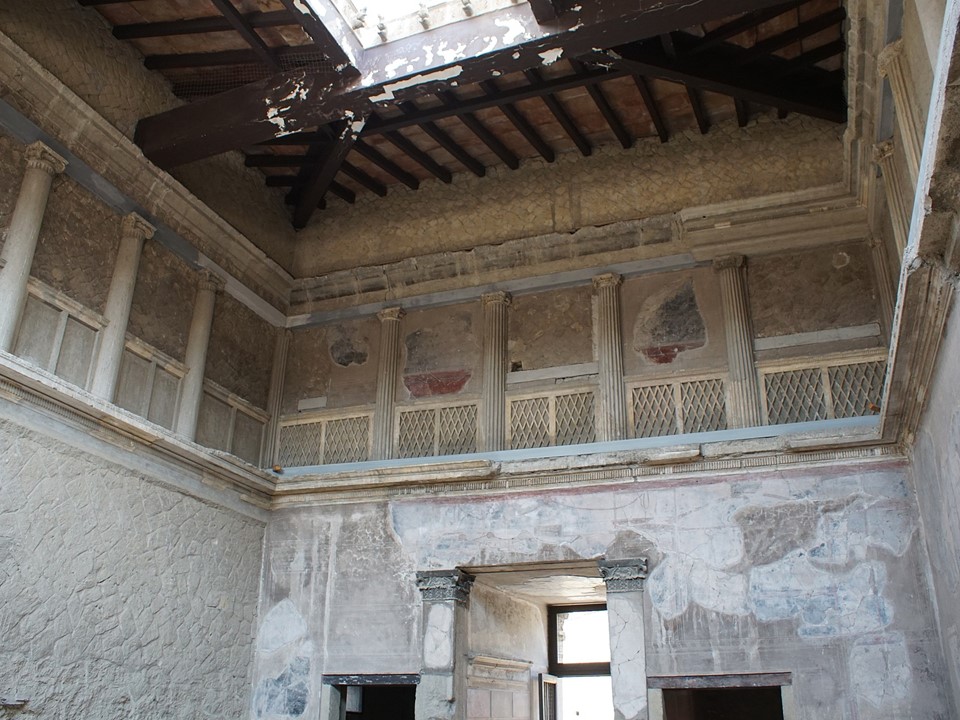
The Samnite House is one of the oldest private residences that has been discovered in Herculaneum, so far, and dates back to the 2nd century BC. It was originally much larger in size, with a three-sided Peristyle Court to the east, followed perhaps by a Hortus area. In the course of the 1st century AD, and for financial reasons, one could suspect, the property changed the plan. A second entrance door leading directly to the second floor was added and the entire upper floor space was rented out. The eastern section of the property, that is the Peristyle and possible Hortus was sold off, allowing a separate residential property, the House of the Great Portal, to be built. What survived of the original property, was a ground-floor house with a huge atrium and six small rooms arranged around it. The owners of the Samnite House… downsized, but part of the original decoration survived… it is unique and worth exploring! https://sites.google.com/site/ad79eruption/herculaneum-1/insula-v/samnite-house

https://upload.wikimedia.org/wikipedia/commons/e/e8/Samnite_House_%287254091242%29.jpg
What I like best is the decoration of the original House Fauces, that is the entrance passageway leading to the Atrium. This small area is a “treasure trove” of distinctive examples of late 2nd century BC architectural features. For example, the House Entrance Portal and the Interior Portal leading to the Atrium, are flanked by impressive tufa columns with Corinthian capitals, intricately sculpted… The walls of the Fauces are decorated with rare frescoes in the 1st Pompeian Style, imitating, in vivid earth colours, polychrome marble… Finally, the Fauces floor, covered with a fine dark red and white mosaic in the Opus Signinum style, is simple, consisting of a scale-type pattern in white. https://sites.google.com/site/ad79eruption/herculaneum-1/insula-v/samnite-house

https://commons.wikimedia.org/wiki/Category:Irelli-Aoyagi-De_Caro-Pappalardo_416#/media/File:Ingresso_Casa_Sannitica.jpg
https://herculaneum.uk/Ins%205/Herculaneum%205%2001%20p1.htm
The Samnite House Atrium is impressive, to say the least! The largest area in the House, includes a central marble impluvium and a well-constructed floor in the Opus Signinum style, as well. The Atrium walls decoration, imitating a fancy two-storey structure, is the main attraction of the whole house! The lower part is decorated in frescoes of the 4th Pompeian Style, while the upper part, really fancy, features a false loggia with Ionic columns closed off with a stucco-lined latticework screen on three of its sides. I particularly like this false loggia decoration as it gives me the opportunity to compare it to another fresco, dated in the early 2nd century BC, coming from Pella, in Greece. https://herculaneum.uk/Ins%205/Herculaneum%205%2001%20p2.htm
For a Student Activity, please… Check HERE!

House of Julia Felix

https://www.museoarcheologiconapoli.it/en/room-and-sections-of-the-exhibition/frescoes/
Julia Felix, daughter of Spurius was very lucky indeed! After the earthquake of 62 AD her sumptuous Villa in Pompeii, today known as the House of Julia Felix, unscathed and extending over an area corresponding to two insulae, could easily be divided into parts and rented out to ease the difficulties caused by the shortage of accommodation in the city. Her first step was to open her private bath to the public. She then, offered private apartments and shops… she even advertised on the façade of her house… “elegant bathing facilities, shops with annexed apartments upstairs and independent apartments on the first floor are offered for rent to respectable people”. She was apparently, a smart businesswoman offering, as she further advertised, a long-term lease, of a period of five years “from August 1st next to August 1st of the sixth year.”

The house was easily divided into three parts. The baths, with access from Via dell’Abbondanza, were provided with all the required facilities and an open swimming pool. Julia Felix kept her own accommodations looking out onto a magnificent garden with a water channel surrounded on all sides by original marble-embellished quadrangular columns. Lastly, there were the shops, some of which opened onto Via dell’Abbondanza and some onto the side-street leading to the Large Palestra where the ground-floor rented lodgings were situated as well. http://www.pompeii.org.uk/m.php/museum-house-of-julia-felix-pompeii-en-92-m.htm

https://www.sutori.com/story/house-of-julia-felix–8TY7jnp2vyUnkDcmdrirvjk2
The Julia Felix’s Villa was one of the first Pompeiian buildings to be excavated or rather “hunted” for treasure, back in 1755 under the direction of R.J de Alcubierre, a military engineer in the Spanish Army, and his assistant Karl Jakob Weber (1712 – 1764) a Swiss architect and engineer who was in charge of the first organized excavations at Herculaneum, Pompeii, and Stabiae, under the patronage of Charles III of Naples. Weber joined the excavations in 1749, was against the R.J de Alcubierre method of “treasure hunting” and fervently argued against it. The detailed drawings of his excavations assisted the European intelligentsia became aware of the importance of what was recovered in Campagna at the time. It is essential to stress that Weber drew plans of the excavated buildings and labeled where objects or paintings had been originally discovered and later removed from. His architectural plans and notes prove priceless for reconstructing today the details of buildings, like the House of Julia Felix, where a taberna, luxurious baths, and richly decorated formal garden dining rooms were revealed since the very first excavations of 1754/55. https://sites.google.com/site/ad79eruption/dramatis-personae/since-the-re-discovery

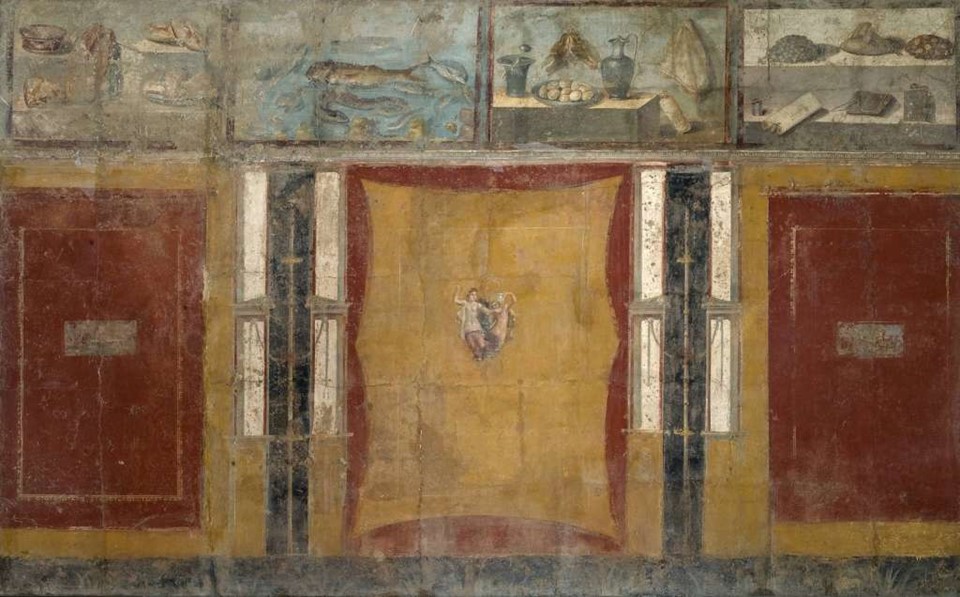
My favourite House of Julia Felix Frescoes are the small Still Life Scenes of the 4th Pompeian style, which date to 62-79 AD, and were discovered in the House Tablinum (Room j in the provided plan) on July 13th, 1755. This beautiful fresco composition was removed from the original wall and inserted in a wooden frame, is now exhibited in the Museo Archeologico Nazionale di Napoli. https://www.museoarcheologiconapoli.it/en/room-and-sections-of-the-exhibition/frescoes/
The four small paintings at the top of the composition form a frieze depicting… starting on the left… a display of Bread exhibited on built shelves and a presentation of various kinds of fresh fish. The next two scenes show a set of silver vessels with a spoon and a platter containing some eggs in addition to hanging quail, and a napkin and exhibited on the final scene, two shelves with a bag of coins and the instrumentum scriptorium (an inkwell, a stylus, and a papyrus).

For More Information on the Pompeian Villa, please… Check https://sites.google.com/site/ad79eruption/pompeii/regio-ii/reg-ii-ins-4/house-of-julia-felix and https://www.pompeiiinpictures.com/pompeiiinpictures/R2/2%2004%2010.htm
For a short but nice Video on the Pompeian Villa, please… Check http://pompeiisites.org/en/archaeological-site/praedia-of-giulia-felice/
For a Student Activity on how to bake Roman Bread, please… Check HERE!

Villa Poppaea Viridarium Frescoes

Photo credit: Carole Raddato published on 06 May 2020
https://www.ancient.eu/article/1552/a-visitors-guide-to-oplontis-stabiae–boscoreale/
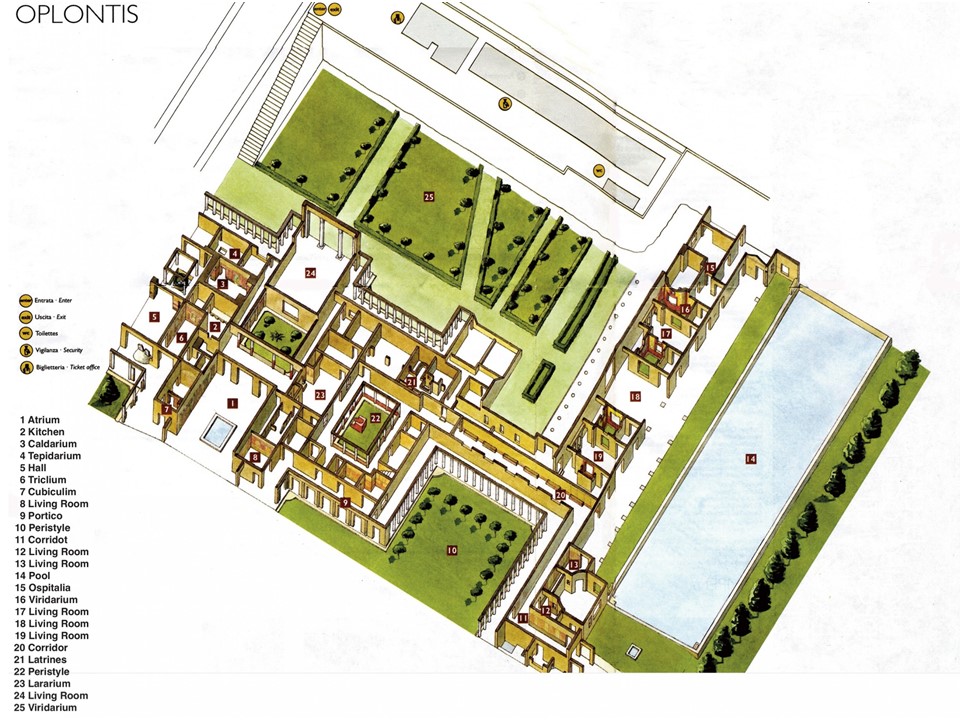
I wish I were standing in the middle of Villa Poppaea’s central sitting room (Room 18 on the plan), gazing at “the portico in front of the swimming pool and its surrounding garden… the large window (behind me, that opens) onto the principal garden of the villa… (more) windows, (on my sides) opening into rooms richly-painted with garden scenes, and (further beyond those) into tiny ‘garden’ courtyards, again decorated with garden frescos. Trees, greenery, flowers, birds and water (are) visible in every direction, both painted and real, with nature being brought into the interiors. …It’s hard not to imagine the building filled with …peace, …accompanied by the twittering of birds and the wind in the grass and leaves.” Villa Poppaea Viridarium Frescoes have a strange effect on me! https://www.italyheaven.co.uk/campania/villa-oplontis.html

Villa Poppaea, built on a plateau fourteen meters above sea level, took advantage of all the scenic pleasures of the Bay of Naples, the latest trends in architecture and the art of fresco painting. Rooms, one hundred of them, were in such a way organized so that its residents and their guests would be able to enjoy the open air and the dramatic view of the sea in an environment of the utmost luxury. Walls decorated with sumptuous frescos further enhanced the effect this Villa probably had on its residents and visitors. Please allow me to explain why exploring the fresco decoration in just one Room in Villa Poppaea, makes your trip to Oplontis, worth your time…
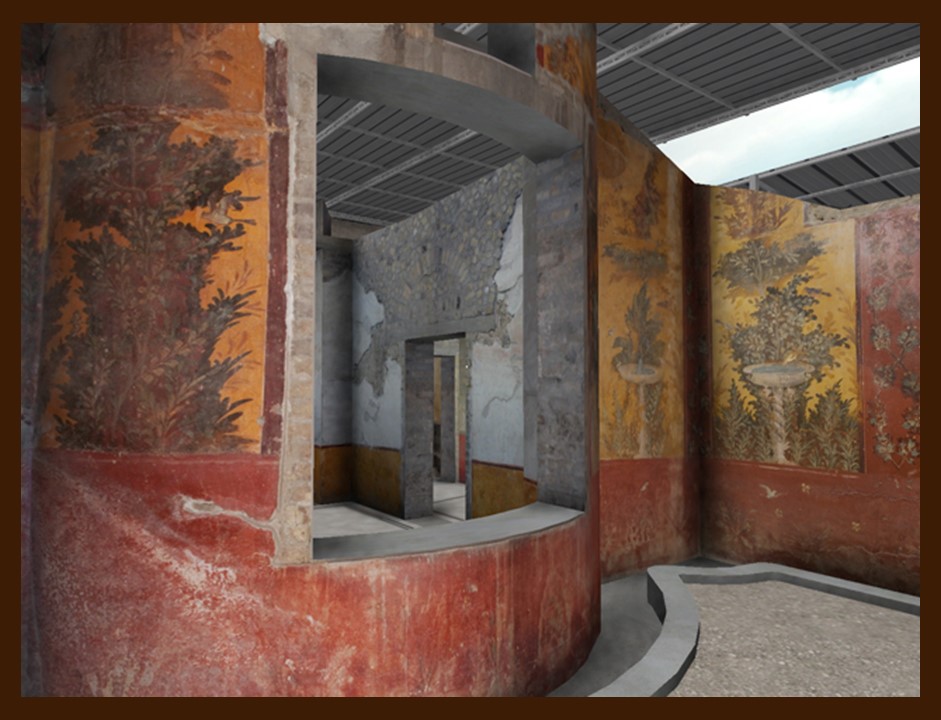
Photo Credit: © King’s College London, 2011
https://www.kvl.cch.kcl.ac.uk/oplontis03.html
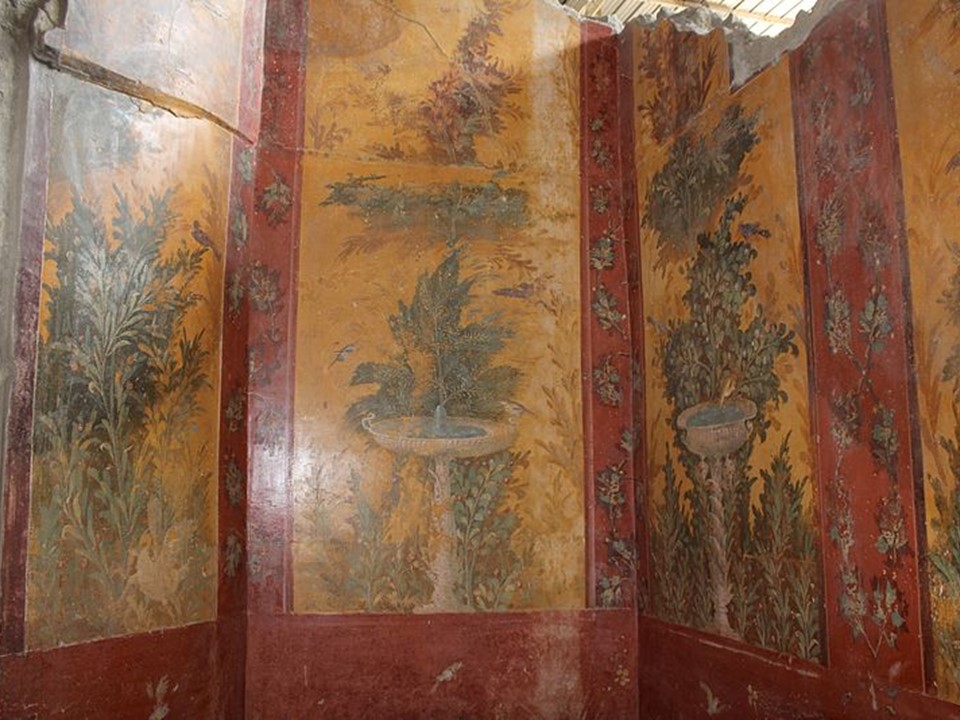
Back in the late 19th century, the German archaeologist August Mau (1840–1909), delineated and described a system of dividing Pompeian Frescoes into four distinct Styles. It is amazing how in Villa Poppaea visitors can see fine examples of the latter three of these four Fresco Styles by just walking from room to room. The amazing frescoes in the small Viridarium area (Room 16 in our Villa Plan) of Villa Poppaea are incredible!
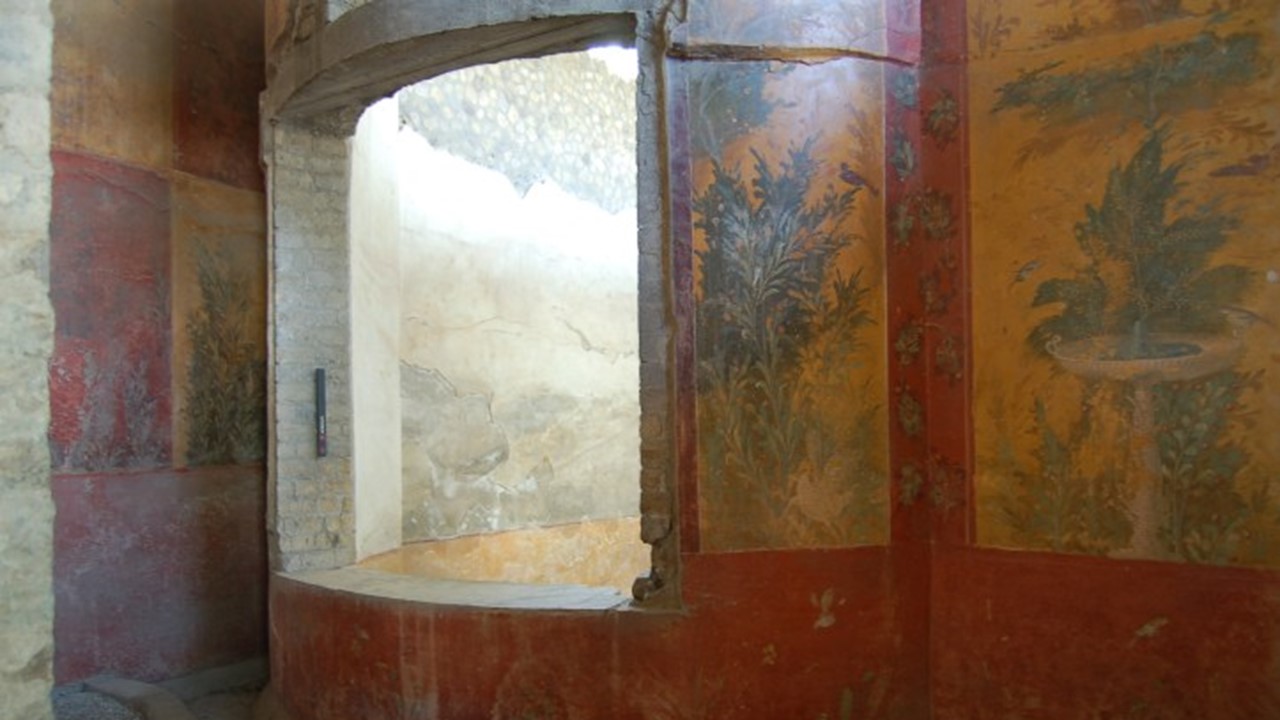
The Viridarium is described as an indoor garden sitting room, decorated with frescoes depicting plants and birds. Room 16 in our Villa Plan is one such Viridarium beautifully embellished with what scholars describe as “Garden Painting,” a very precise genre that is distinct from landscape painting. Garden Paintings give viewers an interesting glimpse of the relationship that existed between architecture and landscape in the ancient world. Exploring the frescoes of Villa Poppaea I read OPLONTIS: VILLA A (“OF POPPAEA”) AT TORRE ANNUNZIATA, ITALY by John R. Clarke and Nayla K. Muntasser, and particularly Chapter 6: Wilhelmina Jashemski and Garden Archaeology at Oplontis, by Kathryn Gleason. The information provided in this presentation is the result of an enjoyable weekend of seeking more and more data… https://quod.lib.umich.edu/cgi/t/text/text-idx?cc=acls;c=acls;idno=heb90048.0001.001;node=heb90048.0001.001:21.7.2;rgn=div1;view=text
https://commons.wikimedia.org/wiki/File:Viridaria_Villa_Poppaea_30.JPG
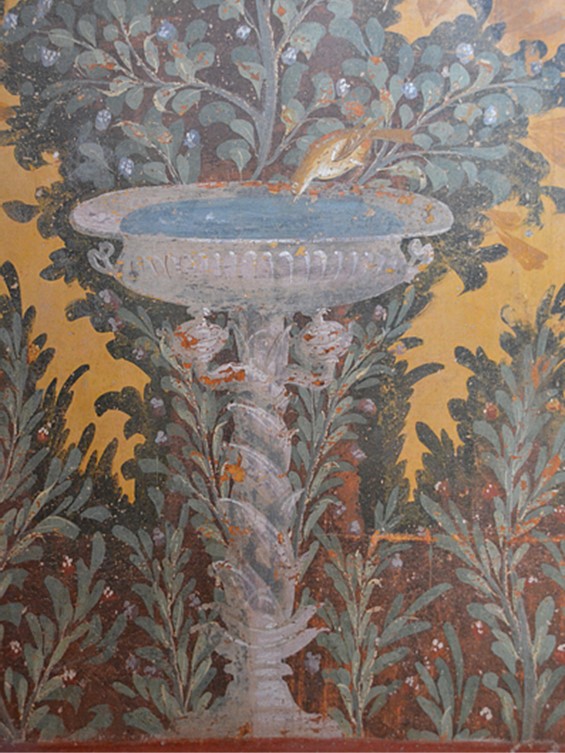
The delightful frescoes in Room 16, the Villa’s Viridarium, display arrangements of evergreen foliage of arbutus, laurels and branches of roses, artfully shaped alone or around a decorative fountain. Hues of red and yellow, powerful primary colours, serve as a striking background. Birds twittering and drinking water from the fountains give an extra sense of joyful life. Kathryn Gleason describes them as Topiarii and continues presenting Ars Topiaria, as the art of creating displays of foliage and shrubs by clipping plants, the pruning and dwarfing of large trees… to the training of ivy into ornate patterns in small peristyle gardens. https://quod.lib.umich.edu/cgi/t/text/text-idx?cc=acls;c=acls;idno=heb90048.0001.001;node=heb90048.0001.001:21.7.2;rgn=div1;view=text
I found of particular interest the site of The Oplontis Project, a collaboration of John R. Clarke and Michael L. Thomas of the University of Texas at Austin and the Soprintendenza Speciale per i Beni Archeologici di Napoli e Pompe, along with the Visual Restorations of King’s Visualisation Lab, in the Department of Digital Humanities at King’s College London, by Martin Blazeby. http://www.oplontisproject.org/ and http://www.oplontisproject.org/index.php/visualization/
For a PowerPoint on Villa Poppaea Viridarium Frescoes, please… Click HERE!
https://historyandarchaeologyonline.com/ancient-roman-gardens/
Villa Poppaea

A traveller cruising by boat in the Bay of Naples during the 1st century AD would have marvelled at the continuous chain of private villas lining the coast. Although evidence of these villas survives to the present day, our knowledge is mostly fragmentary due to the fact that many are buried beneath Vesuvius’s ashes, modern estates or have been swallowed by the sea. Travellers would have been amazed by the opulence of the architectural features exhibited in these structures: porticoes, panoramic exedras, artificial or natural grottos, galleries, nymphaea, and piscinae. Travellers would have been equally amazed by the diverse interior designs and luxurious materials used by the artists. Villa Poppaea, in the ancient Roman town of Oplontis (Torre Annunziata between Naples and Sorrento, in Southern Italy) was one such extraordinary Villa…

https://jeanclaudegolvin.com/oplontis/
“Villa A of Oplontis, attributed by some to Poppaea the second wife of emperor Nero, was, strictly speaking, a maritime villa. It commanded a panoramic view from the top of a sheer cliff more than 14 m high that overlooked the ancient shoreline. To the south the view ranged from the limestone cliffs of the faraglioni (tall formations that resemble lighthouses) of Rovigliano, the islet near the port of Pompeii at the mouth of the Sarno River, to the length of the coast of the Sirens as far as Capri. To the west the superimposition of various layers of lava that created the Capo Oncino promontory during the Middle Ages had not completely concealed the Neapolitan and Phlegraean coast.” https://quod.lib.umich.edu/cgi/t/text/text-idx?c=acls;idno=heb90048.0001.001;rgn=div1;view=text;cc=acls;node=heb90048.0001.001:18
Villa Poppaea, built on a plateau, fourteen meters above sea level, took advantage of all the scenic pleasures of the Bay of Naples. Rooms were in such a way organized so that its residents and their guests would be able to enjoy the open air and the dramatic view of the sea in an environment of the utmost luxury. Please allow me to explain why Villa Poppaea was, for me, worth exploring…

Tabula Peutingeriana, a unique twelfth-century copy of a fourth-century Roman map, marks Oplontis, the area where Villa Poppaea was discovered, as a large square building fronting the sea with twin, gabled, entrances. Interestingly, this is the only Roman reference to a site named Oplontis available to scholars. The name Oplontis is an intriguing mystery! https://quod.lib.umich.edu/cgi/t/text/text-idx?c=acls;idno=heb90048.0001.001;rgn=div1;view=text;cc=acls;node=heb90048.0001.001:20

https://commons.wikimedia.org/wiki/File:Poppaea_Olimpia.jpg
The luxurious Villa Maritime in Oplontis is believed to have been one of the residences of Poppaea Sabina, the second wife of Emperor Nero. Poppaea Sabina, born in nearby Pompeii, was the grand-daughter of Gaius Poppaeus Sabinus, Imperial Proconsul of Greece and the daughter of Poppaea Sabina the Elder, a celebrated Roman matron praised by Tacitus for her wealth and loveliness.

Villa Poppaea, uninhabited and under reconstruction at the time of Vesuvius’s eruption, was a massive residence of more than one hundred rooms and thirteen gardens. Construction started in the 50s BC, while renovations and extensions occurred regularly until the 79 AD volcanic eruption. This sumptuous villa was probably the model house for many of the smaller and less opulent houses built in the area at the same time. The oldest part of the house developed around the atrium, with a number of private or public rooms to serve its purpose for leisure and formalities. By 54 AD, the house extended to the east, with the addition of peristyles with collonaded porticoes extending out from the building’s core, an immense swimming pool and formal gardens. http://pompeiisites.org/en/oplontis-en-2/villa-poppaea/

The 4th reason why Villa Poppaea was, for me, worth exploring, is its interior decoration… please bear with me as I will discuss the Villa’s frescoes in Villa Poppaea, Part II.
For a PowerPoint on Villa Poppaea, please… Check HERE!