Fresco painting of Venus in the Shell (detail), House of Venus in the Shell, Pompeii

House of Venus in the Shell

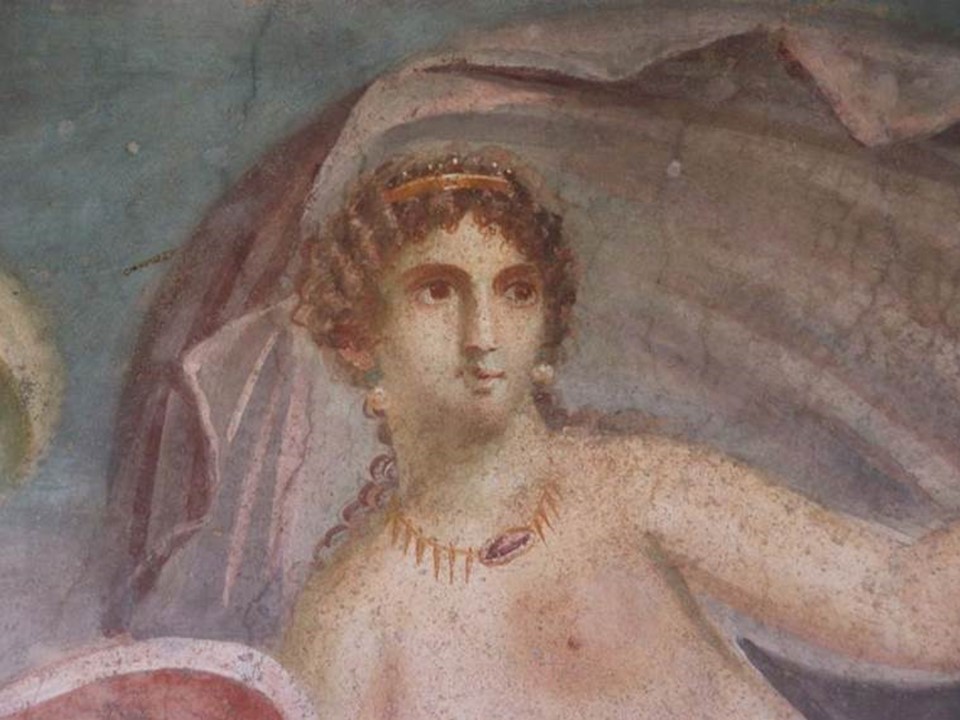
Fresco painting of Venus in the Shell (detail), House of Venus in the Shell, Pompeii
Venus in the Shell (detail), 1st century AD, fresco, House of Venus in the Shell, Pompeii Archaeological Site, Pompeii, Italy, 2017 Photo courtesy of Klaus Heese http://pompeiiinpictures.com/pompeiiinpictures/R2/2%2003%2003%20part%2011.htm

…Ah, goddess, when the spring  /  Makes clear its daytime, and a warmer wind  /  Stirs from the west, a procreative air,  /  High in the sky the happy-hearted birds,  /  Responsive to your coming, call and cry,  /  The cattle, tame no longer, swim across  /  The rush of river-torrents, or skip and bound  /  In joyous meadows; where your brightness leads,  /  They follow, gladly taken in the drive,  /   The urge, of love to come. So, on you move /  Over the seas and mountains, over streams  /  Whose ways are fierce, over the greening leas,  /  Over the leafy tenements of birds,  /  So moving that in all the ardor burns  /  For generation and their kind’s increase… The amazing fresco of Venus in the House of Venus in the Shell inspired me to search for Roman Poems dedicated to the Goddess of beauty… and I “stumbled” upon Lucretius’s Hymn to Venus, the goddess of pleasure.     https://newepicurean.com/lucretius-hymn-to-venus-and-the-defense-of-pleasure/     and     https://www.youtube.com/watch?v=xuqPhR8QTZQ

House of Venus in the Shell, Pompeii
Entrance doorway, looking south, House of Venus in the Shell or House of the Marine Venus or House of D. Lucretii Satrii Valentes, Pompeii, 2012 Photo, courtesy of Michael Binns http://pompeiiinpictures.com/pompeiiinpictures/R2/2%2003%2003%20part%201.htm
Ground Plan of the House of Venus in the Shell or House of the Marine Venus or House of D. Lucretii Satrii Valentes, Pompeii http://pompeiiinpictures.com/pompeiiinpictures/R2/2%2003%2003%20plan.htm

The Via dell’Abbondanza, one of Pompeii’s two Decumani Maximus, formed the main east-west axis which traversed the entire urban area of the city. Facing Via dell’Abbondanza, in Regio II of the city, near the Porta Sarno, the Amphitheatre and the Large Palaestra, lies a private property of particular interest, the House of Venus in the Shell (Insula 3), also known as House of the Marine Venus or House of D. Lucretii Satrii Valentes.  Excavated between 1933-35, it was damaged by bombings during World War II in 1943, but was re-excavated and restored in 1952.     https://sites.google.com/site/ad79eruption/pompeii/regio-ii/reg-ii-ins-3/house-of-venus-in-the-shell

Frescoes, House of Venus in the Shell, Pompeii
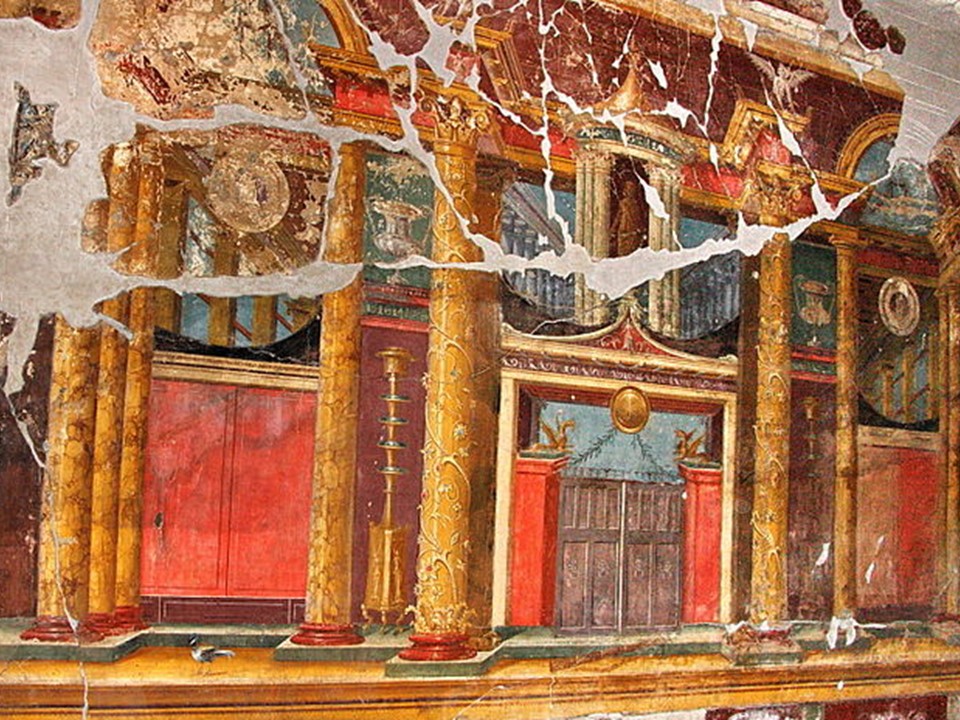
House of Venus in the Shell, Frescoes in Room 4, 1st century AD, fresco, looking towards south-east corner and south wall, Pompeii Archaeological Site, Pompeii, Italy,  Photo courtesy of Buzz Ferebee. https://pompeiiinpictures.com/pompeiiinpictures/R2/2%2003%2003%20part%202.htm

The House of Venus in the Shell has all the characteristics of a typical Pompeiian House. A narrow corridor (1) (fauces) beautifully decorated in the 3rd Pompeiian Style opens directly onto a square atrium (2) with a central impluvium. Both areas were intricately decorated with red or yellow painted panels with small medallions in the center to enhance the visual effect. Three cubicula face the atrium, the one in the south east corner (4) is decorated in the 3rd Pompeiian Style “with framed white panels separated by fantastic architectural views above a lower dark red frieze. The central panel of the south wall contains a badly faded mythological scene of Hermes and Dionysus. The side panels on the north wall contain floating figures while on the east are two portrait medallions.” https://sites.google.com/site/ad79eruption/pompeii/regio-ii/reg-ii-ins-3/house-of-venus-in-the-shell

Frescoes, House of Venus in the Shell, Pompeii
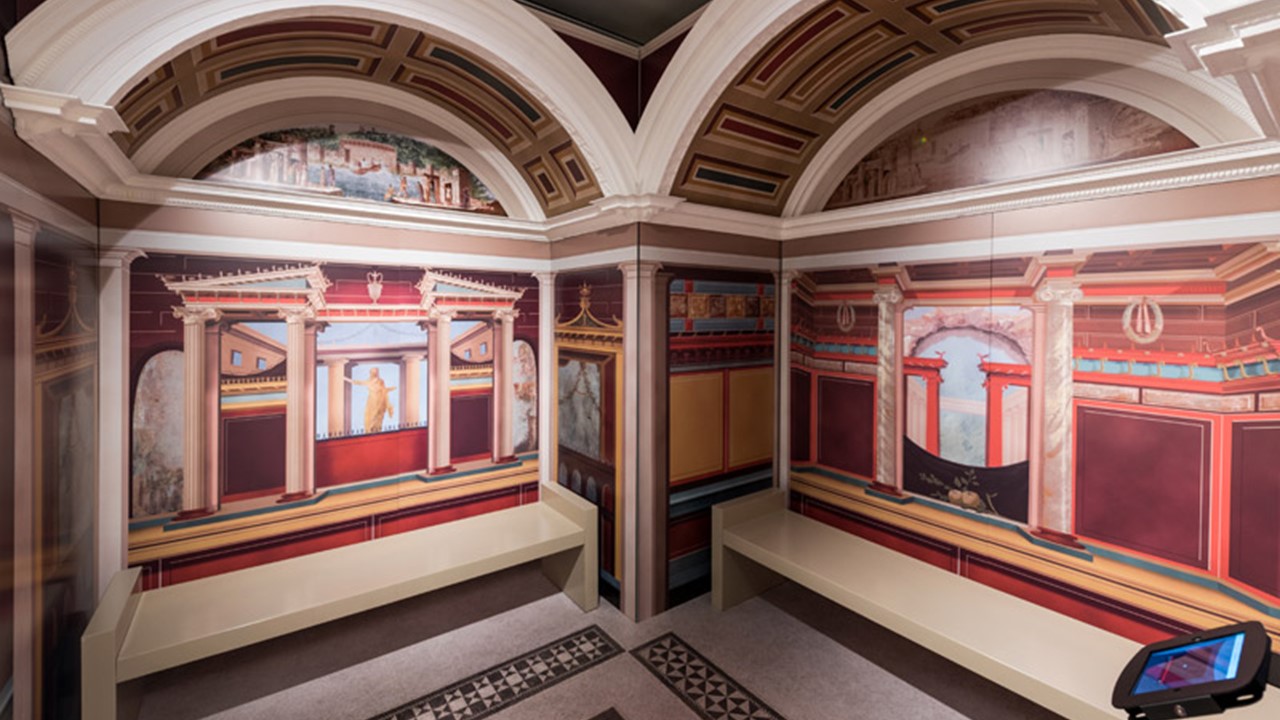
House of Venus in the Shell, Frescoes in Room 6, 1st century AD, fresco, south wall of Triclinium, Pompeii Archaeological Site, Pompeii, Italy, https://pompeiiinpictures.com/pompeiiinpictures/R2/2%2003%2003%20part%203.htm   

Two more interesting rooms open to the Atrium (2), a Triclinium (6) and a large Tablinium  (5). The Triclinium (6) has vaulted ceilings and walls, painted in the 3rd Pompeian Style, with architectural themes framing floating figures within black panels, and on the uppermost part of the room’s decoration, small scenes and still lives. The Tablinum (5), “has lost most of its decoration but still impresses with its size. The tablinum has a second doorway on its south wall which opens onto the north side of the peristyle.”     https://sites.google.com/site/ad79eruption/pompeii/regio-ii/reg-ii-ins-3/house-of-venus-in-the-shell

 House of Venus in the Shell, Pompeii
House of Venus in the Shell, 1st century AD, looking towards the south-west corner of the Atrium, with doorway into room 11, on the left, and rooms 5 and 6, on the right, Pompeii Archaeological Site, 2017 Photo courtesy of Klaus Heese
Fresco painting of Venus in the Shell, House of Venus in the Shell, Pompeii
House of Venus in the Shell, 1st century AD, fresco in the Peristyle area, Pompeii Archaeological Site, Pompeii, Italy     http://janzen3journeys.blogspot.com/2017/12/the-ruins-of-pompeii.html    

The nicest part of the House, the Peristyle area, develops around a lovely garden with 9 fluted columns of stuccoed brickwork (11). Rooms and Porticos, sumptuously decorated, once more, with frescoes in the 3rd Pompeiian Style, display interesting scenes that reveal almost impressionistic qualities. “On the rear wall (17) of the peristyle are three large framed frescoes each set on a blue background. The lefthand painting, is of the god Mars shown standing naked on a plinth while holding a lance and a shield. Around him the foliaged garden is teaming with birdlife. The central painting on the rear wall is of Venus lying in a conch shell with a cherub either side of her. The nymph on the left side of the painting is shown riding a dolphin while the one on the right supports the conch shell. The righthand painting is of flowers and birds drinking at a fountain. The fresco incorporates a niche painted with plants.”     https://sites.google.com/site/ad79eruption/pompeii/regio-ii/reg-ii-ins-3/house-of-venus-in-the-shell

Fresco painting of Venus in the Shell, House of Venus in the Shell, Pompeii
Venus in the Shell, 1st century AD, fresco in the central panel of the Peristyle area South Wall, House of Venus in the Shell, Pompeii Archaeological Site, Pompeii, Italy, 2016 Photo courtesy of Buzz Ferebee https://pompeiiinpictures.com/pompeiiinpictures/R2/2%2003%2003%20part%2011.htm
Fresco painting of Venus in the Shell (detail), House of Venus in the Shell, Pompeii
Venus in the Shell (detail depicting one of the Cherubs), 1st century AD, Fresco, House of Venus in the Shell, Pompeii Archaeological Site, Pompeii, Italy https://commons.wikimedia.org/wiki/Category:Venus_Anadyomenes_in_the_House_of_Venus_(Pompeii)#/media/File:Casa_de_Venus_Pompeya_07.jpg

The star fresco in the House, after which the house, let’s not forget, was named, depicts Venus in the Shell. It portrays a large and striking depiction of the goddess Venus, naked but relaxed “giving no signs of modesty, yet no signs of overt sexuality,” reclining in a shell, swelling “sails” behind her, accompanied by a cortege of two Cherubs. This fresco may not be one of the finest discovered in Pompeii, but it is definitely eye-catching. Venus’s  head of curly hair and pale skinned body, resplendent with gold jewels, “looking off into the distance seemingly without a worry in the world” create a stunning vision. The Cherubs’ look of curiosity and astonishment is a strike of ingenuity. The combination of aquamarine blue and plum-hued violet, cool and refreshing, is precious! Simply put… I love it!!!     https://womeninantiquity.wordpress.com/2018/11/27/the-portrayal-of-venus-in-pompeian-frescoes/

For a student RWAP (Research-Writing-Art-Project), please… Check HERE!

Mosaic Columns from The Villa of the Mosaic Columns in Pompeii

Villa of the Mosaic Columns

Mosaic Columns from The Villa of the Mosaic Columns in Pompeii
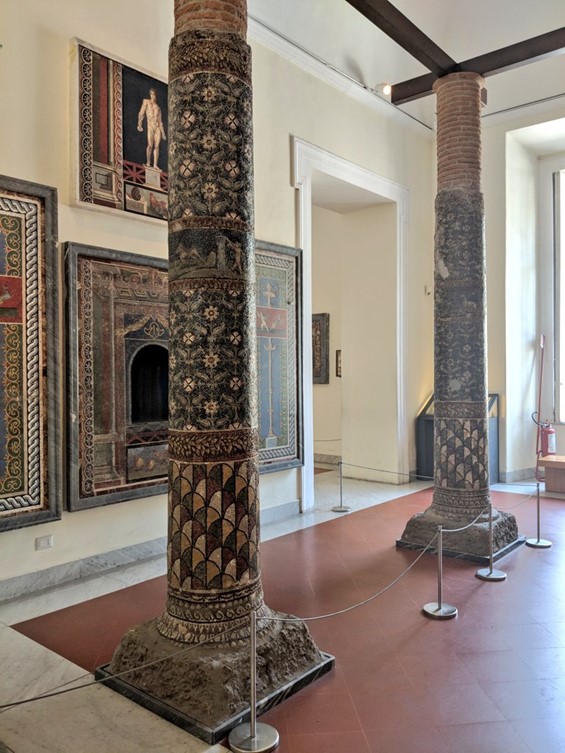
Mosaic Columns from The Villa of the Mosaic Columns in Pompeii, 1st century AD, Naples National Archaeological Museum

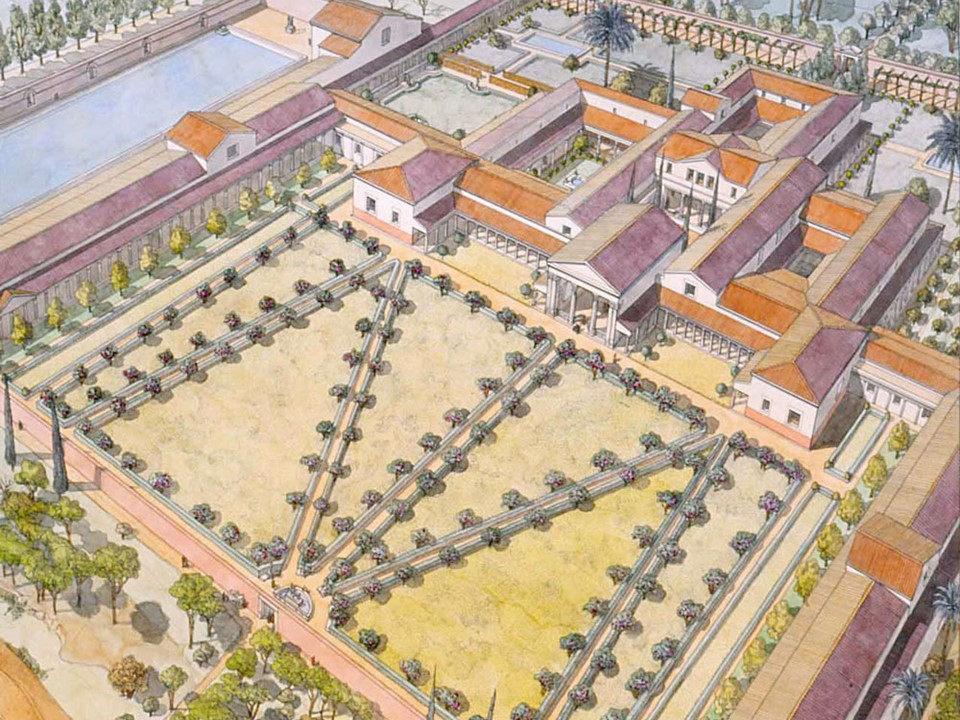
“If you have a garden in your library, we will want for nothing” wrote Marcus Tullius Cicero to his illustrious new friend Marcus Terentius Varro… and he is so right! Gardening can be so gratifying and the Romans understood it and thus “In the middle of Roman buildings…a roofless square, often with Greek sculptures and temples, was where the Hortus, the garden, was planted and enjoyed. Common Romans might only have had a small courtyard or paved square with pots. Many grew basic foods as a thin bulwark against starvation. The rich enjoyed much larger, more fertile and refined gardens, often closer to parks than yards…Cicero’s correspondent, Varro, was not only well-off but also a scholar of gardening and farming. In light of this, it’s likely that Varro did offer Cicero a well-stocked library, and in it a luxurious garden.” Villa of the Mosaic Columns is about one such lovely Garden, very specially decorated…     https://www.commonsenseethics.com/blog/5-things-that-you-need-to-be-happy-according-to-cicero

Mosaic Columns from The Villa of the Mosaic Columns in Pompeii

The Villa of the Mosaic Columns’ Pompeiian address is on the northern side of Via delle Tombe, behind the bars and shops facing the busy street leading to Herculaneum. Either way, you choose to enter this interesting Villa… you enter a Garden. I like to choose Entrance A (see POST Villa Plan) because Garden C is bigger, it has a mosaic-decorated Nymphaeum and a pergola supported on four magnificent Mosaic Columns. It is thanks to these unique mosaic columns that the Villa, justifiably,  took its name.    https://sites.google.com/site/ad79eruption/pompeii/villas-outside-the-walls/villa-of-the-figured-capitals

Mosaic Columns from The Villa of the Mosaic Columns in Pompeii

The Villa’s Columns are magnificent! They are covered in colourful mosaic decorations with successive bands of geometric, floral and/or figurative designs. The Villa is unfortunately in a poor state of preservation and thus soon after their discovery, the columns were removed and taken to the National Archaeological Museum in Naples where can today be seen.

Mosaic Columns from The Villa of the Mosaic Columns in Pompeii

The second Garden G is accessed by a wide-open area on the north side of Garden C as well as a corridor leading to Via delle Tombe. Very little survives of its original decoration apart from a Lalarium on its south-west corner. The colonnade to the north marks the entrance to the main living quarters which are unfortunately in an almost ruinous condition. The Villa was probably the most ostentatious in the area. “The decoration in fine painting and mosaics, the grandeur of the architecture and the size of the servant quarters put the Villa delle Colonne a Mosaico on a par with or greater than its immediate neighbours, above which it literally towered. Finally, the row of shops that lie beneath the Villa, which was certainly built during a combined sequence of construction, implies that one source of the villa owner’s wealth was the trades practised by those who worked and lived in this complex. Therefore, the shops supported the Villa economically as well as physically, extending the metaphor into a clearly visible statement of the social hierarchy of the city – a statement that complemented the public display that the Villa itself represented.”     http://online.sfsu.edu/pompeii/research2006.html

An interesting discovery lays at the Villa’s south/east side where, within a gated enclosure, a Tomb and a unique Blue and White Glass Vase were discovered. According to Jashemski… “Since this was the only tomb that had a door leading from the tomb chamber into the garden, and since the only entrance to the garden was from the villa of the Mosaic Columns, it was obvious that the tomb and its garden belonged to this villa.” Jashemski, W. F., 1993. The Gardens of Pompeii, Volume II: Appendices. New York: Caratzas, (p.256).

Today, the Blue Glass Vase, found in the Villa of the Mosaic Columns’ Tomb, is one of the most precious treasures of the Naples Archaeological Museum. We will discuss this amazing Vase in Villa of the Mosaic Columns, Part 2.

Glass Amphoriskos with cupids gather grapes from the Villa of the Mosaic Columns in Pompeii
Glass Amphoriskos with cupids gather grapes from the Villa of the Mosaic Columns in Pompeii, between circa 1 and circa 79 AD, Cameo Glass, Naples Archaeological Museum

I would like to finish this POST once again with Cicero, who, as he was growing older, he enjoyed more and more the calm and serenity of his gardens, either in his Tusculum Villa where he withdrew to his library and gardens to think and write, or his family Villa in Arpinum, where during his later years, he collected his scrolls and codices, away from Rome, for better protection. “By means of our hands, we struggle to create a second world within the world of nature,” Cicero wrote, thinking as a Stoic philosopher, for whom “the garden was a microcosm of the larger order of the cosmos.”     https://www.commonsenseethics.com/blog/5-things-that-you-need-to-be-happy-according-to-cicero

For a PowerPoint on the Villa of the Mosaic Columns, please… click HERE!

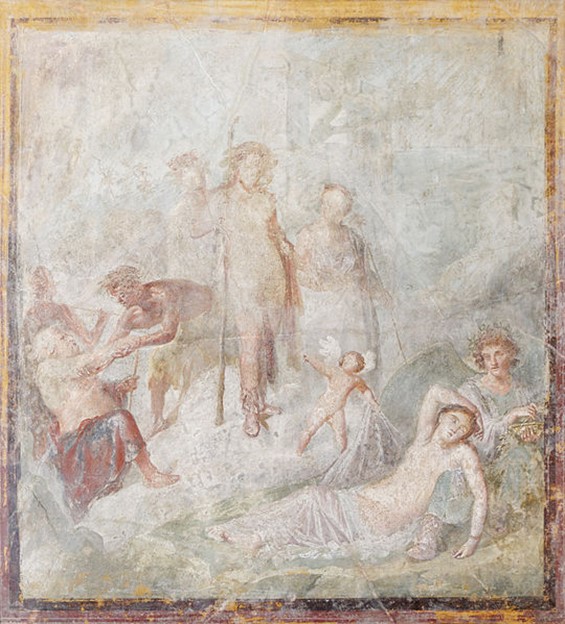
Fresco of Dionysos and Ariadne in the House of Capitelli Colorati, in Pompeii

Ariadne on Naxos

Fresco of Dionysos and Ariadne in the House of Capitelli Colorati, in Pompeii
Dionysos and Ariadne, 1st century AD, Pompeii, from the House of Capitelli Colorati, now in the National Archaeological Museum of Naples

Ariadne on Naxos… what an inspiration… “Eros  /  The archipelago  /  And the prow of his seafoam  /  And the seagulls of his dreams  /  In his highest mast, the sailor flutters  /  A song” the Archipelago Song by Odysseas Elytis, 1979, Nobel Prize in Literature.     https://www.nobelprize.org/prizes/literature/1979/elytis/biographical/     and     https://www.greeklyrics.gr/stixoi/to-tragoudi-tou-arxipelagous/

The Islet of Palatia in Naxos
The Islet of Palatia in Naxos, where today, since the 6th century BC, stands “Portatra,” the entrance to the Temple of Apollo, Naxos’s most recognized monument.

Naxos is one of the most interesting destinations in Greece! In the center of the Aegean Sea, the biggest and greenest Cycladic island, with a glorious ancient Greek past and the strong influences of the Venetians and the Franks, Naxos is not simply beautiful… it breathes history …and Mythology I would like to add! Naxos was the playground of the Olympian gods, the place where virtuous or naughty, entangled with beautiful women and brave men, gods created a scenery of love and adventure, reality and imagination. The story I like most involves the god Dionysus, the Minoan princess Ariadne and the Islet of Palatia, where today, since the 6th century BC, stands “Portara,” the entrance to the Temple of Apollo, Naxos’s most recognized monument. https://www.greeka.com/cyclades/naxos/

Imagine the scene… Theseus and Ariadne flee Crete in a hurry. With the help of Ariadne, Theseus had just killed the horrible Minotaur in the depths of Knossos’s palace maze. Their first stop to rest on their way to Athens is the island of Naxos… where the story unfolds dramatically and excitingly. God Dionysus, in love with Ariadne, appears to Theseus in his sleep and convinces him to abandon Ariadne at Naxos and continue his trip alone. Ariadne, unaware of divine intervention, disembarks at Naxos, enchanted by the beauty of the island, happily explores it, and tired falls asleep on the beautiful islet of Palatia. When she wakes up… god Dionysus, the son of Zeus and Dione, looks at her adoringly and a new love-affair is in the making. A glorious wedding follows and an eternal gift is still with us to admire… the constellation known as Corona Borealis is said to be Dionysus’s wedding gift to Ariadne, a special ornament to adorn her beautiful head.

Fresco of Dionysos and Ariadne in the House of Capitelli Colorati, in Pompeii

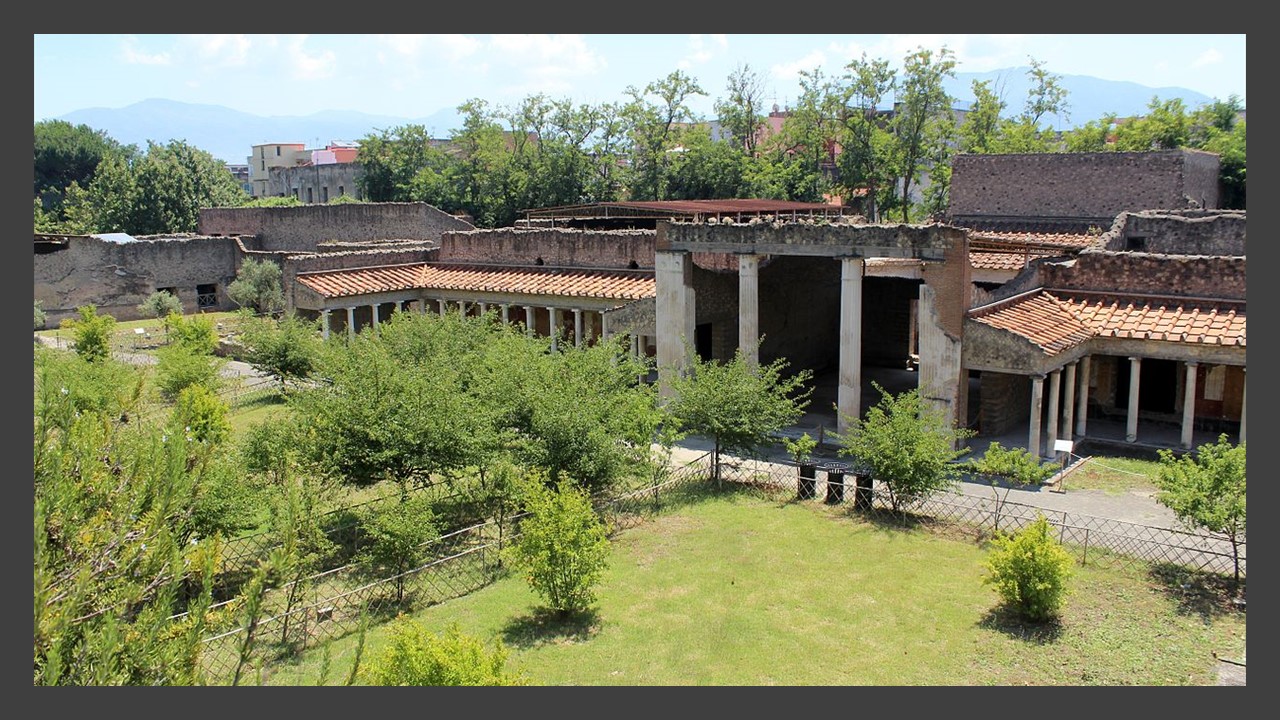
In Pompeii, the House of the Coloured Capitals is one of the oldest excavated, back in 1822, again in 1832/33 and 1846. It is one of the largest houses in Pompeii as well, with more than 40 rooms on the ground floor alone, beautifully decorated with frescoes and floor mosaics, combining architecturally, Samnite and Roman features.  The name of the house comes from the brightly coloured capitals of the columns of the central peristyle.

You enter the House through a rectangular Atrium (area marked b) with a central Impluvium and proceed to a porticoed Peristyle (area marked f). One of the bigger rooms opening to the peristyle (area marked h), the oecus, is beautifully decorated with frescoes in the 4th Pompeiian Style on a yellow ground. Dilapidated today and neglected since it was initially excavated in 1822, the house’ oecus featured central panels on each wall with a mythological scene. The single panel, faded yet still holding its original charm, character portrays Dionysus and the sleeping Ariadne on the island of Naxos. Dionysus, holding a thyrsus, standing tall in the center of the composition, gazes in wonderment at Ariadne, still sleeping at the knees of god Hypnos. A naughty cupid reveals Ariadne’s covered beauty to Dionysus while an old Silenus, in need of support, and an entourage of satyrs and maenads seem to follow the young god of revelry. https://sites.google.com/site/ad79eruption/pompeii/regio-vii/reg-vii-ins-4/house-of-the-coloured-capitals

The fresco depicting Dionysus discovering the sleeping Ariadne was luckily removed and can now be seen in the National Archaeological Museum in Naples. The scenes left in situ, however, have all but faded away…

For a student RWAP (RWAP stands for Research-Writing-Art-Project), please… check HERE!

Oecus is the Latinized form of Greek Oikos (House), used by Vitruvius for the principal hall or salon in a Roman house, which was used occasionally as a triclinium for banquets.     https://en.wikipedia.org/wiki/Oecus

Fresco of Dionysos and Ariadne in the House of Capitelli Colorati, in Pompeii, Student Activity