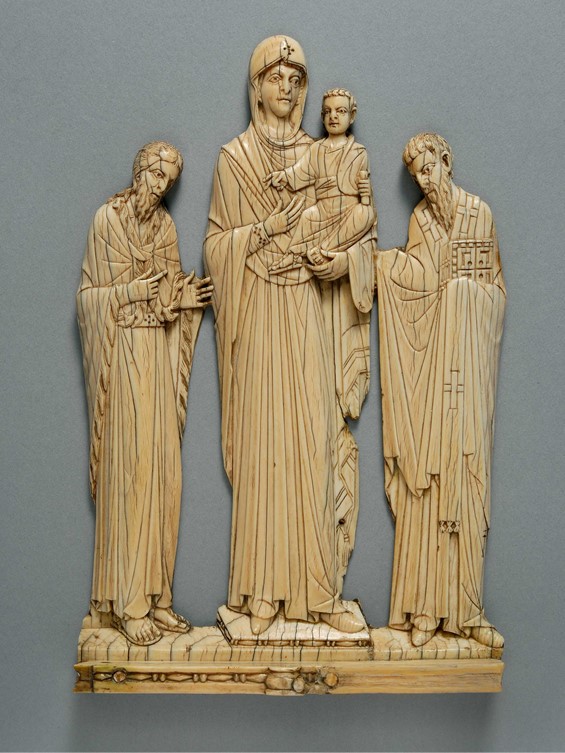
The Hodegetria ivory and its related Louvre panel reveal the refined elegance of 10th-century Byzantine carving, where sacred figures, delicate drapery, and restrained composition embody aristocratic devotion and the serene spiritual authority of the Deësis tradition.
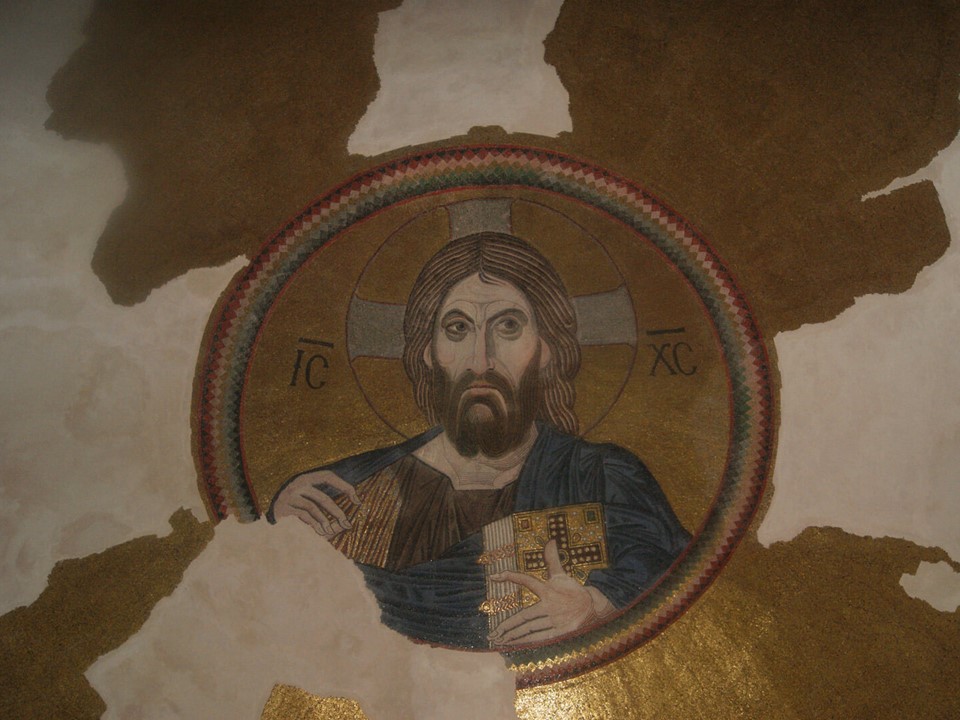
The Christ Pantocrator at Daphni, set within the austere harmony of the 11th-century monastery, embodies Byzantine spiritual intensity, where divine authority, emotional ambiguity, and monumental mosaic craftsmanship converge in an image that continues to provoke awe and interpretation.
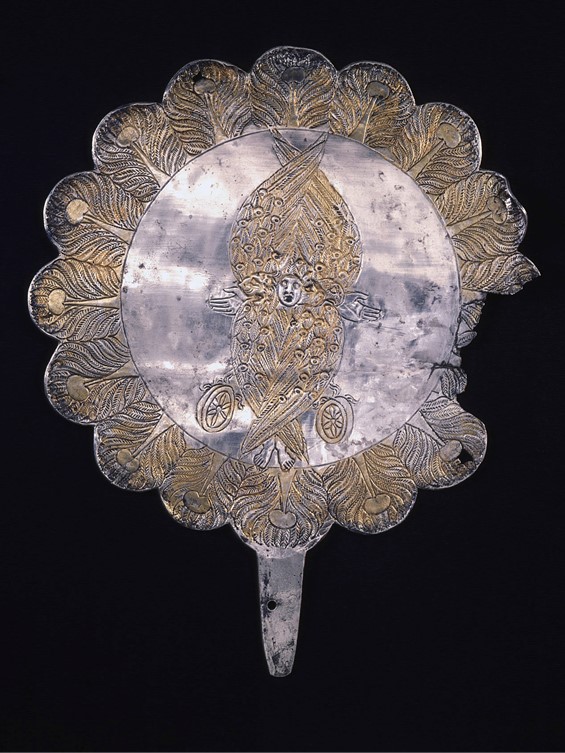
A 6th-century silver flabellum (rhipidion), now at Dumbarton Oaks, exemplifies both liturgical function and artistic refinement, once used to honor the Eucharist and protect sacred elements.
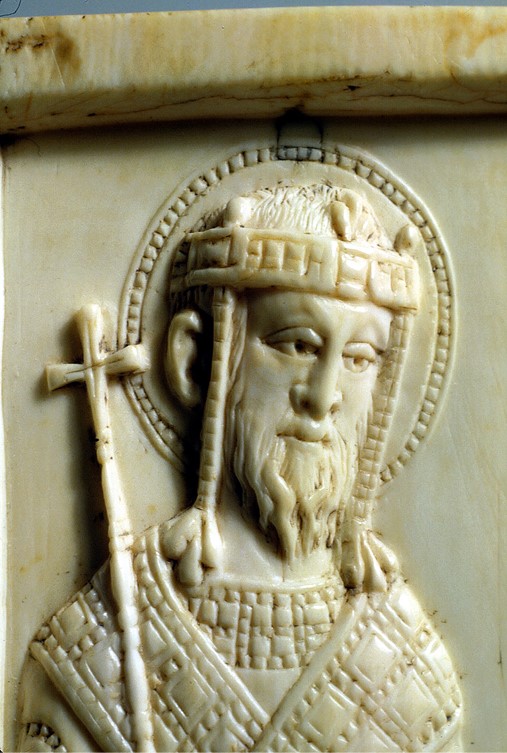
Constantine the Great is honored through a 10th-century ivory triptych leaf from Dumbarton Oaks, portraying him as both imperial ruler and Christian saint, embodying enduring authority and faith.
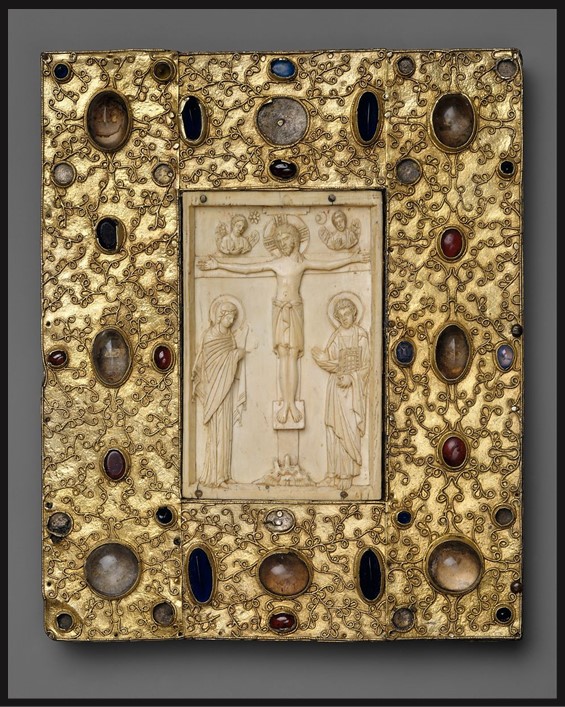
The Byzantine Good Friday hymn contemplates Christ’s Passion with cosmic sorrow, reflected in a 10th-century ivory Crucifixion panel, where serene suffering and sacred symbolism proclaim sacrifice, redemption, and hope.
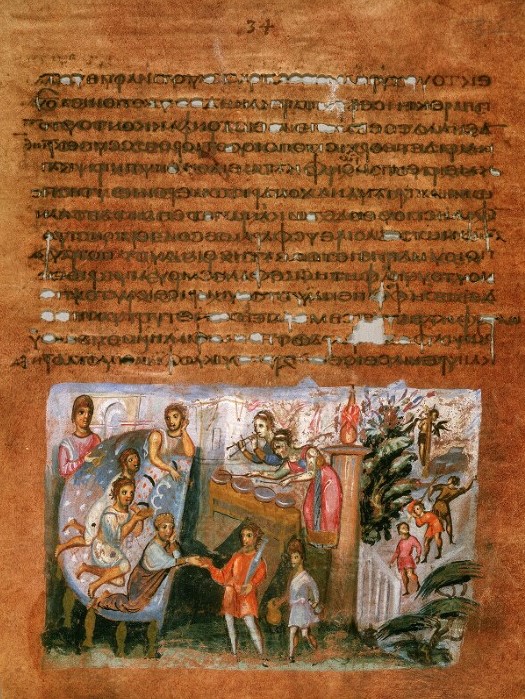
Vienna Genesis, The Pharaoh’s Banquet, folio 17, page 34, (Cod. Theol. gr. 31), first half of the 6th century, Illuminated Parchment dyed purple, heightening in shell gold, with a text written in silver ink, 32.0×26.5 cm, Österreichische Nationalbibliothek, Vienna, Austria https://onb.digital/result/10F14EEA
On the third day, which was Pharaoh’s birthday, he held a feast for all his officials, and in their presence, he lifted up the heads of the chief cupbearer and the chief baker. Pharaoh restored the chief cupbearer to his position, so that he once again placed the cup in Pharaoh’s hand.… (Book of Genesis, The story of Joseph, 40:20-22 – Holy Monday – Μεγάλη Δευτέρα) https://www.biblegateway.com/passage/?search=Genesis+40&version=NIV
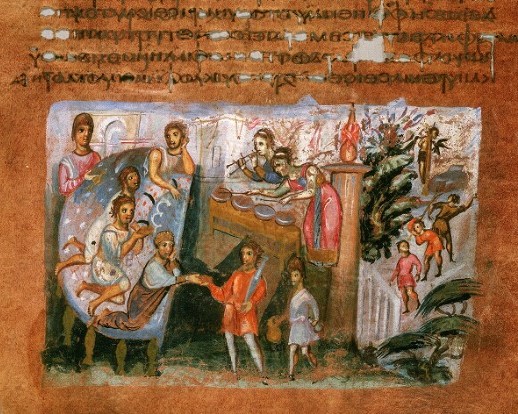
Vienna Genesis, The Pharaoh’s Banquet, folio 17, page 34, (Cod. Theol. gr. 31), first half of the 6th century, Illuminated Parchment dyed purple, heightening in shell gold, with a text written in silver ink, 32.0×26.5 cm, Österreichische Nationalbibliothek, Vienna, Austria https://onb.digital/result/10F14EEA
Andreas Fingernagel, Director of the Department of Manuscripts and Rare Books
at the Austrian National Library, considers the Late Antique Codex theologicus graecus 31, the Vienna Genesis as of outstanding importance, an illuminated manuscript regarded and admired as a rare testimony of Late Antique art history. The manuscript, dated to the first half of the 6th century, consists of 48 preserved pages, written in Maiuscula Biblica in silver ink on purple parchment. It is illustrated with 48 miniatures produced in a city scriptorium of culture and sophistication like Antioch or Constantinople. It is one of the earliest known cycles of book miniatures from the Old Testament, a rare witness of Late Antique book culture. Since 1664, this magnificent codex has been preserved at the Imperial Court Library, today, the Austrian National Library in Vienna. https://library.oapen.org/handle/20.500.12657/41206
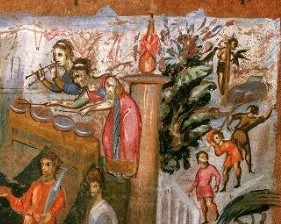
Vienna Genesis, The Pharaoh’s Banquet (detail), folio 17, page 34, (Cod. Theol. gr. 31), first half of the 6th century, Illuminated Parchment dyed purple, heightening in shell gold, with a text written in silver ink, 32.0×26.5 cm, Österreichische Nationalbibliothek, Vienna, Austria https://onb.digital/result/10F14EEA
According to research done in the early 2020s, the Vienna Genesis is the incredible work of 7 different artists. Scholars came to this conclusion, by looking into each artist’s style, iconography, colour palette, pigments, and dyes. All artists involved in the illumination of the Vienna Genesis were trained in creating rich, and lively paintings in an authentic Late Antique style, suited for the sophisticated liking of an imperial patron. Painter E (folios 17–18, pages 33–36) has been identified as the artist who created the amazing miniature (folio 17, page 34) depicting The Pharaoh’s Birthday Banquet. This is a scene in the story of Joseph, son of Jacob and Rachel, celebrated during Holy Monday. https://library.oapen.org/handle/20.500.12657/41206 pp. 232-235 and Age of Spirituality: Late Antique and Early Christian Art, Third to Seventh Century https://www.metmuseum.org/art/metpublications/Age_of_Spirituality_Late_Antique_and_Early_Christian_Art_Third_to_Seventh_Century pp. 458-459
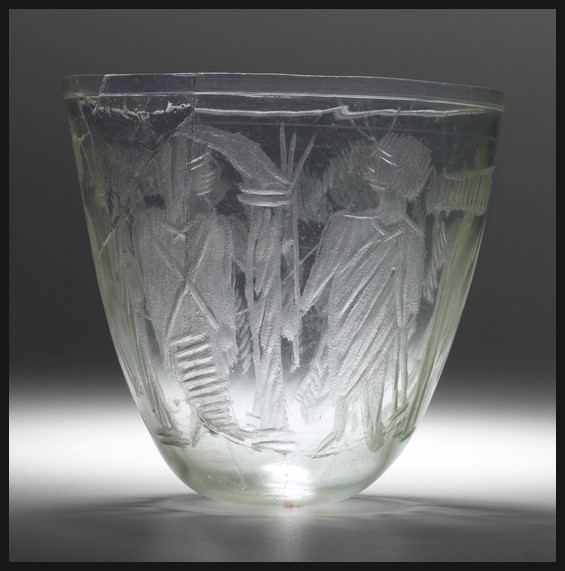
Lazarus Saturday is commemorated in Byzantine art through the Yale glass cup depicting Christ raising Lazarus, a serene Early Christian scene symbolizing resurrection, hope, and divine power over death.
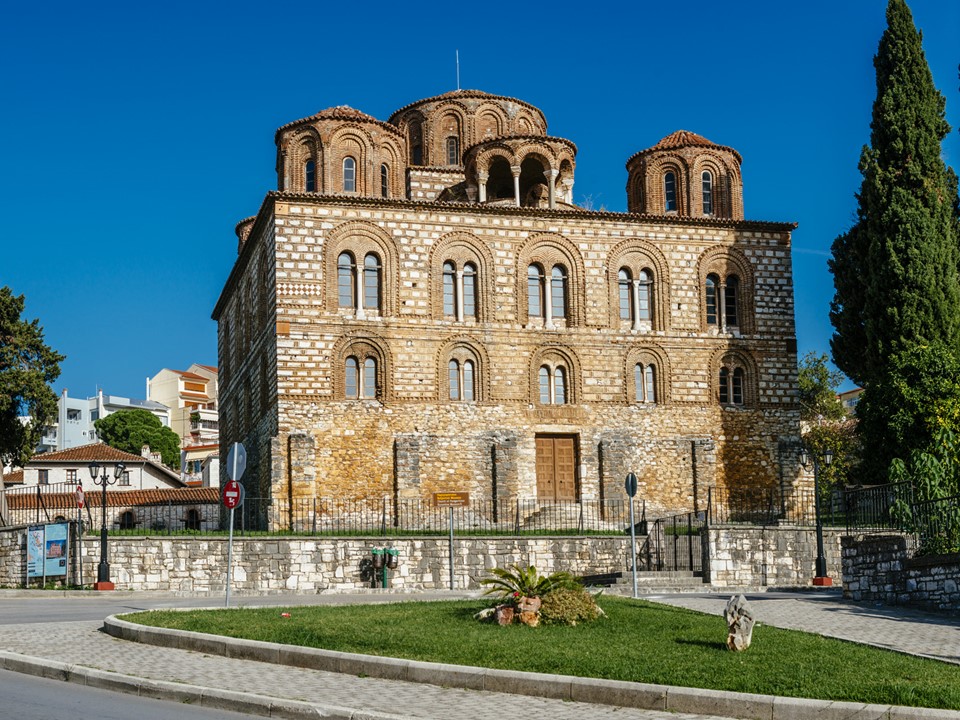
The Church of the Parigoritissa in Arta, a masterpiece of late Byzantine architecture, reflects the ambition of the Despotate of Epirus, combining innovative design, rich decoration, and aristocratic grandeur.
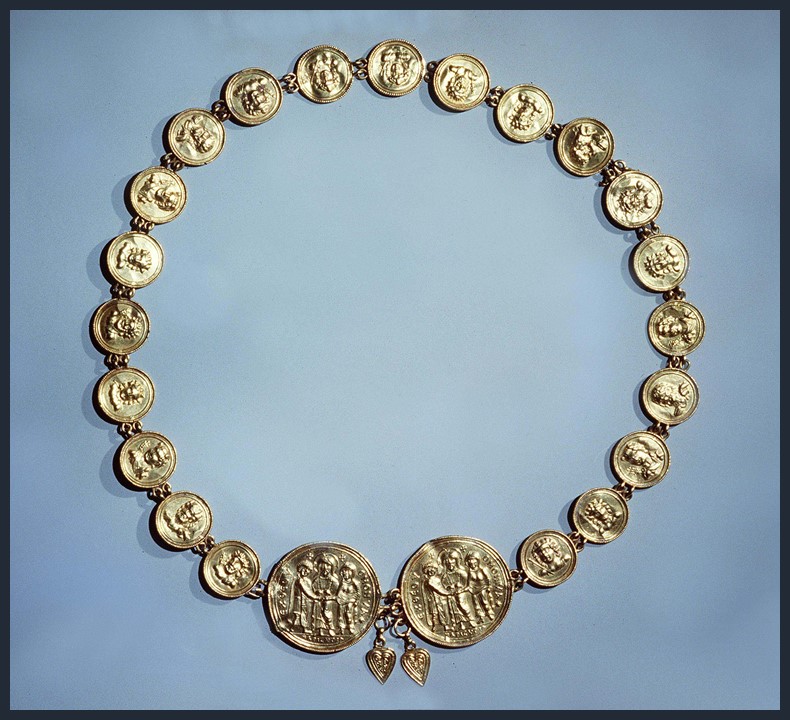
The Dumbarton Oaks Byzantine Marriage Belt unites sacred and pagan imagery, where Christ blesses a union framed by Dionysian figures, symbolising harmony between love, ritual, and cultural continuity in Byzantium.
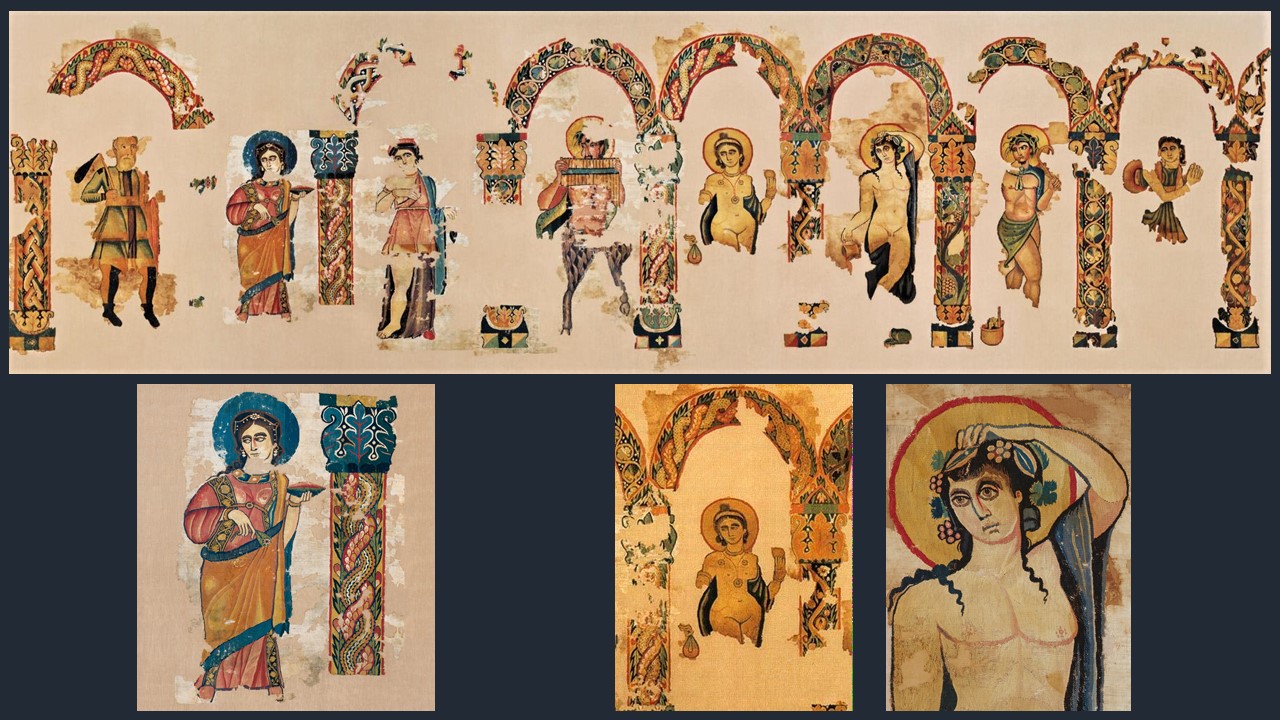
The Abegg-Stiftung’s Dionysus tapestry reveals the god of wine and ecstasy surrounded by lush ornament and mythic figures, reflecting Late Antique beliefs in joy, abundance, and life beyond death.