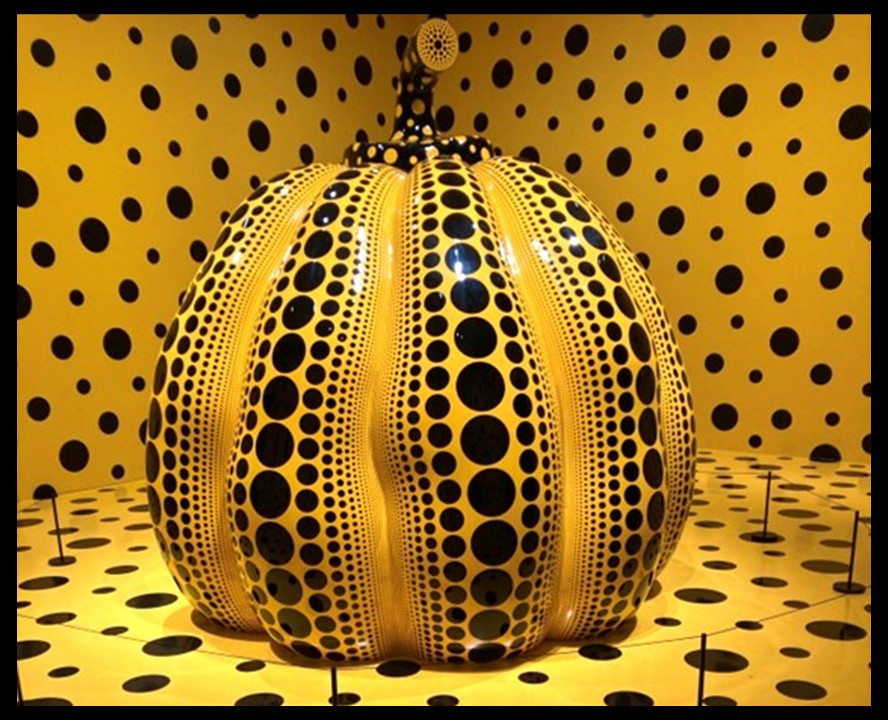
Great Giant Pumpkin, 2017, Fiberglass-reinforced plastic (FRP) and urethane paint, large-scale installation, Yayoi Kusama: The Place for My Soul exhibition at Matsumoto City Museum of Art, Matsumoto, Nagano Prefecture, Japan – Photo Credit: Amalia Spiliakou, February 2026
With Thanksgiving 2026 approaching on Thursday, November 26, pumpkins are showing up everywhere, on doorsteps, in pies, in seasonal decor. It’s a fitting moment to look at Yayoi Kusama Pampkins, the artist who has made the pumpkin her own for more than 70 years.
A Lifelong Obsession
Kusama first became fascinated with pumpkins as a child, growing up near her family’s seed farm in Matsumoto, Japan. She has described discovering a pumpkin in the fields and feeling immediately drawn to its bulbous shape, its “generous unpretentiousness,” and its plain, homely presence next to more delicate, self-important flowers. That first encounter stayed with her for decades, resurfacing again and again across paintings, drawings, soft sculptures, and eventually the massive outdoor sculptures she’s known for today.
Unlike many recurring motifs in art history that shift meaning across an artist’s career, Kusama’s pumpkin has stayed remarkably consistent. It is not a symbol of harvest or seasonal celebration in her work. It’s closer to a stand-in for herself: sturdy, a little strange-looking, and comforting precisely because it doesn’t try to be beautiful in a conventional sense.
Why the Polka Dots?
Kusama’s pumpkins are almost always covered in her signature polka dots, usually black on yellow. This pattern connects to something much deeper than decoration. Kusama has spoken openly about experiencing hallucinations from childhood, describing fields of dots that seemed to spread across everything she saw, sometimes overwhelming her sense of her own body and surroundings. Rather than suppress these visions, she began translating them directly into her art.
The dots covering her pumpkins are an extension of this idea, often described as “self-obliteration”: the dissolving of an object’s individual form into an endless, repeating pattern. When a pumpkin is covered edge to edge in dots, its boundary starts to blur into the space around it. Kusama has said this process helps her manage anxiety and find a kind of peace, turning a personal psychological experience into a visual language millions of people now recognize instantly.
The Great Gigantic Pumpkin, in Her Own Hometown
One of the clearest places to see this idea at full scale is “Great Gigantic Pumpkin” (2017), shown as part of Kusama’s exhibition “The Place for My Soul” at the Matsumoto City Museum of Art. The location matters: Matsumoto, in Japan’s Nagano Prefecture, is where Kusama was born and raised, and where her family ran the seed nursery that first put pumpkins in front of her as a child.
In the installation, the towering yellow, black-dotted pumpkin sits inside a room whose walls and floor are covered in the same polka-dot pattern, so the sculpture and its surroundings seem to bleed into one another. That staging is deliberate. It’s the clearest possible demonstration of “self-obliteration,” Kusama’s term for letting an object’s edges dissolve into a repeating pattern until it’s hard to tell where the pumpkin ends and the room begins.
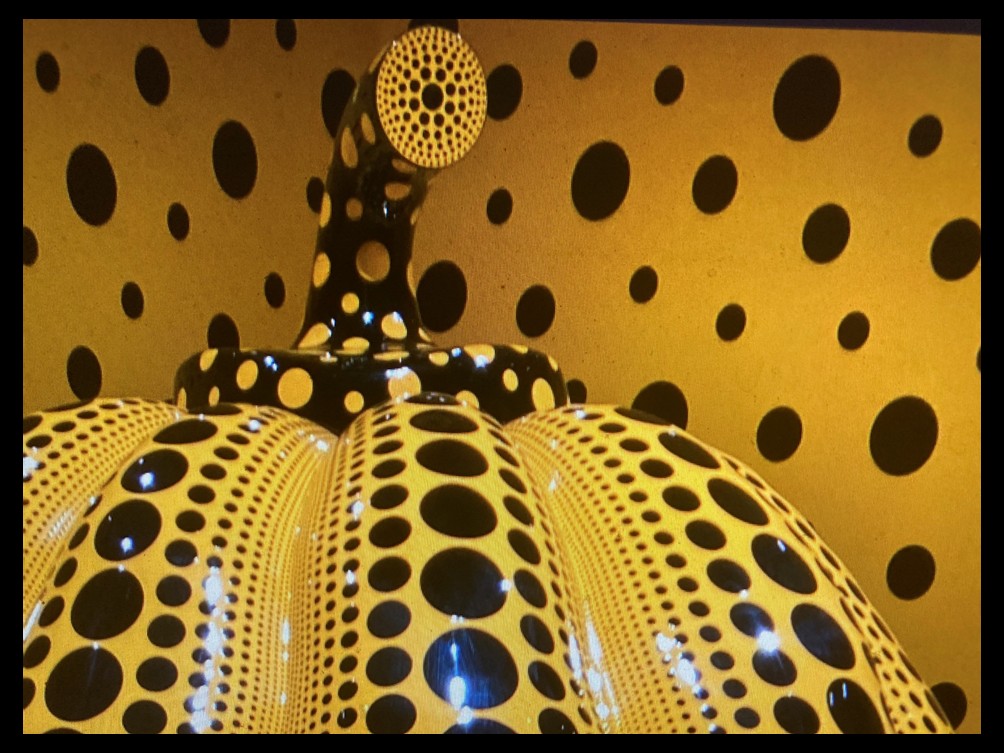
Great Giant Pumpkin (detail), 2017, Fiberglass-reinforced plastic (FRP) and urethane paint, large-scale installation, Yayoi Kusama: The Place for My Soul exhibition at Matsumoto City Museum of Art, Matsumoto, Nagano Prefecture, Japan – Photo Credit: Amalia Spiliakou, February 2026
Seeing the piece in Matsumoto adds another layer of meaning that a version elsewhere might not carry. This is the closest her pumpkin motif comes to a homecoming: an artist returning, in her nineties, to the town where the shape first caught her attention, and rebuilding that fascination on a monumental scale for the public.
Why It Resonates Around Thanksgiving
It’s easy to see why Kusama’s pumpkins surface in conversation this time of year. The shape is already tied to autumn and gratitude in Western culture, even though that’s not where her fascination began. Looking at her work alongside a holiday built around noticing abundance adds an interesting layer: a simple, everyday object, repeated and transformed, can hold much more meaning than it first appears to.
Whether or not pumpkins make it onto your table this Thanksgiving, Kusama’s version is worth a second look. It’s a reminder that some of the most powerful art comes not from grand or exotic subjects, but from returning, again and again, to something ordinary until it reveals something new.
Classroom Activity: Step into the colorful world of Yayoi Kusama. This hands-on student activity draws inspiration from her Great Giant Pumpkin at the Matsumoto City Museum of Art. Students will explore pattern, scale, and repetition — hallmarks of Kusama’s style. Explore the Student Activity →
Continue Exploring on Teacher Curator: Want to dive deeper into Kusama’s work? Check out these related articles – Yayoi Kusama’s Infinity Mirrored Room and Pumpkins.
Sources and further Reading: For more on this influential Japanese artist and her place in 20th-century art, these sources offer excellent starting points – The Matsumoto City Museum of Art hosts Yayoi Kusama: The Place for My Soul, a year-round exhibition dedicated to her work https://matsumoto-artmuse.jp/en/events/event/yayoi/. For further information the Mori Art Museum is another respected Japanese institution. Its STARS: Six Contemporary Artists from Japan to the World exhibition materials explore Kusama’s career, highlighting pumpkins and flowers as recurring motifs in her large-scale public art – https://www.mori.art.museum/en/exhibitions/stars/02/index.html?utm_source=chatgpt.com.