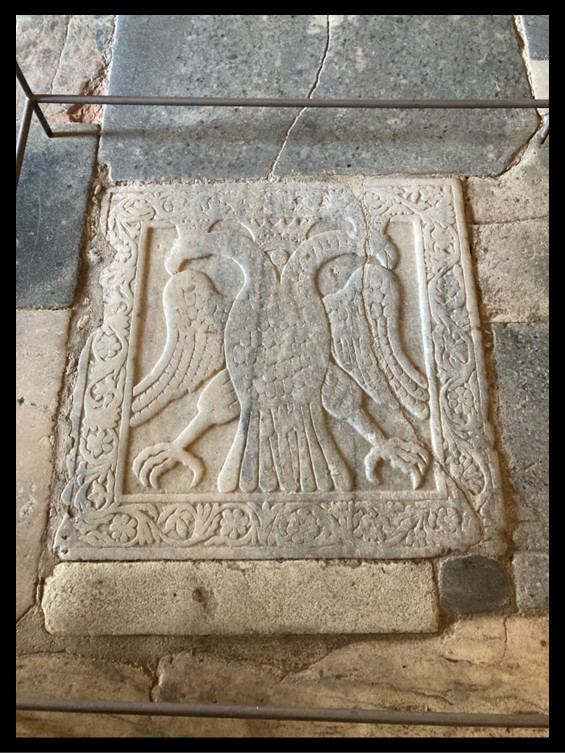
There is a slab of marble on the floor of the Metropolis of Agios Demetrios, in Mystras, that people love to stand on. Literally. It’s carved with a double-headed eagle, wings out, talons gripping nothing but stone floor, and the story that goes with it is irresistible: this is where they crowned the last emperor of Byzantium. I stood next to it too. And then, because I can never leave a good story alone, I went looking for the sources. What I found makes The Eagle on the Floor more interesting, not less.
The Legend
The tradition says that on 6 January 1449, Constantinos XI Palaiologos, soon to be the last Roman emperor to sit on any throne, was crowned right here, on this exact spot, before leaving Mystras for Constantinople. Four years later, the city fell to the Ottomans, and Constantinos died in the fighting, sword in hand, according to the stories that grew up around him almost immediately. It’s the kind of detail that turns a church visit into something closer to standing at a hinge point in history. Which is exactly why it’s worth checking.
What the Eagle Actually Is
First, the easy part. The double-headed eagle carved into that slab is the heraldic device of the Palaiologos dynasty, the last family to rule Byzantium, from the recapture of Constantinople in 1261 until 1453. It shows up on their seals, their flags, their churches, wherever they wanted to leave a mark of who was in charge.
What surprises most people is that this symbol wasn’t ancient even by Byzantine standards. It appears in Byzantine art from around the 10th century, but it only became an official imperial emblem in the final century of the empire, under the Palaiologoi. In other words: by the time this slab was carved, the “eternal” symbol of Byzantium was barely a hundred years old. The two heads are usually read as standing for the emperor’s dual authority, over church and state, or over East and West, a tidy visual argument for a dynasty that was, in reality, losing both.
And it wasn’t exclusive to Constantinople. The same eagle appears on monuments built by the Despots of the Morea (Mystras’s own ruling branch of the family) and even turns up on Palaiologan-affiliated territories as far as Lesbos, carved for the Gattilusi lords who had married into the family. Standing by this slab connects you to that whole network, not just to one coronation story.
The Part the Legend Skips
Here’s where it gets interesting. Historians working on the architectural history of the Metropolis have pushed back on the coronation claim itself. The galleries that gave the church its current, unusual two-level form were added in the first half of the 15th century, and according to the building’s own inscriptions, that work was carried out under the metropolitan Matthew, for reasons connected to the liturgical practice of the Byzantine court, not to commemorate any coronation. The link between that renovation and Constantine XI’s crowning appears in later, popular literature, but it isn’t well supported by the primary sources.
That doesn’t mean Constantine wasn’t crowned in Mystras. It just means the neat, single-slab version of the story is almost certainly a tradition that grew up afterward, plausible, even satisfying, but not quite documented history.
Why It’s Worth Telling Anyway
I don’t think the myth is a problem. I think it’s the point. People needed, still need, a physical place to put their grief for an empire that ended. A carved eagle in a church is a much better place to stand and feel that than an inscription in an archive. The legend isn’t a lie so much as it’s what a city does with a true and enormous loss: it finds a stone and says, here.
So next time you’re in Mystras, go stand by the eagle. Just hold the story a little more loosely than the guidebooks do and pray for Constantino XI Palaiologo, the last emperor.
Classroom Activity: Step into Byzantine history with this hands-on Student Activity inspired by the Double-Headed Eagle of the Palaiologos Dynasty at Mystras. Explore the Student Activity →
Continue Exploring on Teacher Curator: Discover how symbols, monuments and legends can help us investigate sculpture during the Byzantine period with a related article – Parallel Stories of Byzantine Imperial Portraits.
Sources and further Reading: To explore the Church of Saint Demetrios (Metropolis) at Mystras, including its architecture and history, visit the Institute for Mediterranean Studies’ detailed presentation of the church – https://www.ime.gr/choros/mystras/gr/E/13E/13E5.html?utm_source=chatgpt.com. Learn more about Mystras, its monuments and cultural heritage, through the Greek Ministry of Culture’s educational resource – https://www.culture.gov.gr/mystras-edu/art/03.html?utm_source=chatgpt.com. For a closer look at the Metropolis of Mystras and its relief sculpture, explore The Byzantine Legacy’s overview of the church and its surviving decorative elements – https://www.thebyzantinelegacy.com/metropolis-mystras .