https://heraklionmuseum.gr/en/collections/#collections
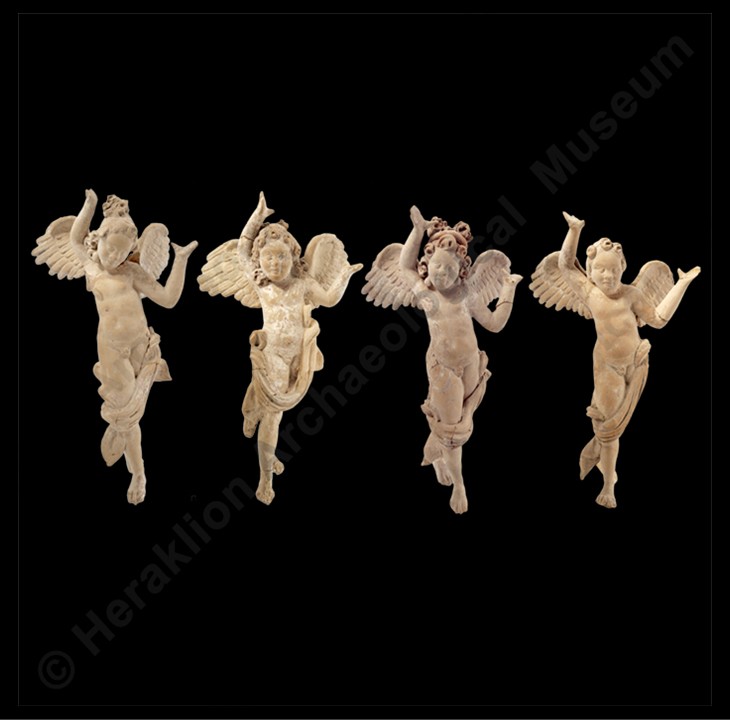
What do we see when we look at a Hellenistic Cupid? A playful child, perhaps, with tiny wings and a lively pose. But these four charming terracotta figures from Gortyn, Crete, tell a more poignant story. Found together in a Hellenistic tomb, they represent Eros, the Greek god of love and desire, in a form that had become increasingly popular in Hellenistic art. Yet here, Eros has a very different role. The figures were associated with burial and served as allegorical personifications of eternal sleep.
Four Cupids from a Hellenistic Tomb
The four Winged Cupid figurines belong to the collection of the Heraklion Archaeological Museum. They date from the 3rd–2nd century BC, a period when Greek art became increasingly interested in movement, emotion and scenes from everyday life. Made of terracotta, the figures are relatively small, with the largest measuring about 23 cm in height. They are shown in lively poses, their bodies carefully modelled and their features finely rendered. Although today we may immediately think of the Roman Cupid, these figures represent the Greek Eros, whose imagery later became closely associated with Cupid in Roman art.
They also preserve traces of their original appearance. White and red paint survives on the clay, reminding us that ancient sculpture and terracotta were often brightly coloured. Small suspension holes in their shoulder blades provide another fascinating clue about how the figures may have been displayed.
Eros and Eternal Sleep
Their funerary context changes the way we look at them. In Greek mythology, Eros was the god associated with love, attraction and desire. During the Hellenistic period, however, artists frequently represented him as a winged child. He could be mischievous, playful or engaged in amusing activities. His image became one of the most familiar subjects in Hellenistic terracotta art.
In these four figures, however, the playful appearance carries a deeper meaning. According to the Heraklion Archaeological Museum, figurines of Eros or Cupid were commonly associated with the burials of women and children, where they functioned as allegorical representations of eternal sleep. This is a beautiful example of how the meaning of an image can change according to its context. A winged child might first appear to us as a symbol of love or youthful play. Placed in a tomb, the same figure can suggest the peaceful sleep of death.
The Charm of Hellenistic Art
These little figures also reveal something important about Hellenistic art. Artists of the period moved beyond the idealised calm associated with earlier Classical sculpture. Instead, they explored movement, emotion and more intimate subjects. Children, theatrical characters, elderly people and scenes from everyday life all became popular themes.
Eros was particularly suited to this new artistic language. His small wings, youthful body and playful gestures allowed artists to explore movement and expression in new ways. Terracotta offered another advantage: figures could be produced in moulds and adapted into different poses and variations. The four Cupids from Gortyn bring together many of the qualities that make Hellenistic art so engaging: liveliness, movement, emotional appeal and a fascination with the human figure. Yet their significance extends beyond their charm and graceful appearance.
Perhaps that is what makes these four small figures so captivating. Their graceful movements and youthful forms speak of the energy of life, yet their place in a tomb gives them another meaning. Here, Eros is no longer simply the playful god of love. He becomes a gentle companion to the dead, transforming the silence of the tomb into an image of eternal sleep. More than two thousand years later, these fragile terracotta figures still hold that quiet tension between life and death—a reminder of how beautifully Hellenistic artists could express complex ideas through the simplest of forms.
Classroom Activity: Bring the playful world of Hellenistic art into your classroom with this engaging student activity inspired by the charming Cupid figurines from Gortyn, Crete. Look closely, uncover their symbolism, and create your own response to these ancient terracotta figures. Explore the Student Activity →
Continue Exploring on Teacher Curator: Discover more about Eros and his many representations in art with these related Teacher Curator posts – Sleeping Eros and Plaque with Eros as a Sleeping Child.
Sources and further Reading: To learn more about the Cupid figurines from Gortyn, visit the Heraklion Archaeological Museum, home to an important collection of archaeological finds from Crete: Heraklion Archaeological Museum – Collections Learn more about Eros and his representations in ancient Greek art through the collection of The Metropolitan Museum of Art in New York city, which includes numerous examples of Eros in sculpture, terracotta, jewellery, and other works of art https://www.metmuseum.org/art/collection/search?searchField=All&sortBy=Relevance&artist=&artistFacet=Eros&department=Greek+and+Roman+Art&utm_source=chatgpt.com .