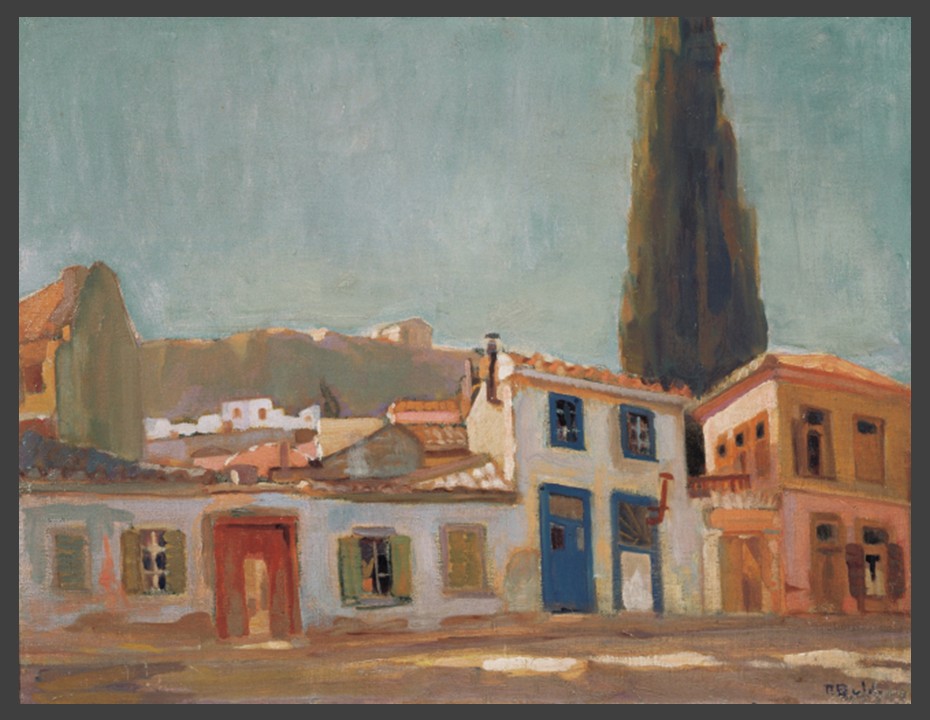
The Atelier, 1927, Oil on Canvas, 44×58 cm, E. Averoff Museum, Metsovo, Greece
https://www.averoffmuseum.gr/en/paintings/atelier-1927
What does an artist choose to paint when the place where he works becomes part of the city he loves? In The Atelier, painted in 1927, Greek artist Periklis Vyzantios gives us an intimate glimpse of Plaka, the historic neighbourhood beneath the Acropolis. Yet this is not simply a cityscape. The modest building at the centre of the painting was Vyzantios’s own atelier, making the work a personal portrait of both the artist and his Athens.
Periklis Vyzantios and his Atelier
Born in Athens in 1893, Periklis Vyzantios belonged to a generation of Greek artists who sought new directions beyond the academic traditions that had dominated Greek painting. He initially travelled to Munich intending to study law, but soon abandoned that path for art. In Paris, he studied at the École des Beaux-Arts and the Académie Julian, where he encountered the lively artistic world of early twentieth-century France.
When Vyzantios returned to Athens, he became an active figure in the development of modern Greek art. He was one of the founding members of the progressive Techni (Art) Group, which included several artists interested in bringing contemporary European ideas into Greek painting.
For several years, Vyzantios lived and worked in Plaka. His atelier was at Diogenous Street, in a building associated with an artistic circle that included the sculptor Fokion Rok and the painter Pavlos Kalligas. The space was more than a place to paint. It was also a meeting place for artists and intellectuals. In The Atelier, however, Vyzantios does not invite us inside. Instead, he turns his attention outward.
Painting Old Athens
The painting presents a quiet street lined with low houses, tiled roofs, coloured façades, shutters and wooden doors. Behind them rises a tall, dark cypress, creating a striking vertical accent against the pale blue-green sky.
The architecture is recognisably Athenian, but Vyzantios does not describe every detail with photographic precision. The houses are simplified into broad areas of colour, while the brushwork remains visible and lively. Soft blues, ochres, terracotta reds and muted greens give the scene a warm, slightly nostalgic atmosphere.
This combination of observation and simplification is important. Vyzantios had absorbed the lessons of modern French painting, but he applied them to the streets and landscapes of Greece. His work belongs to a broader movement in early twentieth-century Greek art that sought to reconcile European modernism with the particular character of the Greek landscape and light.
A Changing Athens
There is also something quietly historical about the painting. In the 1920s, Athens was changing rapidly. The arrival and settlement of refugees after the Asia Minor Catastrophe of 1922, together with the city’s growing population, placed enormous pressure on the traditional urban fabric. The General Building Law of 1929 would soon encourage the construction of multi-storey apartment buildings and dramatically alter the appearance of Athens.
Against this background, paintings of old neighbourhoods such as Plaka acquired a particular poignancy. Vyzantios’s The Atelier preserves a vision of a smaller-scale Athens: irregular roofs, modest houses, narrow streets and abundant colour.
The painting is therefore more than a view from the artist’s neighbourhood. It becomes a visual record of a city on the threshold of transformation.
An Atelier Without Artists
Perhaps the most intriguing aspect of The Atelier is that there are no artists in the picture. Vyzantios does not show himself at work or reveal the interior of his studio. Instead, he paints the building and the world surrounding it.
The title draws our attention to the place where art was created, while the painting itself draws us into the world outside its doors. In this sense, the atelier becomes part of the landscape, and the landscape becomes part of the artist’s creative life.
Looking at The Atelier today, we can imagine Vyzantios standing before these houses, translating familiar streets into paint. His Parisian experiences had not distanced him from Athens. Instead, they gave him new ways of seeing it. Periklis Vyzantios’s The Atelier is both a painting of a place and a memory of a city: a quiet corner of Plaka preserved on canvas just as Athens was beginning to change.
PowerPoint Presentation: Ready to take a closer look at Periklis Vyzantios and The Atelier? Download the PowerPoint presentation for a closer look at the artist, his work, and the world of early 20th-century Greek art. It is ideal for teaching, classroom discussion, or independent learning. Get the PowerPoint →
Continue Exploring on Teacher Curator: Discover more of early 20th-century Greek art through these related Teacher Curator articles: Nikos Hadjikyriakos-Ghika’s Interior with Woman and Mirror and Spyros Papaloukas and the Temple of Aphaia. Together, they offer different perspectives on how Greek artists responded to modernism, place, and the visual traditions of Greece.
Sources and further Reading: To learn more about Periklis Vyzantios’s The Atelier, see the collection entry from the E. Averoff Museum, Metsovo, which provides information about the painting and its provenance, https://www.averoffmuseum.gr/en/paintings/atelier-1927. For a broader view of Vyzantios’s artistic career and oeuvre, visit the artist’s page at the National Gallery of Greece, https://www.nationalgallery.gr/en/artist/vyzantios-periclis/.