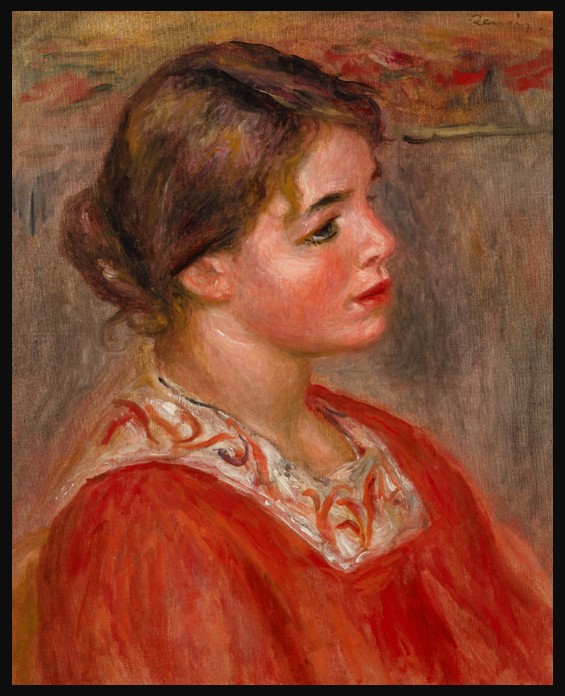
Femme au corsage rouge, ca. 1910, Oil on Canvas, 41.2 x 33.4 cm, Private Collection https://www.christies.com/en/lot/lot-6584150?ldp_breadcrumb=back#lot-essay
Renoir’s Femme au corsage rouge, painted around 1910, is an intimate portrait of a woman in a striking red corsage. The sitter is believed to be Gabrielle Renard, who was closely connected to the artist’s family and became one of Renoir’s most familiar models. With its warm colours, fluid brushwork and close composition, the painting offers a fascinating glimpse into Renoir’s late style and his enduring fascination with the female figure.
Gabrielle Renard: Renoir’s model and companion
Gabrielle Renard entered the Renoir household in 1894 as governess to the artist’s young son, Jean. Over the years, however, her role became much more than that of a governess. She became an important member of the family, helped with the children and assisted Renoir in his studio. She also posed for him repeatedly.
Christie’s identifies the sitter of Femme au corsage rouge as Gabrielle Renard, adding another layer of meaning to this seemingly simple portrait. Renoir knew Gabrielle well, and she was not simply a professional model arriving at the studio for a formal sitting. Her familiarity with the family is reflected in the relaxed character of many of the paintings for which she posed. In this portrait, Renoir avoids elaborate surroundings or formal accessories. The composition is tightly cropped, bringing Gabrielle close to the viewer. Her face, hair and clothing become the principal subjects, while the indistinct background keeps our attention firmly on her presence.
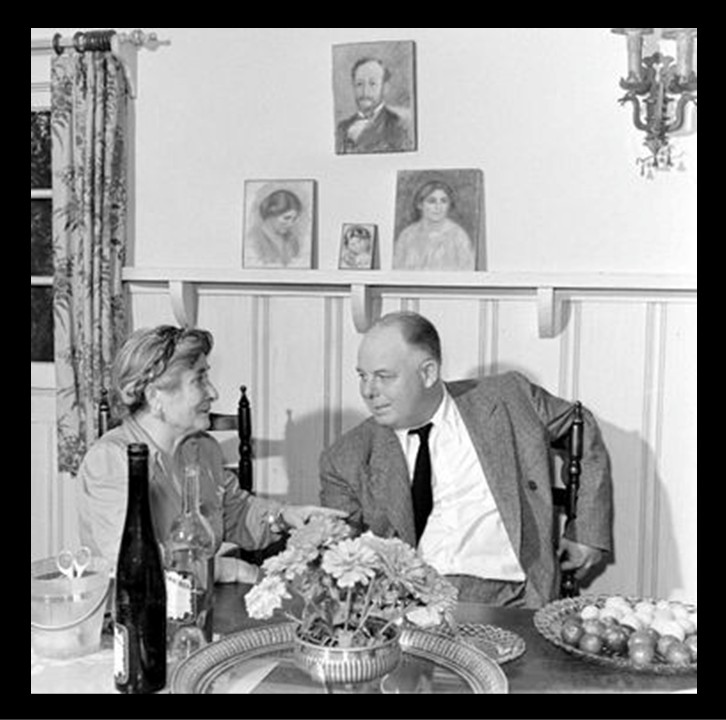
Gabrielle Renard and Jean Renoir in Beverly Hills, between 1955 and 1959, The LIFE Picture Collection. https://www.bonhams.com/stories/41322/a-lasting-impression-the-renoir-collection-of-gabrielle-renard/
The red corsage
The red corsage gives the painting its title and its strongest visual accent. Set against the quieter background and warm tones of the sitter’s skin, the intense red immediately attracts the eye. Colour was fundamental to Renoir’s art throughout his career, but in his later paintings it increasingly became a means of constructing form. Rather than relying on precise outlines, Renoir allows areas of colour and loose brushstrokes to describe the figure.
The red garment therefore does more than identify the sitter’s clothing. It establishes a visual rhythm within the composition and creates a striking contrast with the delicate flesh tones of the face and neck. The result is a portrait that feels both spontaneous and carefully balanced.
Renoir’s late style
By 1910, Renoir had travelled a considerable distance from the Impressionist paintings that had established his reputation in the 1870s and 1880s. His interest in light and colour remained, but his later work often has a softer, more sculptural quality.
In Femme au corsage rouge, the brushwork is fluid and continuous. The contours of the face are softened, while the transitions between skin, hair and clothing are created through subtle changes of tone. The figure seems to emerge from the surrounding atmosphere rather than being sharply separated from it.
This approach is characteristic of Renoir’s late paintings, in which the human figure became increasingly monumental and tactile. Although the canvas is relatively small, the sitter has a strong physical presence. Renoir’s late style can therefore be understood not as a rejection of his earlier Impressionism, but as a continuing exploration of colour, light and the expressive possibilities of paint.
From Renoir’s studio to Japan
The later history of Femme au corsage rouge adds an unexpected international dimension to the work. The painting was acquired directly from Renoir by the influential Parisian dealer Paul Durand-Ruel before entering Japanese collections from 1922 onwards. Its subsequent exhibition history in Japan reflects the strong interest in Renoir among Japanese collectors and audiences. In 1995, the painting was included in the exhibition Renoir and Japanese Painters at the Bridgestone Museum in Tokyo, connecting Renoir’s work with a wider history of artistic exchange between France and Japan.
The journey of Femme au corsage rouge from Renoir’s studio to Japan is a reminder that the history of a painting does not end with its creation. Collectors, dealers, museums and exhibitions all contribute to the ways in which works of art are seen, valued and understood.
PowerPoint Presentation: Ready to explore the theme further? Download the PowerPoint presentation on Renoir’s Portraits of Gabrielle Renard. It is ideal for teaching, discussion, or independent learning. Get the PowerPoint →
Continue Exploring on Teacher Curator: Continue your exploration of Renoir and his art with two related Teacher Curator articles: Oedipus Rex and Jocasta by Renoir and The Council of the Gods by Rubens and Renoir. Together, they reveal two very different aspects of Renoir’s artistic world, from dramatic mythological painting to his dialogue with the Old Masters.
Sources and further Reading: For more information about Renoir’s Femme au corsage rouge, see the Christie’s catalogue entry, which provides details about the painting, its provenance, exhibition history, and the identity of the sitter: https://www.christies.com/en/lot/lot-6584150?ldp_breadcrumb=back#lot-essay. For a broader understanding of Renoir’s artistic development and style, see the Metropolitan Museum of Art essay Auguste Renoir (1841–1919): https://www.metmuseum.org/es/essays/auguste-renoir-1841-1919?utm_source=chatgpt.com