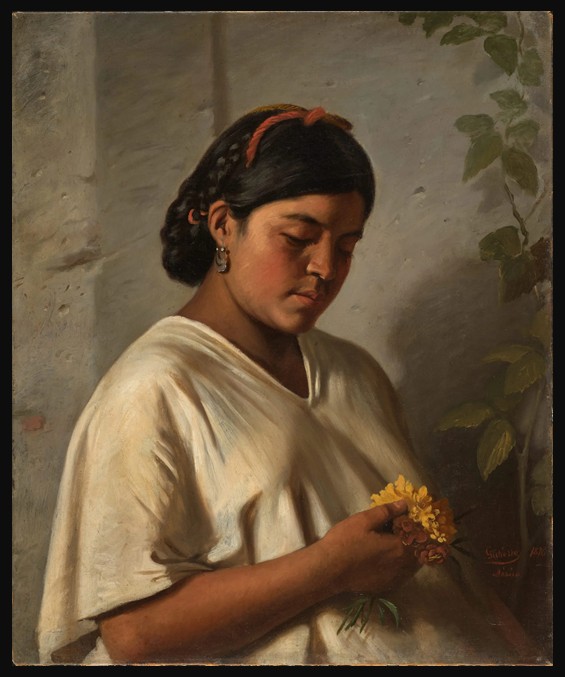
Indian Woman with Marigold (Mujer indígena con cempasúchil), 1876, Oil on Canvas, 67.95×56.52 cm, Los Angeles County Museum of Art, USA
https://collections.lacma.org/node/1035000
What can a flower tell us about life and death? In Indigenous Woman with Marigolds (Mujer indígena con cempasúchiles), painted in 1876, Mexican artist Felipe Santiago Gutiérrez gives us a quiet and thoughtful answer. A young Indigenous woman holds a small group of bright marigolds, known in Mexico as cempasúchil. She looks down at the flowers, while her colourful clothing and calm expression draw us into the scene.
At first, the painting seems simple. There is a woman, a few flowers, and very little action. Yet the longer we look, the more we notice. The woman is pregnant. The flowers she holds are associated with death in Mexican culture. Together, these details create a powerful contrast between new life and mortality.
Felipe Santiago Gutiérrez and Mexican Art
Felipe Santiago Gutiérrez (1824–1904) was an important Mexican painter of the nineteenth century. He studied at the Academy of San Carlos in Mexico City, where he received a traditional academic art education. His career also took him beyond Mexico, and he travelled extensively through the Americas and Europe.
Gutiérrez painted portraits, historical subjects and scenes connected with Mexican life and culture. His work reflects the artistic interests of nineteenth-century Mexico, a period when artists were exploring both European academic traditions and subjects that expressed local identity. In Indigenous Woman with Marigolds, these interests come together. The woman is presented with dignity and seriousness, while her clothing and the flowers connect the painting to Mexican culture.
A Woman, a Flower and a Quiet Moment
The woman’s pose is especially important. She does not look directly at us. Instead, her eyes are lowered towards the marigolds in her hands. This makes the painting feel private, almost as though we have entered a moment of personal reflection. Her pregnancy adds another layer to the image. A pregnant woman naturally suggests birth, continuity and the beginning of a new generation. Yet the flowers she holds carry another association.
The cempasúchil, or Mexican marigold, is strongly connected with death and remembrance. Its brilliant colour and distinctive fragrance have made it an important part of the traditions surrounding Día de Muertos, the Mexican Day of the Dead. This does not mean that Gutiérrez’s painting should be read simply as a painting about death. Instead, the contrast invites us to think about the relationship between life and mortality. Birth and death are not presented as completely separate ideas. They exist together within the cycle of human life.
Why Marigolds?
Flowers appear frequently in art because they can carry meanings beyond their physical beauty. A rose, lily or sunflower can suggest love, purity or abundance. But the meaning of a flower depends greatly on its cultural context.
For a viewer unfamiliar with Mexico, the marigolds in Gutiérrez’s painting might simply appear as cheerful yellow-orange flowers. Knowing their cultural associations changes the way we see the image. The flowers become more than decoration. They encourage us to pause and consider memory, loss and the passage of generations.
This is one of the things that makes looking at art so rewarding. A small detail can completely change our understanding of an entire painting. Perhaps that is why this quiet nineteenth-century painting remains so intriguing. The marigolds remind us that life and death are not always opposites. They can be part of the same story. And sometimes, a single flower is enough to make us stop and think.
Classroom Activities: Bring Felipe Santiago Gutiérrez’s Indian Woman with Marigold to life in your classroom with four hands-on Student Activities. Explore the Student Activity →
Continue Exploring on Teacher Curator: Expand your understanding of Flowers in Art with related articles: Irises by Vincent van Gogh and The Twelve Months of Flowers by Pieter Casteels III
Sources and further Reading: To dive deeper into the world of Felipe Santiago Gutiérrez’s Indian Woman with Marigold, visit the Los Angeles County Museum of Art site: https://collections.lacma.org/node/1035000. Learn more about the history, art, and legacy of Mexican artist Felipe Santiago Gutiérrez in Khan Academy’s site: https://www.khanacademy.org/humanities/art-americas/latin-america-after-independence/art-of-mexico-in-the-18th-and-19th-centuries/a/coming-of-age-in-gutirrezs-costumbrista-painting-la-despedida-del-joven-indio-the-young-indians-farewell