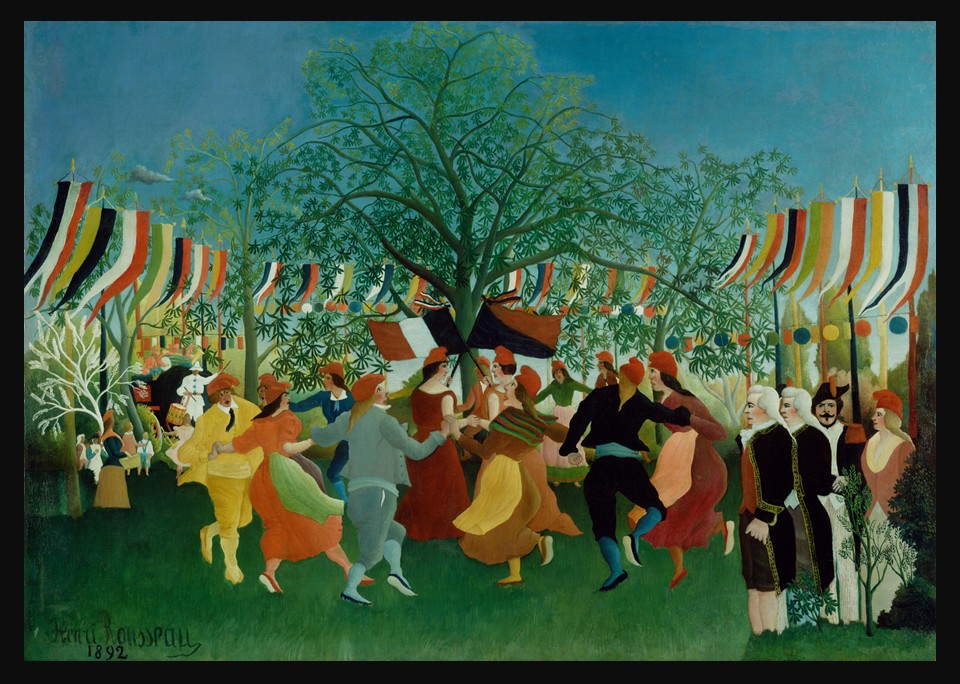
A Centennial of Independence, 1892, Oil on Canvas, 111.8 × 158.1 cm, the Getty Museum, CA, USA
https://www.getty.edu/art/collection/object/103RJB
In 1892, one hundred years after the founding of the First French Republic, Henri Rousseau created a remarkable vision of national identity. His painting A Centennial of Independence, now in the collection of the J. Paul Getty Museum, transforms revolutionary history into a festive communal celebration. Rather than focusing on conflict or political figures, Henri Rousseau’s painting of Bastille Day is a peaceful, almost dreamlike dance of citizens united in symbolic harmony, and a work that rewards close looking.
A Centennial of Independence: Rousseau’s Painting and the French Republic
Rousseau painted this work during the centennial commemorations of the French Republic in 1892, a period when the Third Republic actively shaped national identity through public ceremonies, education, and civic rituals. Instead of portraying revolution as violence or political struggle, he shows a joyful gathering of villagers, soldiers, and symbolic female figures. They dance together beneath tricolor flags and liberty trees, emblems born during the French Revolution that represent freedom and civic renewal. The circular dance at the center of the composition becomes a powerful symbol of unity, suggesting that the Republic is sustained not only by institutions, but by shared cultural participation.
Rousseau’s Painting Style
The distinctive visual language of Henri Rousseau is central to the painting’s impact.
Self-taught and outside academic tradition, Rousseau developed a style characterised by flattened perspective, bold outlines, bright, direct colours, and simplified figures. Once criticised as naïve, this approach reads as deliberate and symbolic. It removes distraction and emphasizes clarity, turning the scene into something timeless and ceremonial. Even movement feels suspended, as if the celebration exists outside ordinary time. His work later gained admiration from modern artists, including Pablo Picasso, who recognised the originality and expressive power of his vision.
Liberty Trees, Symbols, and Civic Identity
One of the most important symbols in the painting is the liberty tree. Originating during the French Revolution, liberty trees were planted in towns and villages as living representations of freedom and collective hope.
In Rousseau’s painting, these trees anchor the celebration in revolutionary tradition while reinforcing its communal meaning. Unlike traditional history paintings that focus on leaders or battles, Rousseau’s vision centers on ordinary people. The Republic becomes something experienced through participation, through movement, gathering, and shared ritual.
Bastille Day Celebrations and Rousseau’s Lasting Vision
To fully appreciate Henri Rousseau’s painting of Bastille Day, it helps to consider how the holiday itself has evolved. Modern Bastille Day celebrations continue many of the themes seen in Rousseau’s work: public space, collective identity, and national memory expressed through celebration. While fireworks and parades dominate today’s imagery, the core meaning of the holiday remains rooted in shared civic experience.
Rousseau’s painting reminds us that national identity is not static. It is continuously renewed through cultural rituals and communal participation. His vision shifts attention away from political authority and toward collective belonging.
A Centennial of Independence offers a unique interpretation of the French Republic. Instead of focusing on rupture or revolution, it presents history as continuity, something carried forward through celebration and shared memory. Henri Rousseau’s painting of Bastille Day offers something rarer than historical record; it offers a feeling. And in that quiet, dreamlike dance, liberty continues to move.
PowerPoint Presentation: Ready to Dive Deeper? Download the presentation and explore Rousseau’s oeuvre at your own pace, ideal for sharing, discussing, or simply learning more. Get the PowerPoint →
Continue Exploring on Teacher Curator: Expand your understanding of how Bastille Day is celebratedin Art with blog posts like Bastille Day and Olympe de Gouges
Sources and further Reading: To dive deeper into the world of Henri Rousseau visit the Getty Museum site https://www.getty.edu/art/collection/object/103RJB and Learn more about the artist reading a Smithsonian Magazine article https://www.smithsonianmag.com/smart-news/meet-henri-rousseau-the-untrained-artist-who-wouldnt-quit-painting-despire-the-ridicule-he-received-from-critics-180987548/