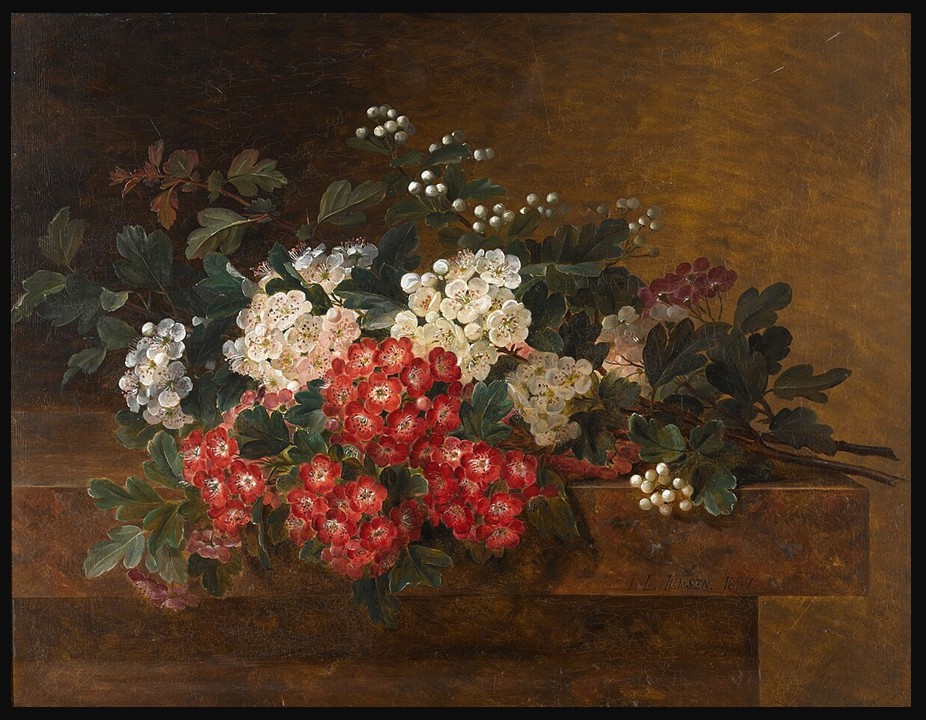
Still Life With Hawthorn Blossom, 1837, Oil on Panel, 29x37cm, Private Collection
https://www.sothebys.com/en/buy/auction/2020/european-british-art/still-life-with-hawthorn-blossom
In the quiet refinement of 19th-century Danish painting, few artists captured the fleeting beauty of nature as delicately as Johan Laurentz Jensen. His exquisite floral still lifes, rich in detail and symbolic resonance, invite us into a world where blossoms become both scientific study and poetic meditation. Among his most evocative works, Still Life with Hawthorn Blossom offers a perfect tribute to May, the month traditionally associated with the hawthorn flower, a symbol of renewal and fragile beauty.
Born in 1800 in Gentofte, near Copenhagen, Jensen trained at the Royal Danish Academy of Fine Arts, where he studied under leading figures such as Christoffer Wilhelm Eckersberg. His artistic education extended beyond Denmark to Paris, where he refined his technique in both large-scale painting and the intricate art of porcelain decoration at Sèvres. This dual training shaped his distinctive style: precise, luminous, and imbued with a sense of controlled elegance.
Jensen became one of the foremost flower painters of the Danish Golden Age, earning a reputation for compositions that balance scientific observation with decorative harmony. His works often present carefully arranged bouquets, sometimes gathered in nature, sometimes imagined, rendered with vibrant color and meticulous detail. An interesting aspect of his career is his role as a teacher, particularly to female artists, for whom flower painting was one of the few acceptable artistic pursuits at the time. His legacy thus extends beyond his canvases into the shaping of a wider artistic community.
Aesthetically, Jensen’s paintings are defined by clarity, stillness, and an almost tactile realism. Flowers appear luminous yet grounded, often set against neutral backgrounds that heighten their presence. There is no excess narrative, only a quiet celebration of form, color, and transience. His compositions reflect both Enlightenment ideals of observation and a Romantic sensitivity to nature’s ephemerality.
His Still Life with Hawthorn Blossom, recently presented at Sotheby’s, exemplifies these qualities. Painted in oil on panel, the work features delicate branches of hawthorn arranged with understated elegance. In this composition, Jensen avoids the opulence of large bouquets, instead focusing on the airy lightness of hawthorn blossoms. The fine white petals, tinged with subtle pink, seem to tremble in soft light, their fragility emphasized by the simplicity of the arrangement. The restrained palette and careful brushwork create a sense of intimacy, inviting the viewer to pause and contemplate the fleeting moment of bloom.
The hawthorn itself carries rich symbolic meaning. Traditionally associated with May, it represents hope, renewal, and protection, often linked to ancient spring festivals and rites of passage. In European folklore, hawthorn blossoms were believed to guard against evil, while in art they frequently signify the delicate threshold between life’s cycles, youth and maturity, bloom and decay. Jensen’s choice of subject thus resonates beyond botanical interest, aligning with a deeper poetic and seasonal symbolism.
In closing, Still Life with Hawthorn Blossom stands as both a celebration of nature and a meditation on transience. Through Jensen’s attentive eye, the humble hawthorn becomes a quiet emblem of May’s fleeting beauty, a reminder that even the most delicate blossoms can carry enduring meaning.
For a Student Activity inspired by Johan Laurentz Jensen’s painting Still Life With Hawthorn Blossom, please, Check… HERE!
Bibliography: from the New Carlsberg Foundation https://www.ny-carlsbergfondet.dk/en/say-it-flowers and Sotheby’s presentation https://www.sothebys.com/en/buy/auction/2020/european-british-art/still-life-with-hawthorn-blossom