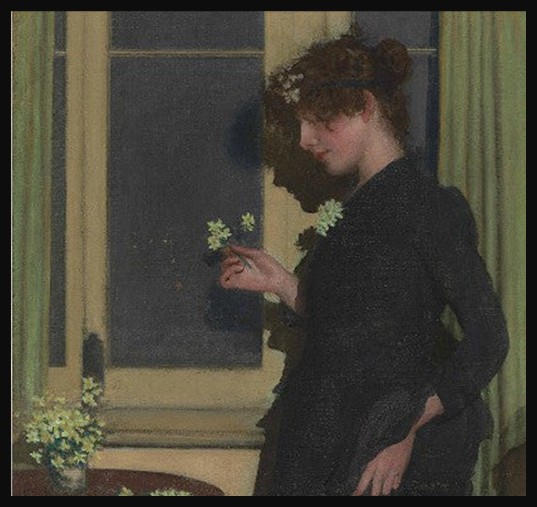
Jonquil, 1890, Oil on Canvas, 91.5×91.5cm, Private Collection
https://www.paulfrasercollectibles.com/blogs/art-photography/philip-wilson-steers-jonquil-will-lead-british-impressionist-art-sale?srsltid=AfmBOooN3TM25j_xhU_nVNGhK4y5qROs7_af7yFZ_Dpx-3wx8w8h2N41
March marks the quiet turning of the year, when winter light begins to soften and the first flowers appear almost shyly in gardens and hedgerows. For this month’s Flower of the Month, Philip Wilson Steer’s Jonquil offers a fitting celebration of early spring. The jonquil, long associated with renewal, modest joy, and the promise of warmer days, emerges here not as a botanical study, but as a moment of looking: intimate, fleeting, and tender. Steer, a leading figure in British Impressionism, was deeply attuned to atmosphere and seasonal change, and this small floral subject allows his sensitivity to come fully into focus.
Atmosphere, Light, and Everyday Beauty in Steer’s Work
Philip Wilson Steer (1860–1942) was born in Birkenhead and trained initially at the Gloucester School of Art before continuing his studies at the South Kensington School of Art in London. He later travelled to Paris, enrolling at the Académie Julian, where he encountered French Impressionist and Realist painting at first hand. This exposure proved formative. On his return to Britain, Steer became a central figure in the development of modern British painting, helping to introduce Impressionist approaches to colour, light, and natural observation. In 1886 he was a founding member of the New English Art Club, which offered an important alternative to the academic traditions of the Royal Academy. Steer went on to enjoy considerable professional success, exhibiting widely and later serving as an influential teacher at the Slade School of Fine Art, where he shaped a generation of British artists.
Steer’s aesthetic was grounded in close observation and a deep responsiveness to light and atmosphere. Rather than dramatic narratives or grand historical themes, he gravitated toward moments of quiet presence: coastal landscapes, figures absorbed in thought, and flowers encountered at close range. His brushwork often dissolves form at the edges, allowing light to become an active presence within the composition. Colour is handled with restraint and subtlety, creating a sense of harmony rather than contrast. This sensitivity gives his paintings a reflective quality, as if the viewer is invited to share in the artist’s own act of looking.
As a leading figure in British Impressionism, Steer played a crucial role in adapting continental ideas to the British landscape and temperament. While influenced by French Impressionists, his work remains distinctively measured and introspective, favouring mood over spectacle. Nature, for Steer, was not something to be mastered or idealised, but quietly attended to, whether in the shifting light of a shoreline or the modest presence of a single flower. His interest in everyday subjects reflects a belief that beauty resides in the ordinary, revealed through patience, attentiveness, and an openness to fleeting sensory experience.
Jonquil and the Spirit of Early Spring
Philip Wilson Steer’s Jonquil depicts a young woman standing in profile beside a tall window, absorbed in the quiet act of holding and examining a small spray of pale flowers. She is dressed in a dark, simple garment that contrasts gently with the soft yellows and greens of the interior setting. The window behind her admits a cool, diffused light, which falls across her face and hands, modelling her features with subtlety rather than clarity. A small table or ledge in the foreground holds additional blossoms, echoing the flowers in her hand and reinforcing the intimacy of the scene. The setting feels domestic and enclosed, yet permeated by light, creating a sense of stillness and inwardness.
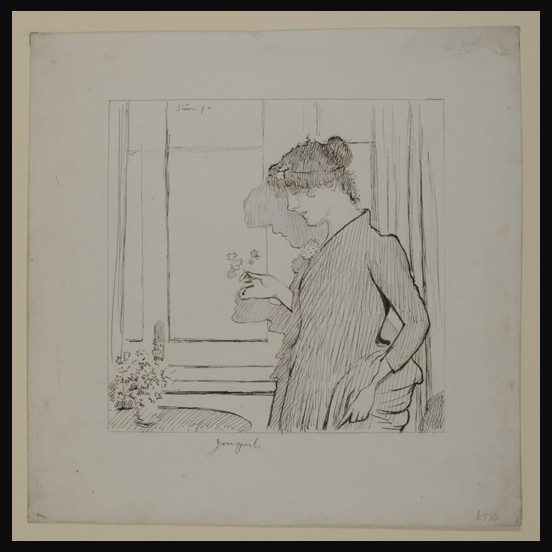
Jonquil, 1890, Pen; Ink; Card, 17.7 cm x 17.8 cm, National Museums, Liverpool
https://www.liverpoolmuseums.org.uk/artifact/jonquil
Steer’s aesthetics here are defined by restraint, atmosphere, and emotional understatement. The palette is carefully harmonised: muted yellows, soft greens, deep blues, and warm neutrals are balanced so that no single element asserts dominance. Brushwork is delicate and softened, particularly in the figure and background, allowing forms to merge gently with their surroundings. Light functions not as a dramatic spotlight but as an enveloping presence, dissolving edges and lending the scene a hushed, contemplative mood. The woman’s absorbed pose and the modest scale of the flowers suggest an interest in private, everyday experience rather than narrative or symbolism. Rather than sharply observing the flowers or the figure, Steer seems to suggest them emotionally, capturing a fleeting moment of quiet attention, where nature and human presence meet in a shared atmosphere of calm reflection.
In Jonquil, Steer offers not a celebration of the flower’s brightness, but a meditation on attentiveness itself. The painting’s quiet harmony of light, colour, and gesture invites the viewer to slow down and share in a moment of private contemplation, where the simple act of holding a flower becomes a reflection on season, presence, and renewal. As a work chosen for March, Jonquil gently captures the spirit of early spring—modest, inward, and full of promise.
For a PowerPoint Presentation, of Philip Wilson Steer’s oeuvre, please… Check HERE!
Bibliography: From the Walker Art Gallery https://www.liverpoolmuseums.org.uk/walker-art-gallery and from Sotheby’s https://www.sothebys.com/en/auctions/ecatalogue/2006/20th-century-british-art-l06141/lot.7.html