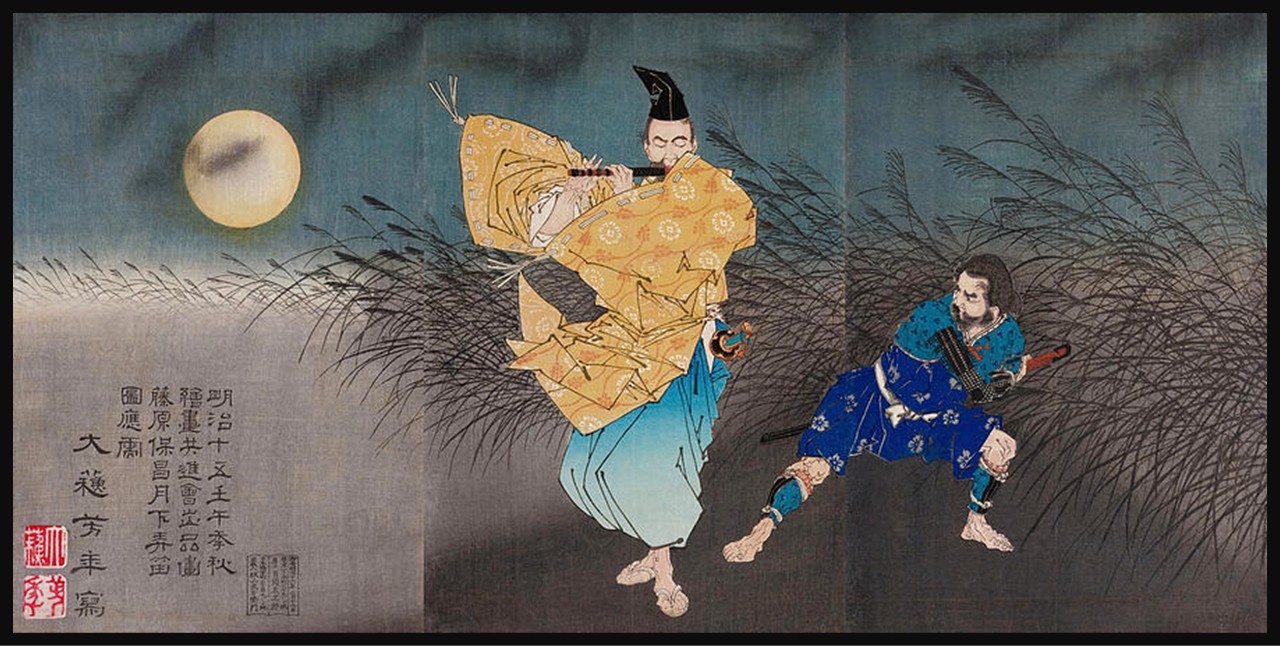
Fujiwara Yasumasa Plays the Flute by Moonlight (Fujiwara Yasumasa gekka roteki) (detail), Meiji period, late 19th century, woodblock print, triptych, left sheet signed zu oju Taiso Yoshitoshi sha, with artist’s seals Taiso and Yoshitoshi, published by Akiyama Buemon (Kokkeido), 12th February 1883, Vertical oban triptych: each sheet approx. 36 x 23.6 cm, Private Collection
https://www.sothebys.com/en/buy/auction/2023/masters-of-the-woodblock-fine-japanese-prints/tsukioka-yoshitoshi-1839-1892-fujiwara-yasumasa
Fujiwara Yasumasa Plays the Flute by Moonlight, a celebrated woodblock print by Tsukioka Yoshitoshi, captures a poetic Kyoto legend in which music disarms violence beneath the moon. Inspired by a tale from the Konjaku Monogatari-shū, the image blends narrative tension with quiet lyrical beauty.
Who Were Fujiwara Yasumasa and the Bandit Hakamadare?
One quiet night in old Kyoto, the nobleman Fujiwara Yasumasa walked slowly beneath the moon, playing his flute as he passed through the great Rashōmon gate. His music drifted softly through the dark streets. Hidden nearby was the bandit Hakamadare, who had been waiting for a traveler to rob. When he saw Yasumasa approaching alone, he crept forward, ready to strike. But as the clear, gentle notes of the flute reached him, he stopped. The music was so calm and beautiful that he found himself listening instead of attacking. Yasumasa continued to play, peaceful and unaware, and the melody filled the silent night.
At last the music ended, and Yasumasa lowered his flute. The bandit stepped out from the shadows—but not as an enemy. Deeply moved, he bowed and admitted that he had meant to rob the nobleman. Yet the music had changed his heart, if only for a moment. That night, the quiet strength of art proved greater than fear, and the sound of a simple flute turned danger into respect beneath the moonlit gate.
Konjaku Monogatari-shū: The Medieval Source Behind the Print
The episode of Fujiwara Yasumasa and the bandit Hakamadare appears in the famous medieval Japanese collection of stories known as Konjaku Monogatari-shū (“A Collection of Tales of Times Now Past”), compiled in the late Heian period, probably in the early twelfth century. This vast anthology gathers more than a thousand short narratives drawn from India, China, and Japan, blending Buddhist teaching, moral reflection, and vivid storytelling about monks, nobles, thieves, spirits, and ordinary people. In its Japanese section, the tale of Yasumasa stands out as a moment in which courtly refinement meets the rougher world beyond the capital’s elegant life. Like many stories in the collection, it offers a brief but memorable scene in which character is revealed through action: the nobleman’s calm artistry contrasts with the bandit’s violent intention, and the encounter becomes a small meditation on the power of culture, virtue, and unexpected transformation.
Centuries after the tale was recorded in the medieval story collection Konjaku Monogatari-shū, the quiet drama of Fujiwara Yasumasa and the bandit Hakamadare inspired a striking visual interpretation by the Japanese artist Tsukioka Yoshitoshi (1839–1892). In his late nineteenth-century woodblock print, created during the Meiji period, Yoshitoshi distills the story into a single, charged moment. Yasumasa stands beneath the moon, absorbed in the gentle sound of his flute, while the bandit waits in the shadows of the tall grass behind him. The composition heightens the tension between calm refinement and hidden danger, visually expressing the moral at the heart of the tale: that the quiet power of art and inner composure can momentarily disarm violence and transform a potentially threatening encounter into one of unexpected admiration.
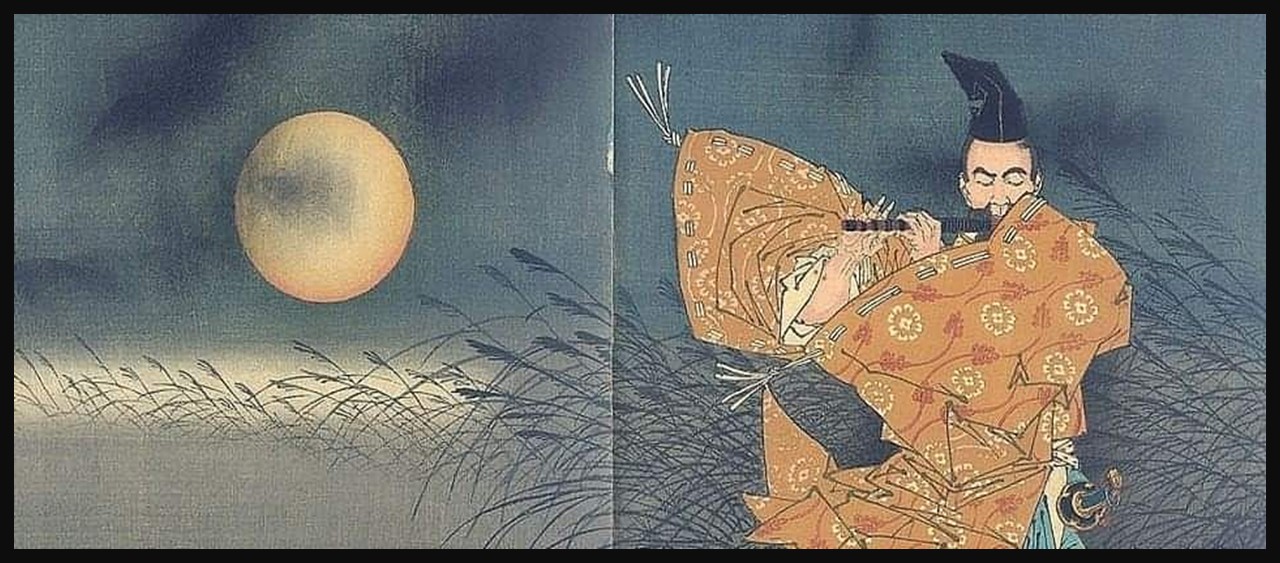
Fujiwara Yasumasa Plays the Flute by Moonlight (Fujiwara Yasumasa gekka roteki) (detail), Meiji period, late 19th century, woodblock print, triptych, left sheet signed zu oju Taiso Yoshitoshi sha, with artist’s seals Taiso and Yoshitoshi, published by Akiyama Buemon (Kokkeido), 12th February 1883, Vertical oban triptych: each sheet approx. 36 x 23.6 cm, Private Collection
https://www.facebook.com/groups/1318447768204833/posts/4901991216517119/
Tsukioka Yoshitoshi and the Ukiyo-e Tradition
Tsukioka Yoshitoshi (1839–1892) was one of the last great masters of the Japanese woodblock print tradition (ukiyo e), working at a time when Japan was undergoing profound political and cultural transformation during the Meiji period. Trained as a student of the celebrated ukiyo-e artist Utagawa Kuniyoshi, Yoshitoshi inherited a rich visual language of dramatic storytelling and expressive line. Yet he developed his career during a moment when traditional woodblock printing faced competition from photography and Western-style painting. In response, Yoshitoshi revitalized the medium by drawing on history, literature, folklore, and the supernatural, creating images that were both deeply rooted in Japanese narrative traditions and strikingly modern in their psychological intensity.
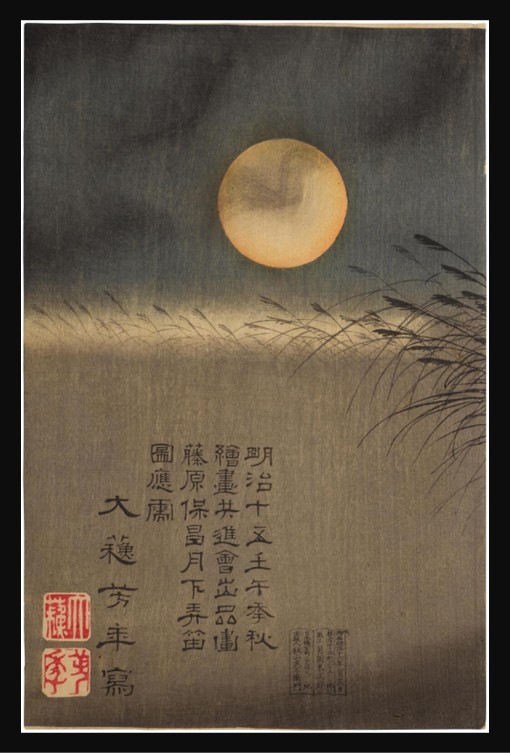
Fujiwara Yasumasa Plays the Flute by Moonlight (Fujiwara Yasumasa gekka roteki) (detail), Meiji period, late 19th century, woodblock print, triptych, left sheet signed zu oju Taiso Yoshitoshi sha, with artist’s seals Taiso and Yoshitoshi, published by Akiyama Buemon (Kokkeido), 12th February 1883, Vertical oban triptych: each sheet approx. 36 x 23.6 cm, Private Collection
https://www.sothebys.com/en/buy/auction/2023/masters-of-the-woodblock-fine-japanese-prints/tsukioka-yoshitoshi-1839-1892-fujiwara-yasumasa
Yoshitoshi’s artistic style is notable for its dramatic compositions, bold contrasts of light and shadow, and an acute sensitivity to mood and atmosphere. His prints often capture moments of emotional tension or quiet revelation, figures poised between action and stillness, set against moonlit landscapes, wind-swept grass, or turbulent skies. While some of his early works explored violent or sensational themes, his later series, particularly his series One Hundred Aspects of the Moon, reveal a more contemplative and poetic vision. In these images Yoshitoshi combined historical subjects with lyrical settings, using the moon as a recurring motif to evoke memory, reflection, and the passage of time. Through this blend of narrative drama and subtle emotion, he brought a renewed expressive depth to the ukiyo-e tradition at the very moment of its transformation.
Together, the Heian period story and Yoshitoshi’s print show how a moment in the moonlit streets of Kyoto could resonate across centuries of Japanese culture. The tale of Fujiwara Yasumasa, preserved in the Konjaku Monogatari-shū, celebrates the idea that refinement, music, and inner composure possess a quiet moral strength. In Tsukioka Yoshitoshi woodblock print, the same story is transformed into a timeless image, reminding viewers that art can momentarily soften even the harshest intentions.
For a PowerPoint Presentation of Tsukioka Yoshitoshi’s oeuvre, please… Check HERE!
Bibliography: Catalogue Raisonné of the Work of Tsukioka Yoshitoshi (1839-1892) https://www.yoshitoshi.net/ and from ‘Viewing Japanese Prints’ https://www.viewingjapaneseprints.net/texts/ukiyoe/yoshitoshi.html