Fabulous Beasts I

Franz Marc, German Artist, 1880 – 1916
Fabulous Beasts I (Composition of Animals I), 1913, tempera and gouache on paper, 25.5×31.5 cm, Private Collection
https://www.sothebys.com/en/buy/auction/2021/modern-evening-auction/fabeltiere-i-tierkomposition-i-fabulous-beasts-i

Wassily Kandinsky’s recollection of Franz Marc offers a deeply revealing lens through which to approach Fabulous Beasts I (Composition of Animals I) (1913). Writing in 1936, Kandinsky described his younger colleague as an artist who ‘had a direct, intimate relationship with nature like a mountaineer or even an animal,’ drawn irresistibly to ‘everything in nature, but above all, the animals.’ This connection, Kandinsky explained, allowed Marc to ‘enter into the lives of animals.’ not as a mere observer but as a participant in their vitality. Yet Marc’s art, he emphasized, was never about literal depiction, ‘he never lost himself in details, never saw the animal as more than one of the elements of a whole.’ In Fabulous Beasts I, this vision is vividly realized… the animals merge into an interlocking harmony of color and form, expressing not their individuality but their shared pulse within the greater ‘organic whole’ of nature that, as Kandinsky observed, defined Marc’s singular artistic world.

Who was Franz Marc, the artist Kandinsky remembered with such admiration? Franz Marc was one of the central figures of German Expressionism and a founding member of Der Blaue Reiter, the avant-garde group he established with Kandinsky in 1911. Deeply spiritual and philosophical, Marc sought to reveal the unseen essence of the world rather than its surface appearance. He believed that animals, untouched by human corruption, embodied purity and harmony that modern life had lost. For Marc, painting them was not an act of observation but of communion, an attempt to visualize a higher spiritual order through form and color.

What drew him so powerfully to the world of animals? Marc viewed animals as symbols of innocence and unity with nature. In Fabulous Beasts I, the overlapping forms of horses, deer, and other creatures seem to dissolve into one another, reflecting this ideal of interconnectedness. Marc’s fascination was not with individual species but with the collective rhythm of life, the pulse that unites all beings. Through animals, he sought to express a vision of nature that was not separate from humanity but part of a divine totality.

How did his engagement with color and abstraction evolve in the years leading up to 1913? By 1913, Marc’s style had shifted from representational imagery toward a more abstract, spiritual expression. Influenced by Kandinsky’s theories of color and music, as well as by Cubism and Orphism, he began to use pure color as a vehicle of emotion and meaning. For the artist, blue symbolized the spiritual and male, yellow the joyful and feminine, and red the material and violent. In Fabulous Beasts I, these hues collide and intertwine, animating the composition with dynamic energy. The result is less a scene from nature than a symphonic vision, an attempt to depict life’s spiritual vibrations.

What does this composition reveal about Marc’s search for unity between humanity, nature, and the divine? Fabulous Beasts I can be seen as a culmination of Marc’s lifelong search for harmony. The animals, abstracted and luminous, are not separate entities but fragments of a universal design. The compositionparticipatesense of cosmic balance, where every form and color participates in a shared rhythm. Marc’s belief that art could restore the spiritual connection between humanity and nature finds one of its purest expressions here.

Can this work be seen as a premonition of the transformation, and destruction, soon to come with the First World War? Painted in 1913, just before the outbreak of war and Marc’s own death in 1916, Fabulous Beasts I carries a poignant sense of forewarning. The swirling forms and intense colors, once symbols of unity, also suggest a world on the brink of dissolution. In retrospect, the painting reads as both a celebration of life’s sacred energy and a lament for its fragility. Through his vision, Marc seemed to sense that the harmony he sought in nature was about to be shattered by human conflict.

In the light of Kandinsky’s words, Fabulous Beasts I stands as a testament to Franz Marc’s rare ability to see beyond appearances into the spiritual essence of life. His art invites us to look at the world not through human eyes, but through a consciousness attuned to the rhythms of nature. Though his life was cut short by war, Marc’s vision endures, radiant, searching, and profoundly humane. In his ‘direct, intimate relationship with nature,’ he created not mere images of animals, but a timeless meditation on the unity of all living things.

For an engaging Student Activity inspired by Franz Marc’s Fabulous Beasts I (Composition of Animals I), please, Check… HERE!

Bibliography: https://www.sothebys.com/en/buy/auction/2021/modern-evening-auction/fabeltiere-i-tierkomposition-i-fabulous-beasts-i

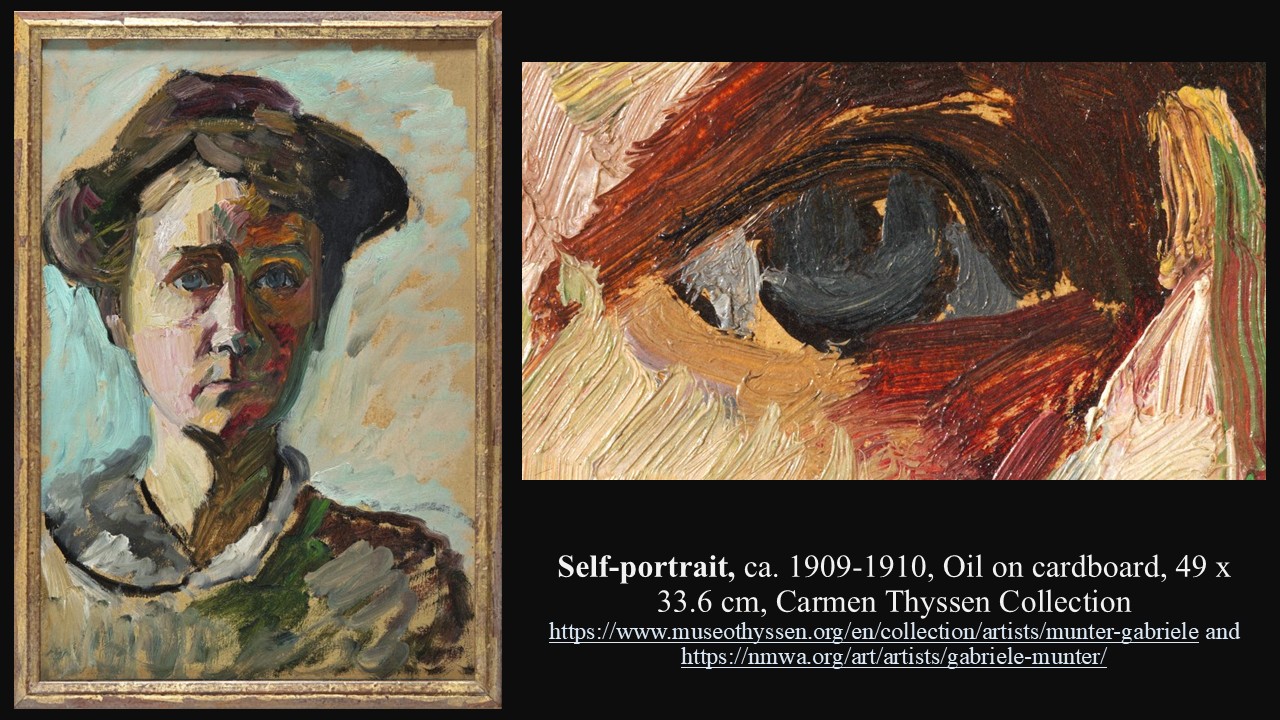
Gabriele Münter's Self-Portrait painting and detail.

Gabriele Münter

Gabriele Münter's Self-Portrait in front of an easel painting
Gabriele Münter, German Artist, 1877–1962
Self-Portrait in front of an easel, ca. 1908–09, Oil on Canvas, 78 × 60.5 cm, Princeton University Art Museum, NJ, USA https://artmuseum.princeton.edu/collections/objects/33606

Gabriele Münter, a key figure in early 20th-century expressionism, once remarked, “I depicted the world the way it essentially appeared to me, how it took hold of me…” This sentiment underscores her ability to channel raw emotion and a deeply personal perspective into her vivid landscapes and striking portraits. Her work, celebrated for its bold use of colour and emotive simplicity, was on display at the Museo Thyssen in Madrid, offering visitors a chance to explore the artistic legacy of a woman who helped shape modern art. As we celebrate April 15 Arts Day—a tribute to creativity’s power to inspire and transform—Münter’s work reminds us of the importance of viewing the world through an authentic, unfiltered lens. https://www.museothyssen.org/en/exhibitions/gabriele-munter and https://www.unesco.org/en/days/world-art

Münter was a German painter and a key figure in early 20th-century Expressionism. Born in Berlin, she displayed an early interest in art and studied at the progressive Phalanx School in Munich, where she met Wassily Kandinsky, with whom she had a long romantic and artistic partnership. Münter was a founding member of Der Blaue Reiter (The Blue Rider), an influential artistic movement that sought to break from traditional academic painting and embrace spiritual and emotional expression through colour and form. During her career, she traveled extensively, experimenting with different artistic styles before settling in Murnau, where her art flourished. Despite facing challenges as a female artist and the disruptions of war, she played a crucial role in preserving many of Der Blaue Reiter’s artworks, which she hid from the Nazis during World War II.

Gabriele Münter's Self-Portrait painting and detail.

Her work is characterized by bold colours, simplified forms, and an emphasis on emotional intensity, aligning her with German Expressionism. While often overshadowed by Kandinsky, her paintings demonstrate a distinct style that merges folk art influences with modernist sensibilities. Her landscapes, such as Autumn in Murnau (1908), feature dynamic compositions and a vibrant palette that convey both structure and spontaneity. She also produced striking portraits that emphasize psychological depth, often using strong outlines and flattened perspectives. Unlike many of her contemporaries, Münter retained a representational quality in her work, balancing abstraction with figuration. Over time, her contributions to modern art have gained greater recognition, securing her place as a pioneering force in early 20th-century avant-garde movements.

Gabriele Münter's Landscape painting.

Gabriele Münter’s Self-Portrait in the Princeton University Art Museum presents a striking image of the artist as both a determined professional and a woman navigating the challenges of the early 20th-century art world. Seated before her easel, she wears a wide-brimmed straw hat—a symbol of her plein-air landscape painting practice—while her intense gaze meets the viewer with quiet confidence. Though still young, her expression conveys resilience and self-assurance, reflecting the perseverance required to establish herself in a male-dominated field. The composition aligns Münter with the great tradition of artists from Rembrandt to Van Gogh, who often depicted themselves at work, reinforcing her identity as a serious painter. Created upon her return to Munich with Kandinsky after years of travel, the portrait also marks her role in shaping modernism as a founding member of the New Artists Association Munich. With its bold yet controlled brushwork and emphasis on psychological depth, this self-portrait asserts Münter’s place within the avant-garde while simultaneously challenging traditional expectations of female artists.

From November 12, 2024, to February 9, 2025, the Museo Nacional Thyssen-Bornemisza in Madrid hosted “Gabriele Münter: The Great Expressionist Woman Painter,” the first retrospective of the German artist in Spain. The exhibition featured over 100 works, including paintings, drawings, prints, and photographs, showcasing Münter’s evolution as a pioneering figure in early 20th-century German Expressionism. It began with her early work as an amateur photographer, highlighting how this modern medium influenced her artistic development. The exhibition then explored her paintings created during travels across Europe and North Africa with her partner, Wassily Kandinsky, and included masterpieces from the Blue Rider period. The final section focused on her exile in Scandinavia during World War I and her subsequent artistic explorations upon returning to Germany. This comprehensive exhibition aimed to shed light on an artist who defied the limitations imposed on women of her time, solidifying her status as a central figure in German Expressionism.

For a PowerPoint Presentation on Gabriele Münter’s oeuvre, please… Check HERE!

Bibliography: https://artmuseum.princeton.edu/story/works-gabriele-m%C3%BCnter

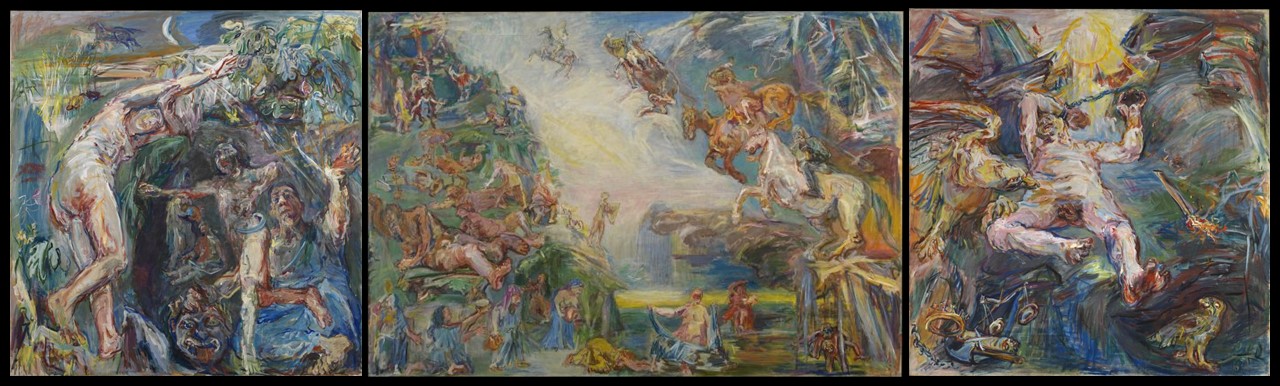
Oskar Kokoschka's Triptych – Hades and Persephone, The Apocalypse, Prometheus

The Prometheus Triptych by Oskar Kokoschka

Oskar Kokoschka's Triptych – Hades and Persephone, The Apocalypse, Prometheus
Oskar Kokoschka, Austrian Artist, 1886-1980
Triptych – Hades and Persephone, The Apocalypse, Prometheus, 1950, © Fondation Oskar Kokoschka/ DACS 2021 https://courtauld.ac.uk/whats-on/oskar-kokoschka-the-myth-of-prometheus/

…And ready-witted Prometheus he bound with inextricable bonds, cruel chains, and drove a shaft through his middle, and set on him a long-winged eagle, which used to eat his immortal liver; but by night the liver grew [525] as much again everyway as the long-winged bird devoured in the whole day. That bird Heracles, the valiant son of shapely-ankled Alcmene, slew; and delivered the son of Iapetus from the cruel plague, and released him from his affliction—not without the will of Olympian Zeus who reigns on high, [530] that the glory of Heracles the Theban-born might be yet greater than it was before over the plenteous earth… If Hesiod’s words laid the foundation and introduced the Myth of Prometheus to his readers back in the 7th century BC, The Prometheus Triptych by Oskar Kokoschka brought the tale into the modern era, creating a forceful and compelling resonance! https://www.perseus.tufts.edu/hopper/text?doc=Perseus%3Atext%3A1999.01.0130%3Acard%3D507

Oscar Kokoschka’s 1950 Triptych, a profound exploration of the human condition through his distinctive expressionist style, was commissioned by the Anglo-Austrian art collector Count Antoine Seilern. The masterpiece was intended to adorn the entrance hall ceiling of Seilern’s London house in South Kensington, and Kokoschka, working diligently, dedicated over six months to its creation. In a reflective note on July 15, the artist expressed the significance of completing the monumental work, stating… I put the last brush-stroke (I feel like saying axe-stroke) to my ceiling painting yesterday… This is perhaps my last big painting, and perhaps it’s my best… Count Seilern later bequeathed the Prometheus Triptych, along with his remarkable collection of old master paintings and drawings, to The Courtauld in 1978. https://courtauld.ac.uk/whats-on/oskar-kokoschka-the-myth-of-prometheus/

Oskar Kokoschka's Triptych – Hades and Persephone
Oskar Kokoschka, Austrian Artist, 1886-1980
Triptych – Hades and Persephone, 1950, © Fondation Oskar Kokoschka/ DACS 2021 https://courtauld.ac.uk/whats-on/oskar-kokoschka-the-myth-of-prometheus/

This monumental triptych reflects Kokoschka’s profound engagement with the existential and psychological dimensions of his subjects. The three panels, Hades and Persephone, The Apocalypse and Prometheus, unfold a visual narrative that is both intimate and universal, capturing the complexities of human relationships, emotions, and the existential journey. Painted after the painful years of the Second World War and during the beginning of the Cold War era, Kokoschka’s Triptych serves as a cautionary tale against human intellectual arrogance, embodied by Prometheus on the right, whose audacious act of stealing fire to empower humanity led to his eternal punishment by Zeus. The central panel depicts a vivid scene from St John’s Apocalypse with the four horsemen heralding the Last Judgment. On the left, a tale of regeneration unfolds as Persephone escapes Hades, portrayed as Kokoschka himself, with assistance from her mother Demeter, standing between them.

Oskar Kokoschka's Triptych – The Apocalypse
Oskar Kokoschka, Austrian Artist, 1886-1980
Triptych – The Apocalypse, 1950, © Fondation Oskar Kokoschka/ DACS 2021 https://courtauld.ac.uk/whats-on/oskar-kokoschka-the-myth-of-prometheus/

Painted on an epic scale, The Prometheus Triptych is, according to the Courtauld experts, one of Kokoschka’s most ambitious compositions… and intended to be a demonstration of the possibilities of figurative painting. Figures contort and intertwine, conveying a sense of tumultuous upheaval and spiritual crisis. The artist’s use of symbolism and distorted forms adds an otherworldly dimension to the composition, inviting viewers to grapple with the profound and unsettling aspects of the human experience. Prometheus Triptych stands as a testament to Kokoschka’s ability to infuse his work with profound emotion and existential inquiry, providing a gripping interpretation of a timeless and weighty theme. https://courtauld.ac.uk/whats-on/oskar-kokoschka-the-myth-of-prometheus/

Oskar Kokoschka's Triptych – Prometheus
Oskar Kokoschka, Austrian Artist, 1886-1980
Triptych – Prometheus, 1950, © Fondation Oskar Kokoschka/ DACS 2021 https://courtauld.ac.uk/whats-on/oskar-kokoschka-the-myth-of-prometheus/

The artist’s use of bold brushstrokes, intense colours, and dynamic compositions infuses the Triptych with a visceral energy, inviting viewers to delve into the depths of the artist’s emotional and intellectual exploration. Through this commissioned work, Kokoschka not only pays homage to the tradition of the triptych but also showcases his continued commitment to pushing artistic boundaries and expressing the human experience in a profoundly evocative manner.

For a Student Activity inspired by The Prometheus Triptych by Oskar Kokoschka, please… Check HERE!