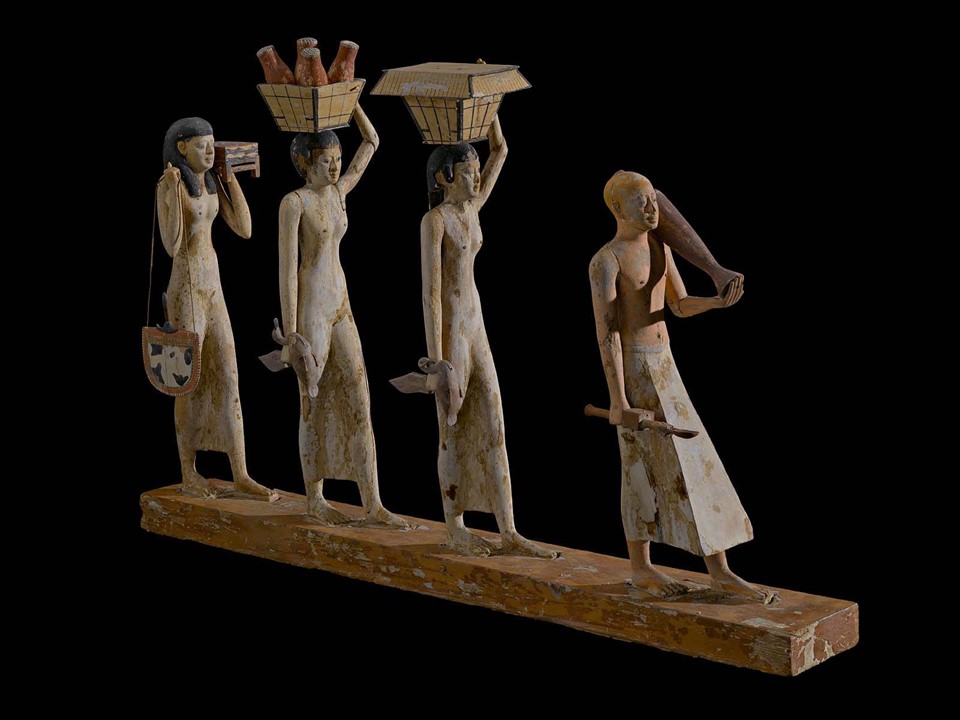
The Bersha Procession, Middle Kingdom, late 11th Dynasty–early 12th Dynasty, 122010–1961 BC, Egypt, Deir el-Bersha, Tomb 10, shaft A (Djehutynakht), Painted Wood, 66.4 x 8.6 x 42.5 cm, MFA, Boston, MA, USA

The Bersha Procession

The Bersha Procession, Middle Kingdom, late 11th Dynasty–early 12th Dynasty, 122010–1961 BC, Egypt, Deir el-Bersha, Tomb 10, shaft A (Djehutynakht), Painted Wood, 66.4 x 8.6 x 42.5 cm, MFA, Boston, MA, USA
https://gr.pinterest.com/pin/670473463254087082/?nic_v3=1a7FXhvpJ

In a 1915 excavation, archaeologists from the Harvard University-Boston Museum of Fine Arts Expedition discovered, explain the MFA experts, the entrance to a tomb at the picturesque site of Deir el-Bersha in Egypt. Inside, the MFA team found, in jumbled array, the largest burial assemblage of the Middle Kingdom (2040-1640 BC) ever discovered. The tomb, designated Tomb 10A, was filled with the funerary equipment of a local governor by the name of Djehutynakht and his wife, also named Djehutynakht. Robbers had stolen the finest jewels but left everything else, including the severed (but nicely wrapped and painted) head of one of the Djehutynakhts. The tomb contained four beautifully painted coffins, one of which, the famous “Bersha coffin” (the outer coffin of the governor), is arguably the finest painted coffin Egypt produced and a masterpiece of panel painting. The tomb also included Djehutynakht’s walking sticks, pottery, canopic jar, and miniature wooden models that were made for the burial but reflect life on Djehutynakht’s estate, including some 58 model boats and nearly three dozen models of daily life such as individual shops for carpenters, weavers, brick-makers, bakers, and brewers. Of these, the best known is the exquisitely carved Bersha procession of a male priest leading female offering bearers.  https://www.mfa.org/exhibitions/secrets-tomb-10a

During the Middle Kingdom, and for reasons we do not know, a new trend occurred in Egyptian burial customs. Miniature models made of wood, a less costly material, were manufactured in large numbers and placed in the burial chamber to furnish provisions for the deceased in the afterlife. In symbolically providing for the tomb owner’s needs, the models functioned in much the same way as painted scenes of these activities did on the walls of tomb chapels. https://collections.mfa.org/objects/143887

A variety of boats, food products, craftsmen and workshops, soldiers, servants, house models, and agricultural activities, are among the most popular representations. They are three-dimensional, and small in size, made out of wood, and colorfully painted. The fact is that the artistic quality of these models varies. However, the Middle Kingdom funerary models are precious as they convey a liveliness and energy that give us a sense of the bustling activities of Egyptian daily life. They also demonstrate innovative poses and subjects that would never have been attempted in the more formal sculptures that represented the tomb owner and his family. https://collections.mfa.org/objects/143702/model-of-a-granary;jsessionid=2E377953D2424D2AFEA2C5AB2332B8C7?ctx=bc58e347-f685-466f-8431-dabc79fda065&idx=32
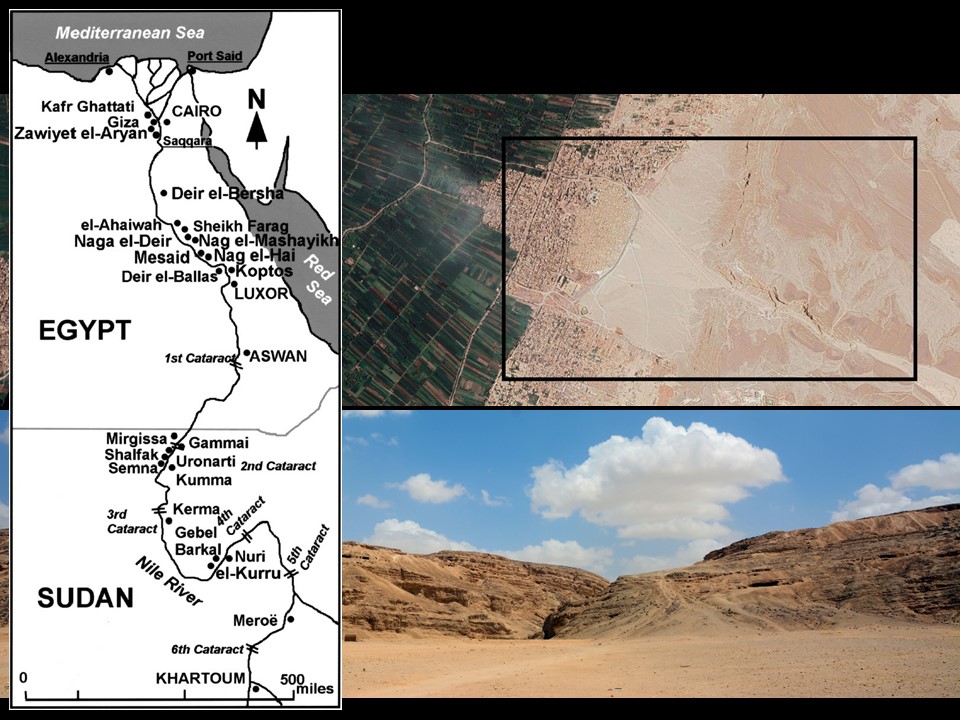
The Deir el-Bersha region in Egypt
The Deir el-Bersha region https://cool.culturalheritage.org/jaic/articles/jaic42-02-003.html and https://www.arts.kuleuven.be/dayr-al-barsha/project-sites

The Tomb of Djehutynakht put on view the largest collection of wooden models ever discovered in Egypt. The archaeologists, excavating the site in May 1915, discovered the ransacked Tomb of a local governor, stripped of all precious artifacts except humble items of clay, wood, and paint. They discovered 58 model boats and nearly three dozen models of daily life such as individual shops for carpenters, weavers, brick-makers, bakers, and brewers. Of these, the best known is the exquisitely carved Bersha Procession of a male priest leading female offering bearers. https://www.mfa.org/exhibitions/secrets-tomb-10a
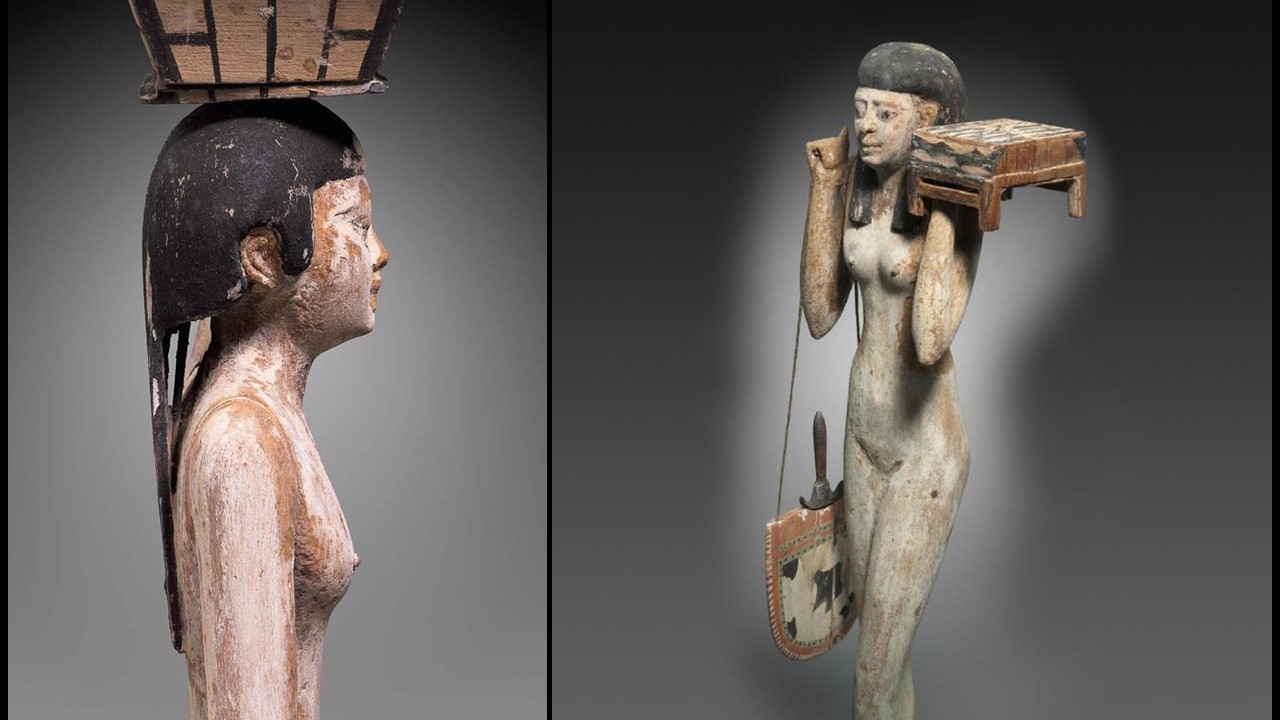
The Bersha Procession, 2010–1961 BC, Egyptian Middle Kingdom, late Dynasty 11 – early Dynasty, Findspot: Egypt, Deir el-Bersha, Tomb 10, shaft A (Djehutynakht), Painted Wood,  66.4 x 8.6 x 42.5 cm, MFA, Boston, USA
https://gr.pinterest.com/pin/405886985159696252/ and https://www.reddit.com/r/AgeofBronze/comments/qhkhq8/procession_of_offering_bearers_egypt_deir/

The MFA experts believe that the Bersha Procession stands out in every aspect. The skill and delicacy with which it was carved, and painted, they state, rank it among the finest wooden models ever found in Egypt. https://collections.mfa.org/objects/143592/model-of-a-procession-of-offering-bearers-the-bersha-proce?ctx=913074da-57e1-4b97-86d5-d4064c9e2c0e&idx=26
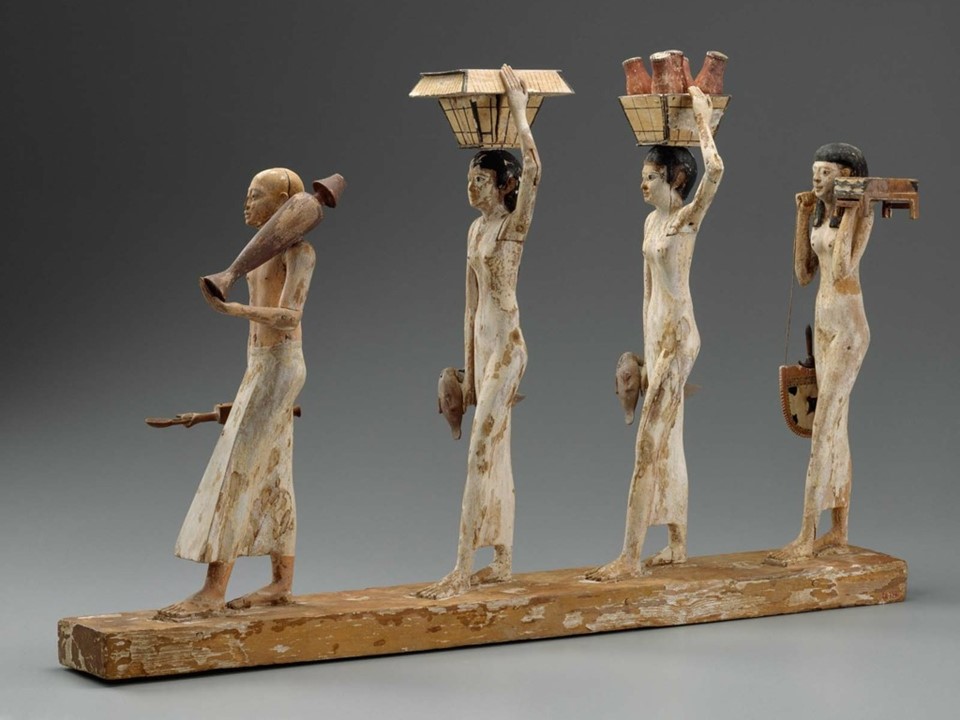
The Bersha Procession, 2010–1961 BC, Egyptian Middle Kingdom, late Dynasty 11 – early Dynasty, Findspot: Egypt, Deir el-Bersha, Tomb 10, shaft A (Djehutynakht), Painted Wood,  66.4 x 8.6 x 42.5 cm, MFA, Boston, USA
The Bersha Procession, 2010–1961 BC, Egyptian Middle Kingdom, late Dynasty 11 – early Dynasty, Findspot: Egypt, Deir el-Bersha, Tomb 10, shaft A (Djehutynakht), Painted Wood,  66.4 x 8.6 x 42.5 cm, MFA, Boston, SA
https://www.facebook.com/photo?fbid=1926909784017802&set=pcb.1926910000684447

The composition is simple, yet elegant, finely carved and subtly painted. Four figures, a man and three women ‘march’ towards the deceased Djehutynakht bringing offerings to sustain his Ka in the afterlife. They bring him food, drink, items of personal adornment, and the incense used to attract and appease divinities and the blessed dead. https://collections.mfa.org/objects/143592/model-of-a-procession-of-offering-bearers-the-bersha-proce?ctx=913074da-57e1-4b97-86d5-d4064c9e2c0e&idx=26

Simply put, I am completely awestruck by the high quality of craftsmanship and anecdotal details of the Bersha Procession model. So much so, that I dream of visiting the MFA once more!

For a PowerPoint on the contents of the Djehutynakht’s Tomb (Tomb 10A), please… Check HERE!

For a Student Activity inspired by the Bersha Procession, please… Check HERE!

The Boston Museum of Fine Arts received the contents of Djehutynakht’s tomb (Tomb 10A) as a gift from the Egyptian government for their assistance in the 1915 excavation. Since 1920 the Bersha finds are in Boston. https://www.mfa.org/exhibitions/secrets-tomb-10a
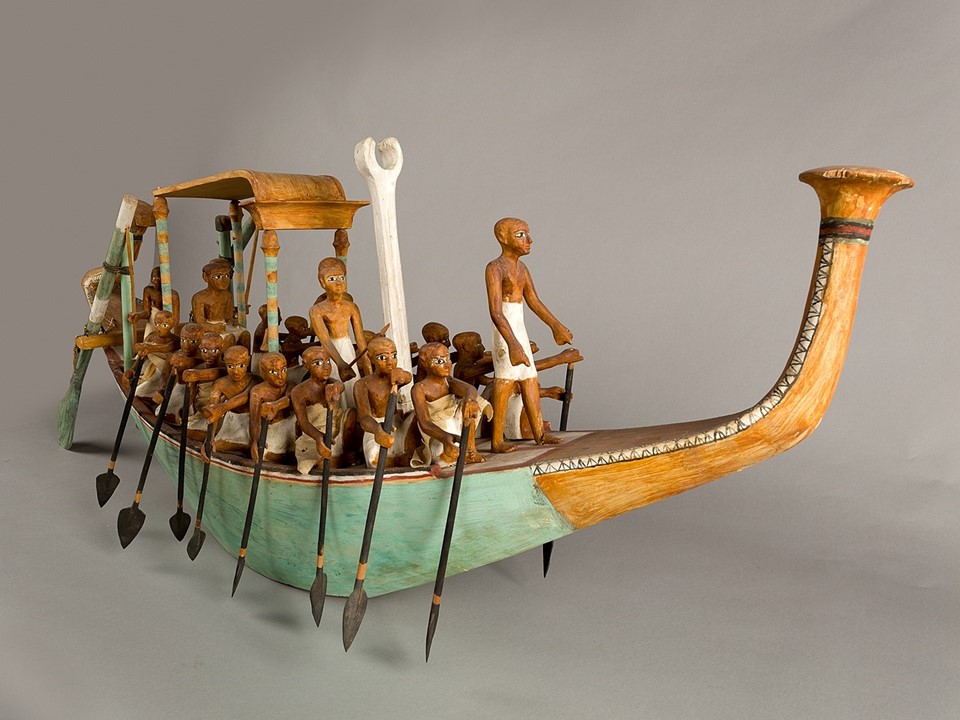
Model of a Boat from the Tomb of Meketre  12th Dynasty, ca. 1981–1975 BC, Wood, paint, plaster, linen twine, linen fabric, Length: 132.5 cm, the MET, NY, USA

The dynamic Middle Kingdom

Model of a Boat from the Tomb of Meketre  12th Dynasty, ca. 1981–1975 BC, Wood, paint, plaster, linen twine, linen fabric, Length: 132.5 cm, the MET, NY, USA
https://en.wikipedia.org/wiki/Wooden_tomb_model#/media/File:Model_Paddling_Boat_MET_20.3.5_EGDP011930.jpg

The dynamic reunification of the Two Lands in ancient Egypt, in the period we call the Middle Kingdom, created new requirements for the Egyptian Pharaohs. No longer an aloof divine representative of the gods on earth, the king in the Middle Kingdom was expected to be more available to the people. This period also saw increased interactions with the outside world, the re-establishment of connections with Syria to the north and the establishment of forts reaching south deep into Nubia. Rich in literature (often of great knowledge and wit), this era also produced exquisite works of art. The cult of Osiris grew as did the number of Egyptians who could equip themselves for the afterlife, what we might recognize as a “middle class.” The dynamic Middle Kingdom represents an amazing period in Egyptian history worth exploring… https://smarthistory.org/middle-kingdom-and-second-intermediate-period-introduction/

Four Steps to Success Lesson Plan for Middle Kingdom Art

During the Middle Kingdom, a period stretching from about 2040 to 1650 BC, Egyptian cultural principles were reimagined. We will start with my Steps to Success Lesson Plan Outline… our Goal is to “travel” through the Middle Kingdom timeline and discuss aspects of cultural and social developments, changes in religious perspectives, and new artistic viewpoints. Let’s not forget that the Middle Kingdom is considered by some scholars the ‘classical’ period of the ancient Egyptian era.

Credited with reuniting Egypt, Mentuhotep II of the 11th Dynasty, brought back peace and prosperity to Egypt and became the first Pharaoh of the Middle Kingdom. During the extended period of his reign, a unique burial complex in Deir el-Bahri was constructed, and a fresh style in Pharaonic representation took shape. By the end of the 12th Dynasty art production reached new heights in architecture, sculpture, painting, relief decoration, and jewelry.

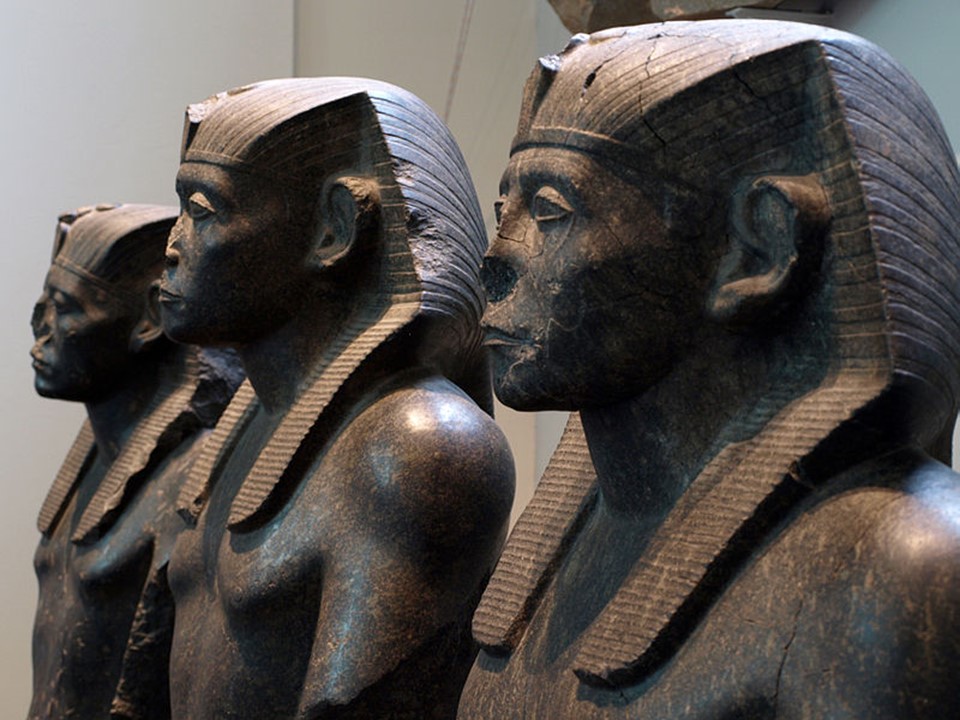
Statues of Senusret or Sesostris or Senworset III, 12th Dynasty, c. 1878-1839 BC, Granodiorite, Height: 122 cents, British Museum, London, UK
https://en.wikipedia.org/wiki/Senusret_III  

If the art of the Old Kingdom appears majestic and confident, let’s not forget the solid stone pyramids, and the youthful, serene, self-assured statues of the pharaohs, the new Middle Kingdom era captivates us with its sense of maturity, and realism. The key development in art is the invention of the Portrait. The transition towards a humanizing tendency in portraiture is captivating. The Portrait of Senwosret III is a good example, as the ruler seems to have consciously chosen to represent his humanity rather than an idealized image of eternal kingship.

Fascinating is the Middle Kingdom’s penchant for symbolic jewelry. The cloisonné pectoral of Princess Sithathoryunet, for example, is astounding. Inlaid with 372 carefully cut pieces of semiprecious stones the pectoral presents us with high-quality craftsmanship and a new  Egyptian love for rendering detail… even on the back part of a jewelry piece, the part visible solely to the Egyptian who wore it!

Finally, the increase in the number of private monuments, like the rock-cut tombs in Beni Hasan, the lavish fresco decoration on the walls of these monuments, and the vast production of simple, yet enchanting, funerary gifts like the wood models of workshops, food-production facilities, and domestic structures, is compelling. It shows that a group of talented workmen served the provincial ‘aristocracy’ with fine quality work in every medium, suggesting that during the Middle Kingdom afterlife was ‘democratized’ to allow nonroyal individuals access to a different type of afterlife, and a wider range of ‘available’ symbols to use.

For the PowerPoint ‘The Art of the Middle Kingdom’, please… Check HERE!

For the Middle Kingdom Timeline, please… please Check HERE!

Learn about Pharaoh Mentuhotep II and his achievements through a DW World History Videohttps://www.youtube.com/watch?v=KNArI5Y8MOg

Watch a Video about the small MET Model of an Offering Lady  Bearer from the Tomb of Meketrehttps://www.youtube.com/watch?v=B4k9JklNrTk

The Art of Ancient Egypt: A Resource for Educators is very informative and easy to download… https://www.metmuseum.org/art/metpublications/The_Art_of_Ancient_Egypt_A_Resource_for_Educators