Bottom of a Gold Sandwich-Glass Vase with representation of a Christian Martyr, Mid-4th century AD

Gold Sandwich-Glass Vase at the Canellopoulos Museum

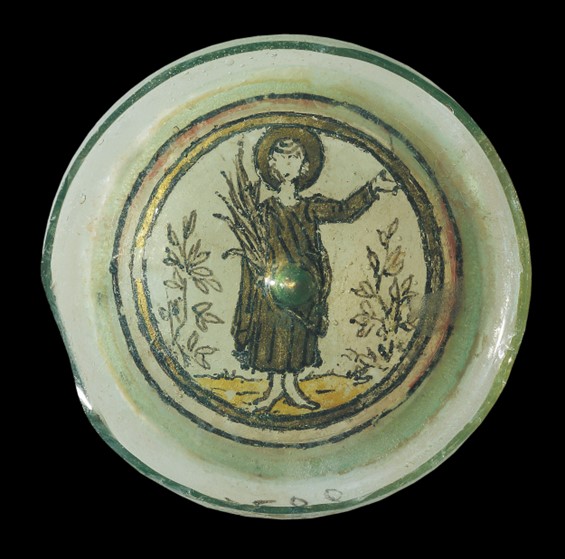
Bottom of a Gold Sandwich-Glass Vase with representation of a Christian Martyr, Mid-4th century AD
Bottom of a Gold Sandwich-Glass Vase with representation of a Christian Martyr, Mid-4th century AD, Diam. 4,9 cm., Canellopoulos Museum, Athens, Greece https://camu.gr/en/item/pythmenas-amfyalou-chrysografimenou-angeiou/

The Gold Sandwich-Glass Vase at the Canellopoulos Museum in Athens is a truly rare and precious exhibit. Also referred to as Verre Églomisé, Gold Sandwich-Glass is a decorative technique with a rich history dating back to antiquity, used to craft stunning and opulent objects. The example on display at the Canellopoulos Museum stands as a unique treasure in Greece, inviting keen exploration and admiration!

Displayed at the Canellopoulos Museum in Athens, Greece, this remarkable piece is organized within a tondo, defined by concentric rings, and embellished with gold leaf in the space between the innermost pair. The composition takes on a triangular form, exhibiting simplicity, stability, and balance. Positioned at the very center of the tondo is a male figure, devoid of a beard but adorned with a luminous halo. In his lowered right hand, he clasps a palm branch, a Christian symbol of victory over death, while his left hand extends upward in a gesture of acclamation. The figure, portrayed in a strikingly naturalistic manner, stands upright and is flanked by laurel bushes on either side. The combination of brown hues and gold against a background of transparent glass creates an aethereal, and delicate composition, suitable for a religious shallow bowl (phiale).

According to Constantine Scampavias, the Canellopoulos Museum expert… Although the piece is not inscribed, the halo and the palm branch (as well as the two bushes if they are laurels) identify the figure as a Christian martyr. Perhaps it is the martyr Gereon, whose cult was widespread in the Rhineland and particularly in Cologne, where this bowl was possibly made. https://camu.gr/en/item/pythmenas-amfyalou-chrysografimenou-angeiou/

The Gold Sandwich-Glass technique was particularly popular throughout the Roman Empire during the 4th century AD. Images in this technique were etched in gold leaf and then, the leaf was fused between two layers of glass… like a sandwich! Items of Gold Glass were usually created into circular bottoms of luxurious drinking vessels since the Hellenistic period. A popular practice for the Romans of the later period, was to cut out the Gold Glass decorated roundel of a cup and cemented it to the wall of a catacomb Grave to serve as a grave marker for the small recesses where bodies were buried. In Rome, where this practice was particularly popular, archaeologists discovered over 500 pieces of Gold Glass used in this way. Decoration themes for Gold Sandwich-Glass items vary from pagan mythology and portraits to purely Jewish or Christian imagery. Chapter 13 Making Late Antique Gold Glass by Daniel Thomas Howells, pp.112-120https://webarchive.nationalarchives.gov.uk/20190801105206/https://www.britishmuseum.org/research/publications/research_publications_series.aspx#AllResearchPublications

For a PowerPoint on 10 artifacts of Gold Sandwich-Grass, please… Check HERE!

A Teacher Curator POST, on another famous Gold Sandwich-Glass roundel, titled Portrait Medallion of Gennadioshttps://www.teachercurator.com/uncategorized/portrait-medallion-of-gennadios/?fbclid=IwAR2gufFAvOMcFrz9j2sGH55wP-ajBQUA4ELpGgXpTpp-SRTXMIzyr0GUVTw

A wonderful Video on the Gold Sandwich-Glass making technique created by the Corning Museum of Glass https://www.youtube.com/watch?v=ALNMn6DGQJg
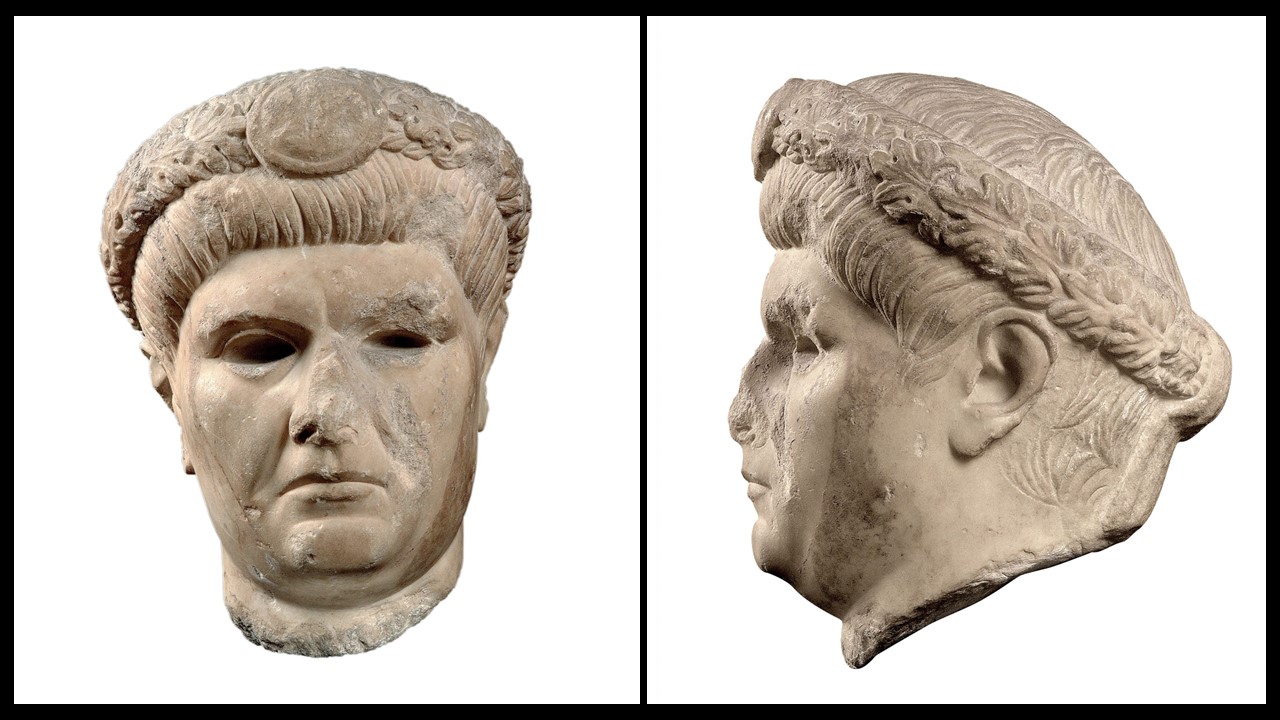
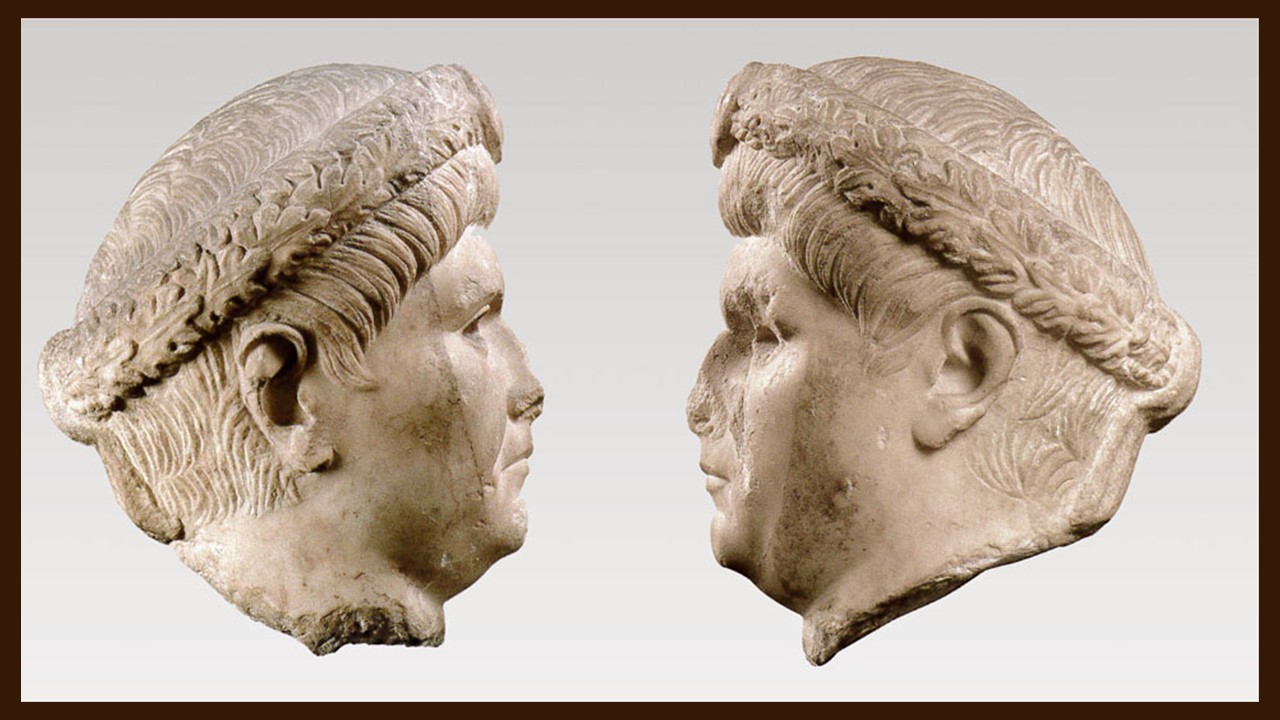
Portrait of the Emperor Galerius from an over life-sized statue, 310 AD, 27x17,9 cm, Canellopoulos Museum, Athens, Greece

Emperor Gaius Galerius Valerius Maximianus

Portrait of the Emperor Galerius from an over life-sized statue, 310 AD, 27x17,9 cm, Canellopoulos Museum, Athens, Greece
Portrait of the Emperor Galerius from an over life-sized statue, 310 AD, 27×17,9 cm, Canellopoulos Museum, Athens, Greece https://camu.gr/en/item/portraito-tou-aftokratora-galeriou/

…Constantius and Galerius were made emperors; and the Roman world was divided between them in such a manner, that Constantius had Gaul, Italy, and Africa; Galerius Illyricum, Asia, and the East… Galerius, a man of excellent moral character, and skillful in military affairs, finding that Italy, by Constantius’s permission, was put under his government, created two Caesars, MAXIMIN, whom he appointed over the east, and SEVERUS, to whom he committed Italy. He himself resided in Illyricum… wrote Eutropius in Book X of Abridgement of Roman History about Emperor Gaius Galerius Valerius Maximianus. https://www.forumromanum.org/literature/eutropius/trans10.html

In the Epitome De Caesaribus, a booklet about the Style of Life and the Manners of the Imperatores, sometimes attributed to Sextus Aurelius Victor, Emperor Galerius is described as …possessed of an uncultivated and rustic justice…he was, however, the author continues,  praiseworthy enough, physically attractive, a skilled and fortunate warrior, sprung from country parents, a keeper of cattle, whence for him the cognomen Armentarius [“Herdsman”]. 16. He was born and also buried in Dacia Ripensis, a place which he had called Romulianum from the name of his mother, Romula. 17. He insolently dared to affirm that, in the fashion of Olympias, the mother of Alexander the Great, his mother had conceived him after she had been embraced by a serpent. http://roman-emperors.sites.luc.edu/epitome.htm

Living in Thessaloniki, where numerous buildings and structures commissioned by Galerius still grace the cityscape, serving as popular attractions, I find it necessary to introduce you to Emperor Gaius Galerius Valerius Maximianus, commonly referred to as Galerius. He held the position of Roman Emperor within the Tetrarchy system, a governance framework established by Emperor Diocletian, which partitioned the Roman Empire into four co-ruling territories. Galerius, during his rule as Augustus from 305 to 311 AD, gained renown for his multifaceted role within the Tetrarchy, his involvement in the Christian persecutions of the early 4th century, and his military campaigns waged against the Sassanid Empire and hostile Danube frontier tribes.

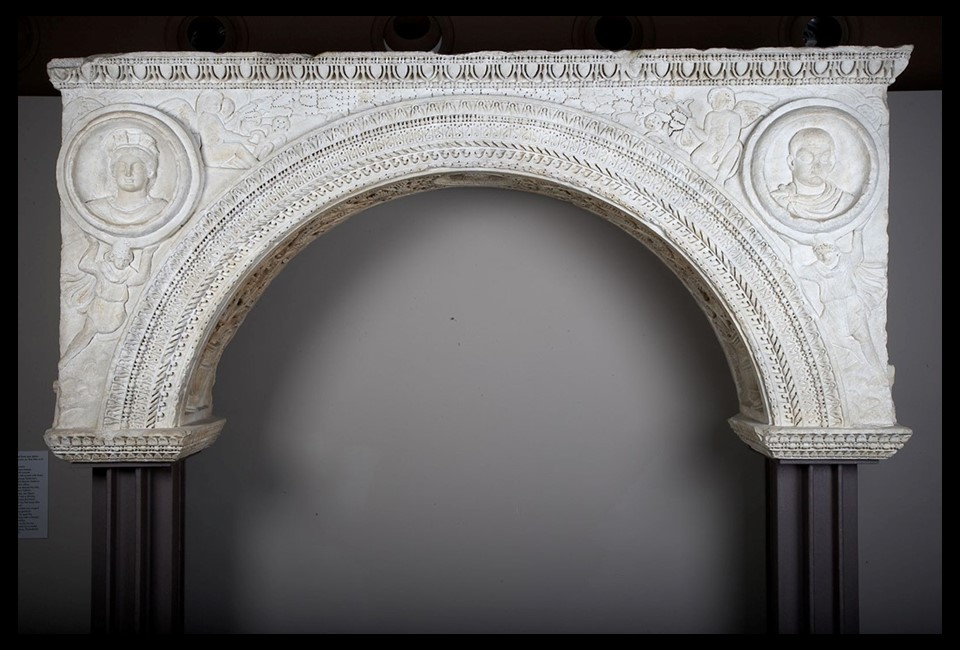
From the Octagon in the Palace of Galerius in Thessaloniki: “The Small Arch of Galerius”, Archaeological Museum of Thessaloniki, Greece
From the Octagon in the Palace of Galerius in Thessaloniki: “The Small Arch of Galerius”, Archaeological Museum of Thessaloniki, Greece https://www.amth.gr/en/exhibitions/highlights

Much like many of his predecessors, Galerius was prominently featured in a multitude of portraits and statues throughout his reign. These artistic representations consistently cast him as a strong and unwavering leader, characterized by stern expression and adorned with intricate military regalia. Beyond their artistic merit, these depictions held profound historical value, serving as windows into the prevailing culture and politics of the Roman Empire during his rule. Moreover, they afford us a glimpse into the nuanced strategies employed by emperors to project their influence and command, shedding light on the perceptions held by their subjects and contemporaries.

Portrait of the Emperor Galerius from an over life-sized statue, 310 AD, 27x17,9 cm, Canellopoulos Museum, Athens, Greece
Portrait of the Emperor Galerius from an over life-sized statue, 310 AD, 27×17,9 cm, Canellopoulos Museum, Athens, Greece https://camu.gr/en/item/portraito-tou-aftokratora-galeriou/

Upon encountering his portrait at the Canellopoulos Museum in Athens, I was truly taken aback. Galerius appeared notably advanced in age, likely in the twilight of his life, exuding an aura of austerity, distance, and impassivity. Gazing upon his face, one can vividly sense the gravity of his station. Despite, however, the impression of weariness, detachment, and aloofness, the Emperor unmistakably embodies the quintessential image of an absolute monarch within the Tetrarchy – a power deserving of the most serious consideration!

For a PowerPoint of Portraits depicting Emperor Galerius, please… Check HERE!