Old Hall, Queen’s College, The Hall’s Fireplace, January

Fireplace Artistry and Overmantel Splendor at Queens’ College

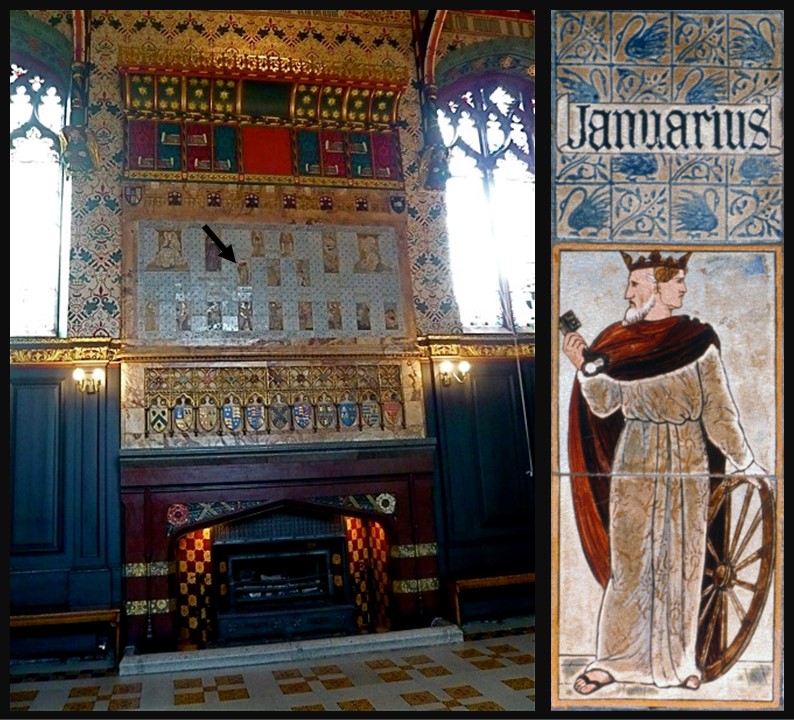
Old Hall, Queen’s College, The Hall’s Fireplace, January
Old Hall, Queen’s College, The Hall’s Fireplace, Cambridge, UK https://www.flickr.com/photos/costi-londra/2670523596
January, designed possibly by Edward Burne-Jones (1833-1898), or possibly by William Morris (1834 – 3 October 1896) https://www.queens.cam.ac.uk/visiting-the-college/history/college-facts/the-buildings/morris-co-tiles

Step into the enchanting world of this English Medieval Ballad, where each stanza unfolds the rhythm of the passing months, offering a vivid glimpse into the seasonal activities of a bygone era. The verses paint a pastoral tableau, capturing the essence of daily life through the lens of nature’s cycles… Januar By thys fyre I warme my handys; / Februar And with my spade I delfe my landys. / Marche Here I sette my thynge to sprynge; / Aprile And here I here the fowlis synge. / Maij I am as lyght as byrde in bowe; / Junij And I wede my corne well I-now. / Julij With my sythe my mede I mawe; / Auguste And here I shere my corne full lowe. / September With my flayll I erne my brede; / October And here I sawe my whete so rede. / November At Martynesmasse I kylle my swyne; / December And at Cristesmasse I drynke redde wyne… next, step into the pictorial world of the Arts and Crafts Movement and the splendid Fireplace Artistry and Overmantel Splendor at Queens’ College, in Cambridge.

Morris, Marshall, Faulkner & Co. was a notable design and decorative arts firm that operated in England during the second half of the 19th century. The company was founded in 1861 by a group of artists and designers, including William Morris, Edward Burne-Jones, Ford Madox Brown, Dante Gabriel Rossetti, Philip Webb, Charles Faulkner, and Peter Paul Marshall. The firm played a crucial role in the Arts and Crafts Movement, which emerged as a reaction to the Industrial Revolution and mass production. The firm’s influence extended beyond its immediate time, and its principles had a lasting impact on design and the decorative arts. The emphasis on quality craftsmanship and the use of natural materials became enduring themes in subsequent design movements.

Old Hall, Queen’s College, The Hall’s Fireplace ceramic Tiles
Artists collaborating with Morris, Marshall, Faulkner & Co., UK Company, 1861–1875
Overmantel Panel decorated with ceramic Tiles depicting the two Queens’ College foundress queens, the two patron saints, the Angel of Night, the Angel of Day, and a Labour of the Month for each of the twelve months, Installed in 1864, modified in 1873, in 1875, Old Hall, Queen’s College, Cambridge, UK https://www.queens.cam.ac.uk/visiting-the-college/history/college-facts/the-buildings/morris-co-tiles

Queens College is one of the constituent colleges of the University of Cambridge in England. The college was founded in 1448 by Margaret of Anjou, the Queen of Henry VI. The Old Hall is one of the oldest, most notable buildings within the college. It is located on the college’s main site, known as the Old Court. The Hall was originally constructed in the late 15th century and has undergone various modifications and renovations over the centuries. It serves various functions, including dining, events, and ceremonies. https://www.queens.cam.ac.uk/visiting-the-college/history/college-facts/the-buildings/old-hall-chronology

In 1861–4, the Hall’s classical fireplace was removed, and a new fireplace was erected, designed by the architect G.F. Bodley, of alabaster and tiles… the decoration of which includes a red rose (House of Lancaster: Henry VI and Margaret of Anjou), a white rose (House of York: Edward IV and Elizabeth Woodville), and the college’s motto: Floreat Domus. Painted above the fireplace, Philip Webb designed the eleven coats of arms of the college’s founders, foundresses, and benefactors. Further up, in 1864, a composition of painted tiles created by the artists of Morris, Marshall, Faulkner & Co. were installed as an overmantel decorative piece which by 1873 depicted the two foundress queens, the two patron saints, the Angel of Night, the Angel of Day, and a Labour of the Month for each of the twelve months of the year. The spaces between the represented figures are filled by tiles decorated with a swan design in blue. The tiles of this design, which appear for the first time around 1863-64, are divided by a linear grid into squares, in which a stylized swan alternates with a diagonally-placed twig. The entire tile panel is framed by a border with a foliate pattern in blue. https://www.queens.cam.ac.uk/visiting-the-college/history/college-facts/the-buildings/old-hall-chronology and https://www.queens.cam.ac.uk/files/downloads/tile_decoration_by_morris_and_co_0.pdf

According to Dr. Michaela Braesel, the popular representations of the Labours of the Months, with their lettered scrolls, were inspired by 15th-century Calendars found in Books of Hours at the University Library. The tiles produced by Morris, Marshall, Faulkner & Co. were created by various artists collaborating with the company. While some tiles can be confidently attributed to specific Company artists, the exact attribution for others, such as January, remains uncertain.

Today, on January 1, 2024, we turn our attention to the January scene, the most surprising of all the tiles featured in the Queens’ College fireplace panel. Designed either by Edward Burne-Jones or William Morris, it presents an unusual depiction within a calendar context—the ancient Roman god Janus holding a key and a wheel. Janus is associated with doorways, gates, transitions, and beginnings. Depicted with two faces, one looking forward and the other backward, this duality symbolizes his role as a god of both beginnings and endings, as well as his ability to perceive both the past and the future.

Old Hall, Queen’s College, The Hall’s Fireplace, January
January, designed possibly by Edward Burne-Jones (1833-1898), or possibly by William Morris (1834 – 3 October 1896) https://www.queens.cam.ac.uk/visiting-the-college/history/college-facts/the-buildings/morris-co-tiles

One of Janus’s two heads is turned towards the old year and is characterized as an old bearded king, while the other, which looks to the future, shows a young king in profile. In his right hand, correctly depicted by either Morris or Burne Jones, Janus holds his traditional attribute, a key, while his left hand is shown resting on a wheel. The key signifies the end of the previous year, while the wheel might possibly hint at the wheel of Fortune, since what the coming year will bring remains unknown. https://www.queens.cam.ac.uk/files/downloads/tile_decoration_by_morris_and_co_0.pdf

As a guardian of entrances and exits, Janus was invoked at the commencement of significant events and ceremonies. The first month of the year, January, is named after him. In addition to his association with time and transitions, Janus was also regarded as a god of diplomacy and peace, as he could oversee and facilitate communication between different phases or states.

Janus was perfectly chosen, in my humble opinion, to mark the beginning of the New Year. Allow me to use his attributes and wish you all… Peace, a bright Future, and a Happy New Beginning!

For a PowerPoint on all Morris, Marshall, Faulkner & Co. Tiles for the Old Hall, Queens’ College, Overmantel Fireplace Panel, fully identified and explained, please… Check Here!

Sir Lawrence Alma-Tadema, A Coign of Vantage (detail), 1895 and The Sphinx at Villa San Michele, approximately 3200 years old, Red Granite, Villa San Michele, Anacapri

A Coign of Vantage by Sir Lawrence Alma-Tadema

Sir Lawrence Alma-Tadema, O.M., R.A., R.W.S., Anglo-Dutch Artist, 1836-1912
A Coign of Vantage, 1895, Oil on Canvas, 63.8 x 44.7 cm, Private Collection
Sir Lawrence Alma-Tadema, O.M., R.A., R.W.S., Anglo-Dutch Artist, 1836-1912
A Coign of Vantage, 1895, Oil on Canvas, 63.8 x 44.7 cm, Private Collection https://www.telegraph.co.uk/art/what-to-see/alma-tadema-home-antiquity-leighton-house-museum-review/

Sir Lawrence Alma-Tadema was a renowned Dutch-born British painter who had a profound interest in Roman antiquity. He was one of the leading artists of the late 19th century and early 20th century, specializing in historical and classical subjects. Alma-Tadema’s fascination with Roman antiquity was central to his artistic vision and played a significant role in shaping his career. The painting A Coign of Vantage by Sir Lawrence Alma-Tadema, regarded as one of the artist’s quintessential masterpieces, is a favourite of mine! SIR LAWRENCE ALMA-TADEMA, O.M., R.A., R.W.S. (BRITISH, 1836-1912) (christies.com)

The painting A Coign of Vantage by Sir Lawrence Alma-Tadema has an interesting title! The phrase comes from Shakespeare’s Macbeth, no jutty, frieze, Buttresss, nor coign of vantage, but this bird Hath made his pendent bed and was later popularized by Sir Walter Scott. The word coign, meaning a projecting corner or cornerstone, is a variant of the coin from Old French meaning ‘wedge, corner, die’, from Latin cuneus ‘wedge’. Sir Lawrence Alma-Tadema’s painting is perfectly titled! https://www.encyclopedia.com/humanities/dictionaries-thesauruses-pictures-and-press-releases/coign-vantage

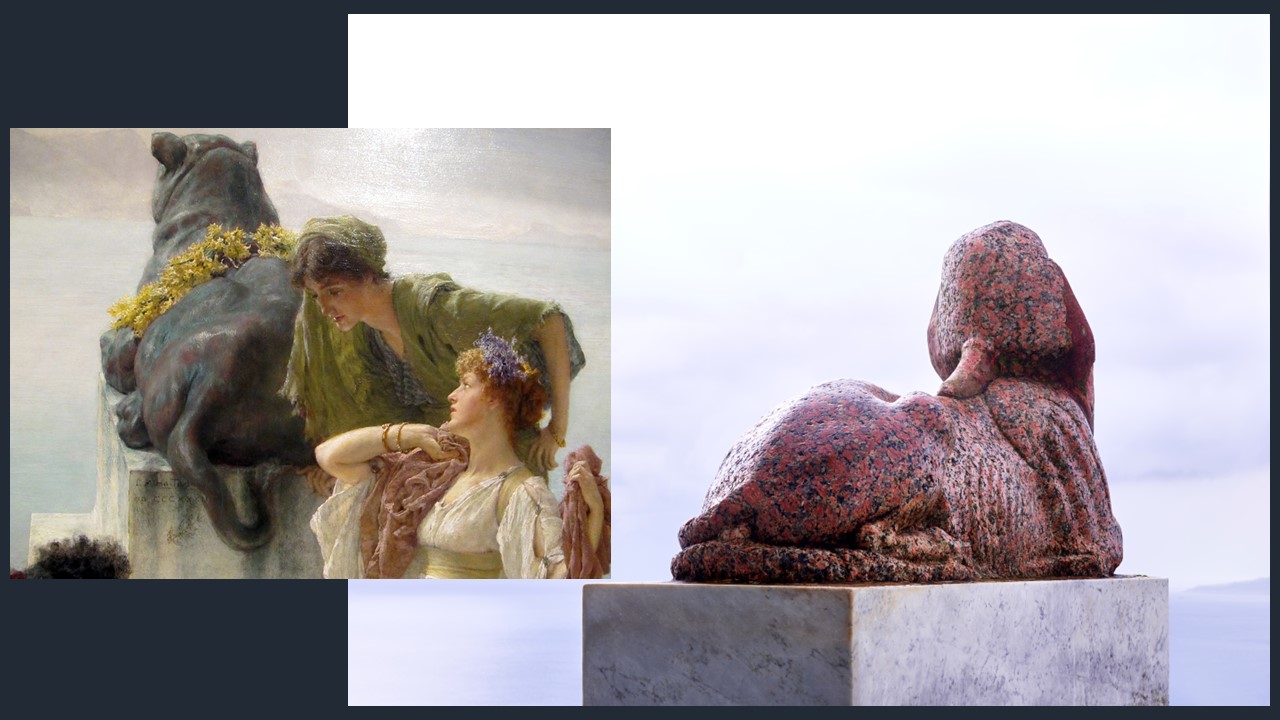
The focal point of the painting is a group of three young women, elegantly dressed in vibrant gowns, olive green, beige, white, and pink, standing on a marbled terrace, over a thrilling, vertiginous drop, an advantageous viewpoint, overlooking the sea below. May I suggest this is the island of Capri and the Bay of Naples, in the distance? The women stand against a marble railing and gaze down at the sea, where a luxuriously decked trireme is depicted arriving. The composition is further enhanced with the addition of an impressive bronze sculpture of an animal, wreathed with vibrant yellow flowers. Was the artist inspired by the Egyptian Sphinx he probably saw in Villa San Michele on Capri? Alma-Tadema would have visited the famous Villa after inspecting the sites at Pompeii and Herculaneum, seeking inspiration for his pictures, and gathering material for use as props for his paintings. https://www.christies.com/lot/lot-6426695?ldp_breadcrumb=back&intObjectID=6426695&from=salessummary&lid=1

Sir Lawrence Alma-Tadema, A Coign of Vantage (detail), 1895 and The Sphinx at Villa San Michele, approximately 3200 years old, Red Granite, Villa San Michele, Anacapri
Sir Lawrence Alma-Tadema, O.M., R.A., R.W.S., Anglo-Dutch Artist, 1836-1912
A Coign of Vantage (detail), 1895, Oil on Canvas, 63.8 x 44.7 cm, Private Collection https://makeupandbeautyblog.com/daily-photo/more-pics-of-a-coign-of-vantage/
The Sphinx at Villa San Michele, approximately 3200 years old, Red Granite, Villa San Michele, Anacapri, Italy https://www.villasanmichele.eu/collection

The painting A Coign of Vantage is a prime example of Alma-Tadema’s ability to transport viewers to a distant time and place, evoking a sense of nostalgia and fascination for the grandeur of ancient Rome. The painting captures the artist’s dedication to historical accuracy, his love for opulent settings, and his skill in creating an alluring atmosphere through his meticulous technique. This is a picture of grand luxe, according to the experts at Christie’s, ease and well-being, an escapist fantasy perfectly attuned to the wishes of a picture-buying public who reveled in the warmth of its Mediterranean light. At the height of his fame, his pictures of Ancient Rome, wealthy, secure, and insouciant, reflected the success enjoyed by the newly rich plutocrats of Victorian Britain, who had made their fortunes building another Empire, a couple of millennia later. https://www.christies.com/lot/lot-6426695?ldp_breadcrumb=back&intObjectID=6426695&from=salessummary&lid=1

A view of the Blue Parlor in the Temple of Wings Mansion, and Alma-Tadema’s painting ‘A Coign of Vantage’ as displayed
A view of the Blue Parlor in the Temple of Wings Mansion, and Alma-Tadema’s painting ‘A Coign of Vantage’ as displayed in the Parlor… The contents of the Ann and Gordon Getty Collection in their Mansion, The Temple of Wings were auctioned at Christie’s (May 31 – June 15, 2023) https://www.artandobject.com/news/masterpieces-alma-tadema-moore-and-bouguereau-headline-getty-collection-auction

Sir Lawrence Alma-Tadema, born as Lourens Alma Tadema on January 8, 1836, and died on June 25, 1912, was a Dutch-born British painter. He is known for his meticulously detailed and beautifully rendered paintings depicting scenes from ancient civilizations, particularly ancient Rome, and Egypt. Alma-Tadema’s works often portrayed opulent interiors, lavish costumes, and intricate architectural details, capturing the splendor and decadence of the ancient world.

His paintings typically featured historical or mythological themes, and he was known for his thorough research and attention to detail. Alma-Tadema would often reconstruct historically accurate settings for his works, using models, props, and costumes to bring his visions to life. His compositions were carefully arranged, with an emphasis on color, light, and texture. They were highly sought after, and he had a significant influence on later artists. His attention to detail and ability to create immersive and visually stunning scenes made him one of the most successful painters of the late 19th century.

For a PowerPoint presentation of 10 Important Paintings by Sir Lawrence Alma-Tadema inspired by Ancient Rome, please… Check HERE!

Seascape Study with Rain Cloud by John Constable

John Constable, Artist of the United Kingdom, 1776–1837
Seascape Study with Rain Cloud (Rainstorm over the Sea), 1824-1828, Oil on paper laid on canvas, 22.2x31.1 cm, Royal Academy of Arts, London, UK
John Constable, Artist of the United Kingdom, 1776–1837
Seascape Study with Rain Cloud (Rainstorm over the Sea), 1824-1828, Oil on paper laid on canvas, 22.2×31.1 cm, Royal Academy of Arts, London, UK https://upload.wikimedia.org/wikipedia/commons/c/c7/Constable_-_Seascape_Study_with_Rain_Cloud.jpg

…Look! look! that livid flash! / And instantly follows the rattling thunder, / As if some cloud-crag, split asunder, / Fell, splintering with a ruinous crash, / On the Earth, which crouches in silence under; / And now a solid gray wall of rain / Shuts off the landscape, mile by mile; / For a breath’s space I see the blue wood again, / And, ere the next heart-beat, the wind-hurled pile… writes James Russell Lowell and the Seascape Study with Rain Cloud by John Constable in the Royal Academy of Arts comes to my mind. https://www.gutenberg.org/files/38520/38520-h/38520-h.htm, page 97

John Constable, a British landscape painter who was known for his beautiful paintings of the English countryside, was also fond of rendering the dramatic English sky. In fact, in a letter to fellow artist and friend John Fisher, he wrote back in 1821… It will be difficult to name a class of landscape in which the sky is not the keynote, the standard of scale, and the chief organ of sentiment. The sky is the source of light in nature, and it governs everything. If you paint the colours of the sky and reflected light, you cannot do otherwise than produce beautiful pictures. https://artsandculture.google.com/asset/clouds-john-constable/IwH3AnjdEZxMEg

Constable believed that clouds were an essential element in creating a sense of atmosphere and mood in landscape paintings. He studied them carefully and believed that they were constantly changing, creating an ever-evolving and dynamic landscape. In his paintings, he often depicted large, billowing clouds that filled the sky, adding drama and depth to his compositions. He used a variety of techniques to capture the fleeting nature of clouds, including layering paint and using bold brushstrokes to create texture and movement. His works continue to inspire artists today, and his philosophy on the importance of capturing the ever-changing beauty of nature, including clouds, remains relevant.

Constable’s love for clouds is evident in his many paintings, including Seascape Study with Rain Cloud, a painting created between 1822 and 1824 in Brighton, and currently held in the collection of the Royal Academy of Arts in London. According to the Museum experts… This is one of the most dramatic studies of sea and sky that Constable sketched at Brighton. The thunderous black clouds and torrential downpour have been painted rapidly to capture the fleeting nature of the scene. https://www.royalacademy.org.uk/art-artists/work-of-art/rainstorm-over-the-sea

The painting depicts a seascape with a large rain cloud looming in the distance. The sea is choppy, and the waves are rough, with white caps visible on the surface of the water. The sky is dark and moody, with the rain cloud dominating the upper half of the painting. The lower half of the painting features the sea and the horizon, with a few distant boats visible on the horizon.

The painting is a study of mood and atmosphere, with Constable expertly capturing the power of nature. The sky has been created with a series of hasty sweeps of the brush. The surface of the sea has been given emphasis by a number of horizontal incisions perhaps with the end of the brush. The dark, stormy sky and the shaft of sunlight suddenly breaking through the glowering black clouds is beautiful, uplifting… sublime! https://www.royalacademy.org.uk/art-artists/work-of-art/rainstorm-over-the-sea

Seascape Study with Rain Cloud by John Constable is considered to be one of the artist’s masterpieces and a prime example of his ability to capture the beauty and power of nature in his paintings. It is a significant work in the history of British landscape painting and remains a popular piece in the Royal Academy’s collection.

For a Student Activity, please… Check HERE!

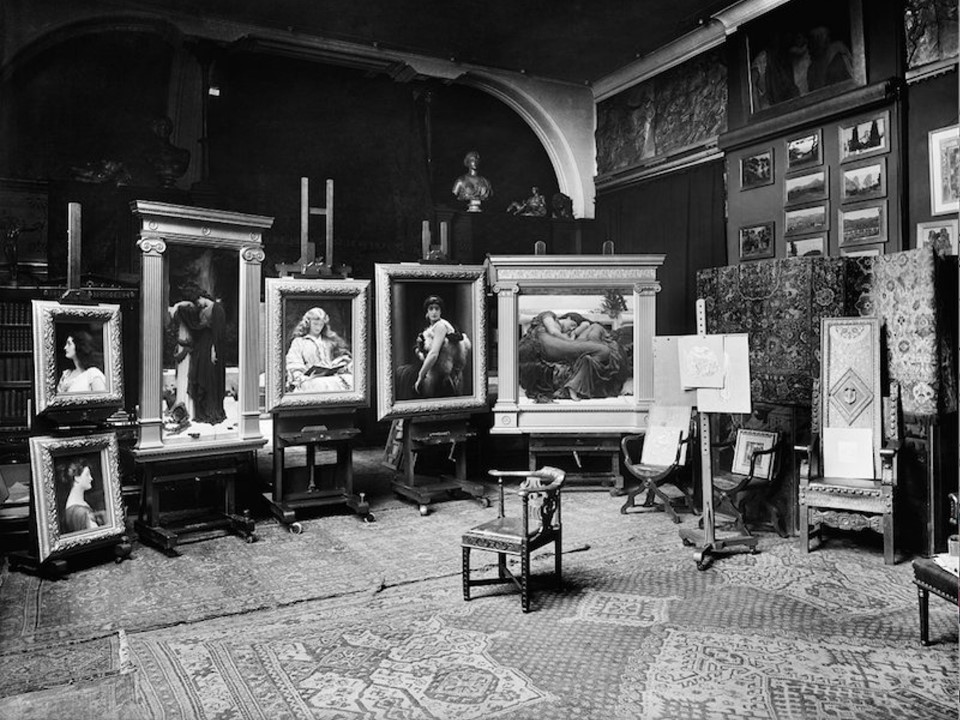
Leighton’s studio on the eve of the exhibition in 1895

Flaming June

Frederic, Lord Leighton, British Artist, 1830–1896
Flaming June, 1895, Oil on Canvas, 119.1 × 119.1 cm, Museo de Arte de Ponce, The Luis A. Ferré Foundation, Inc., Ponce, Puerto Rico
Frederic, Lord Leighton, British Artist, 1830–1896
Flaming June, 1895, Oil on Canvas, 119.1 × 119.1 cm, Museo de Arte de Ponce, The Luis A. Ferré Foundation, Inc., Ponce, Puerto Rico https://www.art-theoria.com/painting-of-the-month/flaming-june/

According to Leighton, the composition was inspired by the posture of a tired model. He elaborated her sinuous pose and then added sheer orange draperies. Her skin flushed by the sun, she is transformed into a personification of summer heat. The image reflects Leighton’s allegiance to artistic ideals that emphasized harmonious color and form over narrative… Flaming June is currently presented at the MET, in New York City, part of the Victorian Masterpieces from the Museo de Arte de Ponce, Puerto Rico (October 8th, 2022 – February 2024) Exhibition. I first saw the painting in 1997 in Washington DC, as part of The Victorians: British Painting in the Reign of Queen Victoria, 1837-1901 NGA Exhibition. Lord Leighton’s painting was one of the highlights… and rightly so! https://www.metmuseum.org/art/collection/search/888184?&exhibitionId=0&oid=888184&pkgids=undefined and https://www.nga.gov/exhibitions/1997/victorians.html

When Flaming June was first exhibited in 1895 at the Royal Academy in London, it received mixed reviews from the public and critics. Some praised the painting for its beauty and technical skill, while others criticized it for being too decorative and lacking in substance. Over time, Flaming June became one of Lord Leighton’s most celebrated works and is now regarded as a masterpiece of Victorian art. Its popularity is due in part to the fact that it captures the essence of the Aesthetic Movement, which valued beauty and art for art’s sake. The painting’s stunning colours, intricate details, and graceful composition have made it a favorite of art lovers and collectors around the world.

Leighton’s studio on the eve of the exhibition in 1895
Photo: Bedford Lemere / Historic England Archive
https://arthive.com/news/2252~Flaming_June_returned_home_for_the_first_time_in_85_years

The first time I saw Flaming June I was stunned by the artist’s use of colour, light, and texture. The painting features an amazing palette of warm oranges, yellows, and reds, contrasted with cool blues and greens. The colour scheme creates a sense of harmony and balance, with the warm tones of the woman’s dress and skin offset by the cool tones of the background and the marble bench.

The use of light and shadow is another important aspect of the painting’s composition. The warm light of the sun illuminates the woman’s neck, face, and body, creating a sense of warmth and intimacy. The play of light and shadow also adds depth and dimensionality to the painting, making it appear almost three-dimensional.

The texture is also notable. Lord Leighton was known for his attention to detail, and this is evident in the intricate folds and drapery of the woman’s dress, which appear almost lifelike. The texture of the marble bench is also finely rendered, with the veins and striations of the stone adding depth and dimension to the painting.

Frederic, Lord Leighton, British Artist, 1830–1896
Flaming June, 1895, Oil on Canvas, 119.1 × 119.1 cm, Museo de Arte de Ponce, The Luis A. Ferré Foundation, Inc., Ponce, Puerto Rico
Frederic, Lord Leighton, British Artist, 1830–1896
Flaming June (detail), 1894, black and white Chalk on brown Paper, Leighton House Museum, London, UK
https://www.linkedin.com/pulse/art-sir-frederic-leighton-flaming-june-1895-francisco-filipe-cruz/

Overall, the colours, use of light, and textures of Flaming June are integral to the painting’s beauty and impact. The warm, vibrant colours and intricate textures work together to create a sense of luxury and elegance, while the play of light and shadow adds depth and dimension to the painting. The result is a stunning work of art that continues to captivate viewers more than a century after its creation.

Frederic, Lord Leighton (1830-1896) was a British painter and sculptor who is considered one of the most important figures of the Victorian era. He was born in Scarborough, England, and showed an early talent for art, studying under several well-known artists before enrolling at the Royal Academy in London. He was known for his technical skill and attention to detail, and his paintings often featured classical or historical themes. He was particularly interested in the human form, and many of his works depict idealized figures in elegant poses. Leighton’s legacy as an artist is a lasting one. Regarded as one of the most important artists of the Victorian era, his influence can be seen in the work of many artists who came after him.

Frederic, Lord Leighton, British Artist, 1830–1896
Flaming June, 1895, Oil on Canvas, 119.1 × 119.1 cm, Museo de Arte de Ponce, The Luis A. Ferré Foundation, Inc., Ponce, Puerto Rico
Frederic, Lord Leighton, British Artist, 1830–1896
Flaming June, 1894, black and white Chalk on brown Paper, Leighton House Museum, London, UK
https://www.linkedin.com/pulse/art-sir-frederic-leighton-flaming-june-1895-francisco-filipe-cruz/

Flaming June is part of the collection of the Ponce Museum of Art in Ponce, Puerto Rico. The painting was acquired by the Ponce Museum of Art in 1963 and has been on display there ever since.

In the early 20th century, when Victorian art was already falling out of fashion, Samuel Courtauld, the millionaire collector and founder of the Courtauld Institute, called it “the most wonderful painting in existence”. https://www.theguardian.com/artanddesign/2016/jun/20/flaming-june-frederic-lord-leighton-house-museum

For a Student Activity, please… Check HERE!

Exhibition Flaming June: The Making of an Icon (4 November 2016 to 2 April 2017) at Leighton House
The curator of the exhibition Flaming June: The Making of an Icon (4 November 2016 to 2 April 2017) at Leighton House, Daniel Robbins, assembled five of the six works from the artist’s original 1895 Studio Installation on the eve of the 1895 Exhibition at the Royal Academy. Besides Flaming June (1895), we can see Lachrymal (Tears), 1895, from the Metropolitan Museum of Art in New York, Between Hope and Fear, The Maid with the Golden Hair, and Candida which have been in private collections since the 19th century. Curators could not trace the sixth canvas, A Study, or Listener, the painting that Leighton sent to the Royal Academy instead of Candida.
https://www.rbkc.gov.uk/museums/past-exhibitions-leighton-house

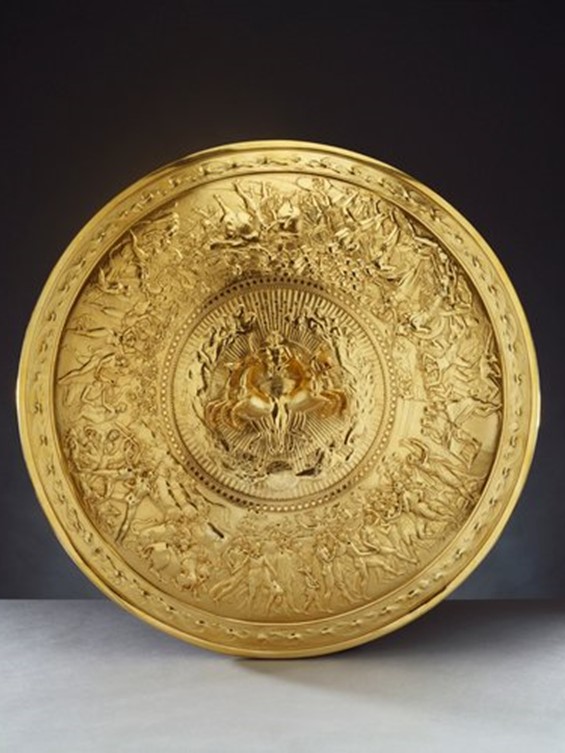
Philip Rundell, Shield of Achilles

The Legendary Shield of Achilles

Philip Rundell, Shield of Achilles
Philip Rundell (1746-1827) for Rundell, Bridge & RundellPhilip
Shield of Achilles, 1821-22, Silver-gilt, 90.5 x 90.5 x 18.0 cm (whole object), Royal Collection Trust     https://www.rct.uk/collection/51266/shield-of-achilles

First of all he forged a shield that was huge and heavy,  /  elaborating it about, and threw around it a shining  /  triple rim that glittered, and the shield strap was cast of silver.  /  There were five folds composing the shield itself, and upon it  /  he elaborated many things in his skill and craftsmanship.  /  (483) He made the earth upon it, and the sky, and the sea’s water,  /  and the tireless sun, and the moon waxing into her fullness,  /  and on it all the constellations that festoon the heavens,  /  the Pleiades and the Hyades and the strength of Orion  /  and the Bear, whom men give also the name of the Wagon,  /  who turns about in a fixed place and looks at Orion  /  and she alone is never plunged in the wash of the Ocean… ” When Homer describes The Legendary Shield of Achilles my eyes fill with images of a world long gone and my mind dreams of fabled stories… I wonder how Achille looked like carrying it and how brave Hector felt facing him…     http://www.u.arizona.edu/~afutrell/w%20civ%2002/iliad.html

The making of the Shield of Achilles brings the readers of the Iliad closer to its horrific end… When Hector killed Patroclus and stripped him of Achilles’s Armour, his fate was sealed! He committed Ύβρις and his punishment was imminent! In Homer’s 18th Ραψωδία, Thetis, Sea Goddess and mother of Achilles took immediate charge. She commissioned God Hephaestus to create a new Armour for Achilles, the lame God of Smithing got to work… and Homer created an amazing description of his world! Achilles’ shield was “a mirror of the world of gods and men, within the mighty Stream of Ocean and although Homer described its appearance in great detail, the precise relationship of the various elements was unclear…”     https://www.rct.uk/collection/themes/publications/carlton-house/the-shield-of-achilles

Philip Rundell, Shield of Achilles
Philip Rundell (1746-1827) for Rundell, Bridge & RundellPhilip
Shield of Achilles (detail), 1821-22, Silver-gilt, 90.5 x 90.5 x 18.0 cm (whole object), Royal Collection Trust     https://www.rct.uk/collection/51266/shield-of-achilles

Lines 468 to 607 in the 18th Ραψωδία, give readers a vivid and detailed portrayal of the imagery which adorns the new Shield of Achilles. “Starting from the shield’s centre and moving outward, circle layer by circle layer, the shield is laid out as follows: (in the center) The Earth, sky and sea, the sun, the moon and the constellations (484–89).” The circle that immediately follows depicts two cities, one peaceful and festive, its people taking part in a wedding and a case of law administration (490–508), the other in trouble, besieged, ambushed and in battle (509–40). The Shield is furthered decorates with scenes depicting a field being ploughed (541–49), a harvest setting (550–60), a vineyard with grape pickers (561–72), a herd of straight-horned cattle under attack by a pair of lions, herdsmen and cattle dogs trying to them beat off (573–86), a picture of a sheep farm (587–89) and a group of young men and women dancing (590–606). The great Ocean is depicted in the outermost circle, somehow encasing Homer’s view of a civilized microcosm…  “where images of conflict and discord… i.e. war and peace, work and festival… show the basic forms of a civilized, essentially orderly life.” (607–609).     https://www.wikiwand.com/en/Shield_of_Achilles

Philip Rundell, Shield of Achilles
Philip Rundell (1746-1827) for Rundell, Bridge & RundellPhilip
Shield of Achilles (detail), 1821-22, Silver-gilt, 90.5 x 90.5 x 18.0 cm (whole object), Royal Collection Trust     https://www.rct.uk/collection/51266/shield-of-achilles

“In 1810 John Flaxman (a British Sculptor and Draughtsman, and a leading figure in British and European Neoclassicism) received the first of a number of payments from Rundells  (Philip Rundell for Rundell, Bridge & Rundell master jewellery makers) to reconstruct” the legendary Shield described by Homer in the Iliad. Flaxman was a well-versed Greek scholar and an admirer of Homer “who spent many evenings reading aloud (in Greek) from the Iliad.” Flaxman completed his design in 1817 and then “modelled and cast it in plaster himself. This shield was the first in a series of silver-gilt and bronze casts and was completed in 1821, when it was prominently displayed at George IV’s coronation banquet. Flaxman was said to have been justly proud of his design, which was subsequently described by Rundells as a masterpiece of modern art and considered by many as one of the artist’s most successful works.” Other silver-gilt versions of the shield were made in 1821/2 for the Duke of York (now Huntington Collection, San Marino), and in 1822/3 for the Duke of Northumberland (now Al-Tajir Collection) and the Earl of Lonsdale (now National Trust, Anglesey Abbey). There is an early bronze cast of the shield, subsequently electro-gilt, in the Royal Collection (RCIN 31606) https://www.rct.uk/collection/51266/shield-of-achilles    includes a Video and      https://issuu.com/artsolution/docs/koopman_2019_the_shield_of_achilles
For a PowerPoint on The Legendary Shield of Achilles, please… Check HERE!

For a PowerPoint of Student Work inspired by The Legendary Shield of Achilles, please… Check HERE!

Bulletin Board display of Grade 3 student work inspired by The Legendary Shield of Achilles
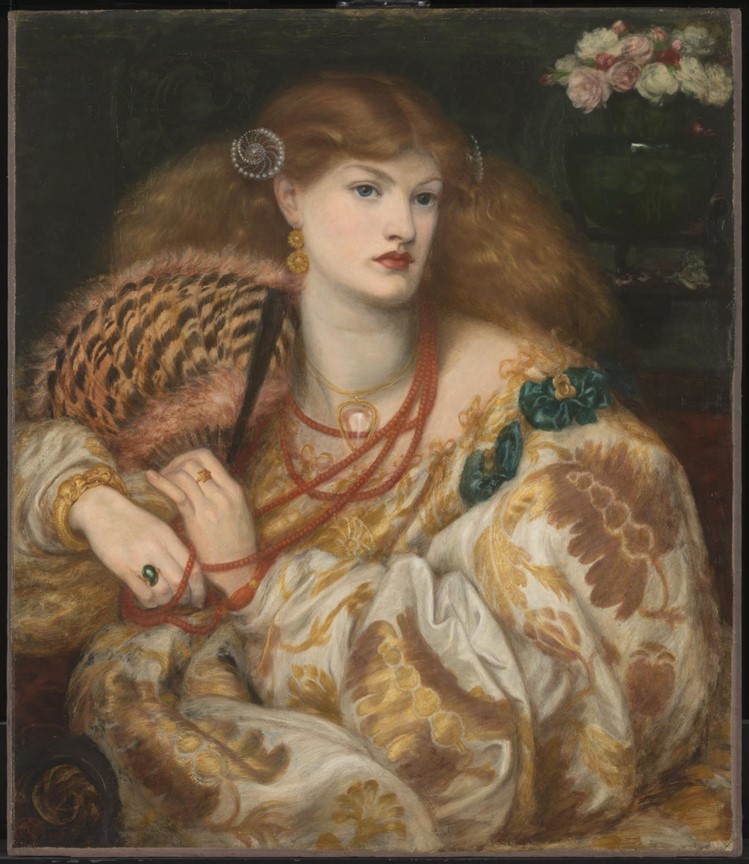
Dante Gabriel Rossetti, Monna Vanna

Virtual Trip to meet the Pre-Raphaelites

Dante Gabriel Rossetti, Monna Vanna
Dante Gabriel Rossetti, 1828–1882
Monna Vanna, 1866, oil on canvas, 88,9 cm × 86,4 cm, TATE Britain, London

“Conception, my boy, fundamental brain work, is what makes all the difference in art…” once said, Dante Gabriel Rossetti. During COVID 19 Days, we need a new meaningful Conception of our Life, and how we can make it powerful and fulfilling… just like ART! London, home of Dante Gabriel Rossetti and his Brotherhood friends, is an ideal Virtual Trip to meet the Pre-Raphaelites! Please… Stay in the comfort of your HOME! Snack on something deliciously BRITISH! …and ACTION!

The Guildhall Art Gallery in London
The Guildhall Art Gallery in London, founded in 1886 as the “Collection of Art Treasures worthy of the capital city,” exhibits some superb examples of Pre-Raphaelite works.

According to the TATE experts “The Pre-Raphaelites were a secret society of young artists (and one writer), founded in London in 1848. They were opposed to the Royal Academy’s promotion of the ideal as exemplified in the work of Raphael. …Inspired by the theories of John Ruskin, who urged artists to ‘go to nature’, they believed in an art of serious subjects treated with maximum realism. Their principal themes were initially religious, but they also used subjects from literature and poetry, particularly those dealing with love and death. They also explored modern social problems.”    https://www.tate.org.uk/art/art-terms/p/pre-raphaelite.

Let’s uncover the mysteries of this secret society of painters with the help of our KIDS and the TATE    https://www.tate.org.uk/kids/explore/who-is/who-are-pre-raphaelites …and let’s explore Pre-Raphaelite London! https://theculturetrip.com/europe/united-kingdom/england/london/articles/a-pre-raphaelites-tour-of-london/    and    https://www.standard.co.uk/go/london/arts/pre-raphaelite-art-london-best-paintings-exhibitions-a3965701.html

Dante Gabriel Rossetti, Monna Vanna
Dante Gabriel Rossetti, 1828–1882
Monna Vanna, 1866, oil on canvas, 88,9 cm × 86,4 cm, TATE Britain, London

Movie Time with the Pre-Raphaelites… and ACTION!

Effie Gray is a 2014 British biographical film written by Emma Thompson and directed by Richard Laxton. It is based on the true story of John Ruskin’s marriage to Euphemia Gray and the subsequent annulment of their marriage.     https://www.imdb.com/title/tt1605798/     and     https://www.youtube.com/watch?v=5BLzK1z0EII

Desperate Romantics is a six-part television drama series about the Pre-Raphaelite Brotherhood, first broadcast on BBC Two between 21 July and 25 August 2009. Discussing the series’ billing as “Entourage with Easels,” Franny Moyle, whose book about the Pre-Raphaelite Brotherhood, Desperate Romantics: The Private Lives Of The Pre-Raphaelites was an inspiration for the series, said: “I didn’t pitch it as ‘Entourage with easels’ … I pitched it as a big emotional saga, a bit like The Forsyte Saga. Having said that, I think it was a useful snapshot – a way of getting a handle on the drama.”     https://www.imdb.com/title/tt1346018/?ref_=kw_li_tt     and     https://www.youtube.com/watch?v=g4BraAD71cE

The BBC Documentary, The Pre-Raphaelites: Victorian Revolutionaries, examines the 19th century Pre-Raphaelite Brotherhood art movement. This 3-Part Documentary explores its origins, some early works and the criticism faced by the Brotherhood.    https://www.youtube.com/watch?v=FkWONORqHZw     https://www.youtube.com/watch?v=Oe9JOWEYldU     https://www.youtube.com/watch?v=OSCRU73LIms

FOOD… with Victorian Recipes

What did the Victorians eat? Mrs. Avis Crocombe was the head cook at Audley End House in the 1880s. She compiled many different recipes in her handwritten cookery book, which includes a range of Victorian delights – including a recipe for a roasted swan! Will they prove interesting to taste?     https://www.english-heritage.org.uk/visit/inspire-me/victorian-recipes/