Angelos Giallinas, a master of atmospheric landscape painting, captured Corfu and Mediterranean scenes with luminous sensitivity, blending precise draftsmanship with the delicate spontaneity of watercolour.
Teaching with Antonello da Messina
Antonello da Messina, inspired by Flemish oil painting, became a pioneering Italian innovator, blending Northern technique with Mediterranean sensibility, creating luminous, emotionally powerful sacred images that transformed Renaissance painting.
Mother’s Day
Motherhood in art, from Mary Cassatt to Kitagawa Utamaro, reveals intimate, universal bonds of tenderness, care, and love across cultures and centuries.
The Labours of the Months: May
The Venetian Labours of the Months series in the National Gallery, London presents miniature Renaissance scenes of rural life, with May showing a young man preparing agricultural supports in a symbolic, seasonal rhythm.
Anastasis at the Monastery of Hosios Loukas
The Anastasis mosaic at the Monastery of Hosios Loukas presents the Resurrection as Christ descends into Hades, a masterpiece of 11th-century Byzantine mosaic art radiating spiritual intensity and imperial grandeur.
The Raising of Lazarus by Duccio
The Maestà of Duccio di Buoninsegna, a monumental altarpiece for Siena Cathedral, bridges Byzantine tradition and emerging Renaissance naturalism in a profoundly devotional visual language.
The Interceding Theotokos at Dumbarton Oaks

“…denuded of all help, and deprived of human alliance, we were spiritually led on by holding fast to our hopes in the Mother of the Word, our God, urging her to implore her Son, invoking her for the expiation of our sins, her intercession of our salvation, her protection as an impregnable wall for us, begging her to break the boldness of the barbarians, her to crush their insolence, her to defend the despairing people and fight for her own flock…” writes Patriarch Photius in the second of his two homilies on the siege of Constantinople by the Rus’ and Sirarpie der Nersessian, in his 1960 Dumbarton Oaks Papers article titled Two Images of the Virgin, quotes him. I couldn’t find better introductory remarks for a BLOG POST on the marble Icon of The Interceding Theotokos at Dumbarton Oaks. https://www.jstor.org/stable/1291145?seq=15#metadata_info_tab_contents page 72 and https://www.doaks.org/resources/bliss-tyler-correspondence/art/bz/BZ.1938.62.jpg/view
The Dumbarton Oaks Museum is my favourite temple of the Muses in Washington DC! It breathes history, scholarship elegance and class… Its collection of Byzantine Art is top quality, the ways and the hows this collection was acquired fascinates me, the scholarship involved, I believe, is more than appreciated by everyone who loves Byzantium. https://www.academia.edu/3585132/_Royal_Tyler_and_the_Bliss_Collection_of_Byzantine_Art_in_James_N_Carder_ed_A_Home_of_the_Humanities_The_Collecting_and_Patronage_of_Mildred_and_Robert_Woods_Bliss_Washington_D_C_Dumbarton_Oaks_Research_Library_and_Collection_27_50?email_work_card=view-paper “Royal Tyler and the Bliss Collection of Byzantine Art,” in James N. Carder, ed., A Home of the Humanities: The Collecting and Patronage of Mildred and Robert Woods Bliss, Washington, D.C.: Dumbarton Oaks

https://www.doaks.org/visit/museum/explore/byzantine-gallery
I confess, I first noticed The Marble Interceding Theotokos in the collection of Dumbarton Oaks when I visited the grand Metropolitan Museum Exhibition The Glory of Byzantium back in 1997. Exhibited then, along with the Lips Monastery Icon of Saint Eudokia from the Archaeological Museum of Istanbul, the two marble Icons “opened my eyes” in the genre of Sculpted Marble Icons from the Byzantine era. Ever since I seek them out, and when I visit the Museum of Byzantine Culture in my hometown Thessaloniki, I always pay my respects to the marble ΜΗ(ΤΗ)Ρ Θ(ΕΟ)Υ(=Mother of God) Icon in Room 4, where artefacts of the Macedonian and Komnenian dynasties are presented. https://www.metmuseum.org/art/metpublications/The_Glory_of_Byzantium_Art_and_Culture_of_the_Middle_Byzantine_Era_AD_843_1261 and https://www.mbp.gr/en/object/marble-icon-praying-virgin

The Interceding Theotokos – Virgin Hagiosoritissa Relief, Middle Byzantine, mid-eleventh century, Marble, 104 cm x 40 cm x 7 cm, Dumbarton Oaks Museum, Washington, DC, USA
Praying ΜΗ(ΤΗ)Ρ Θ(ΕΟ)Υ(=Mother of God), 11th century, Marble, 135×70 cm, Museum of Byzantine Culture, Thessaloniki, Greece
https://www.johnsanidopoulos.com/2016/08/saint-eudocia-empress-wife-of-emperor.html
https://www.doaks.org/resources/bliss-tyler-correspondence/art/bz/BZ.1938.62.jpg/view
https://www.mbp.gr/en/object/marble-icon-praying-virgin
One more confession… the title of this BLOG POST was a decision that troubled me. At Dumbarton Oaks Museum the marble Icon of the Theotokos is presented as Virgin Hagiosoritissa Relief. The Glory of Byzantium Exhibition Catalogue uses a similar name Icon of the Virgin Hagiosoritissa. I thought, this is it…until I started reading Sirarpie der Nersessian article Two Images of the Virgin in the Dumbarton Oaks Collection, and I changed my mind! The author presents in detail the different styles, whereabouts and use of Interceding Theotokos Icons in every medium! Bottom line… I was not convinced the Marble Icon of the Theotokos is of the Hagiosoritissa type… and the title changed to The Interceding Theotokos at Dumbarton Oaks.
For a Student Activity on The Interceding Theotokos at Dumbarton Oaks, please… check HERE!
Villa Poppaea Viridarium Frescoes

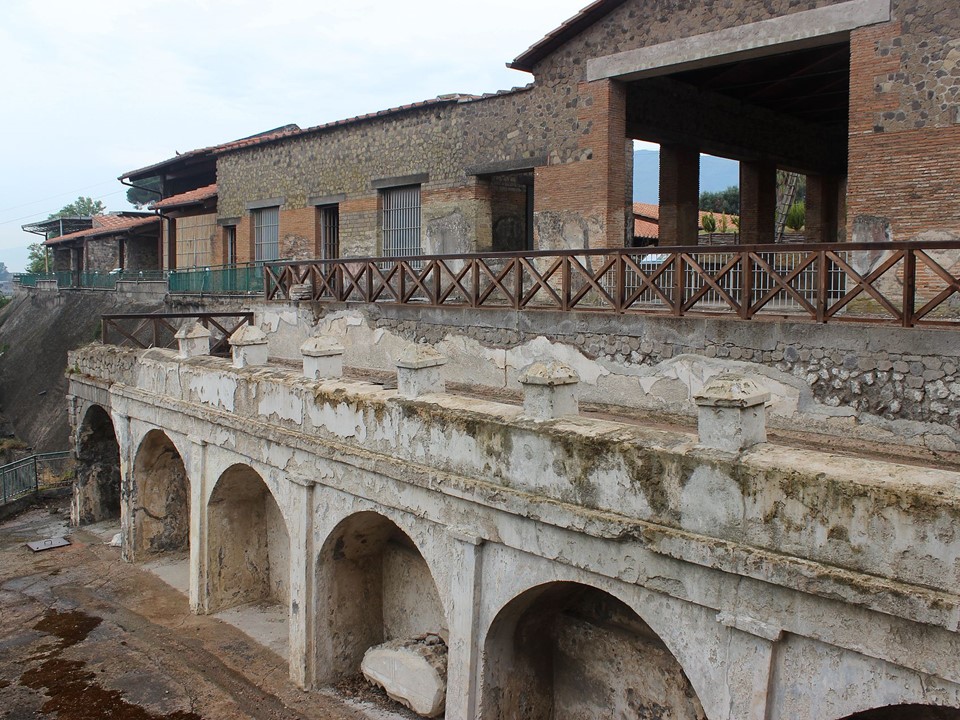
Photo credit: Carole Raddato published on 06 May 2020
https://www.ancient.eu/article/1552/a-visitors-guide-to-oplontis-stabiae–boscoreale/
I wish I were standing in the middle of Villa Poppaea’s central sitting room (Room 18 on the plan), gazing at “the portico in front of the swimming pool and its surrounding garden… the large window (behind me, that opens) onto the principal garden of the villa… (more) windows, (on my sides) opening into rooms richly-painted with garden scenes, and (further beyond those) into tiny ‘garden’ courtyards, again decorated with garden frescos. Trees, greenery, flowers, birds and water (are) visible in every direction, both painted and real, with nature being brought into the interiors. …It’s hard not to imagine the building filled with …peace, …accompanied by the twittering of birds and the wind in the grass and leaves.” Villa Poppaea Viridarium Frescoes have a strange effect on me! https://www.italyheaven.co.uk/campania/villa-oplontis.html

Villa Poppaea, built on a plateau fourteen meters above sea level, took advantage of all the scenic pleasures of the Bay of Naples, the latest trends in architecture and the art of fresco painting. Rooms, one hundred of them, were in such a way organized so that its residents and their guests would be able to enjoy the open air and the dramatic view of the sea in an environment of the utmost luxury. Walls decorated with sumptuous frescos further enhanced the effect this Villa probably had on its residents and visitors. Please allow me to explain why exploring the fresco decoration in just one Room in Villa Poppaea, makes your trip to Oplontis, worth your time…

Photo Credit: © King’s College London, 2011
https://www.kvl.cch.kcl.ac.uk/oplontis03.html
Back in the late 19th century, the German archaeologist August Mau (1840–1909), delineated and described a system of dividing Pompeian Frescoes into four distinct Styles. It is amazing how in Villa Poppaea visitors can see fine examples of the latter three of these four Fresco Styles by just walking from room to room. The amazing frescoes in the small Viridarium area (Room 16 in our Villa Plan) of Villa Poppaea are incredible!
The Viridarium is described as an indoor garden sitting room, decorated with frescoes depicting plants and birds. Room 16 in our Villa Plan is one such Viridarium beautifully embellished with what scholars describe as “Garden Painting,” a very precise genre that is distinct from landscape painting. Garden Paintings give viewers an interesting glimpse of the relationship that existed between architecture and landscape in the ancient world. Exploring the frescoes of Villa Poppaea I read OPLONTIS: VILLA A (“OF POPPAEA”) AT TORRE ANNUNZIATA, ITALY by John R. Clarke and Nayla K. Muntasser, and particularly Chapter 6: Wilhelmina Jashemski and Garden Archaeology at Oplontis, by Kathryn Gleason. The information provided in this presentation is the result of an enjoyable weekend of seeking more and more data… https://quod.lib.umich.edu/cgi/t/text/text-idx?cc=acls;c=acls;idno=heb90048.0001.001;node=heb90048.0001.001:21.7.2;rgn=div1;view=text

https://commons.wikimedia.org/wiki/File:Viridaria_Villa_Poppaea_30.JPG
The delightful frescoes in Room 16, the Villa’s Viridarium, display arrangements of evergreen foliage of arbutus, laurels and branches of roses, artfully shaped alone or around a decorative fountain. Hues of red and yellow, powerful primary colours, serve as a striking background. Birds twittering and drinking water from the fountains give an extra sense of joyful life. Kathryn Gleason describes them as Topiarii and continues presenting Ars Topiaria, as the art of creating displays of foliage and shrubs by clipping plants, the pruning and dwarfing of large trees… to the training of ivy into ornate patterns in small peristyle gardens. https://quod.lib.umich.edu/cgi/t/text/text-idx?cc=acls;c=acls;idno=heb90048.0001.001;node=heb90048.0001.001:21.7.2;rgn=div1;view=text
I found of particular interest the site of The Oplontis Project, a collaboration of John R. Clarke and Michael L. Thomas of the University of Texas at Austin and the Soprintendenza Speciale per i Beni Archeologici di Napoli e Pompe, along with the Visual Restorations of King’s Visualisation Lab, in the Department of Digital Humanities at King’s College London, by Martin Blazeby. http://www.oplontisproject.org/ and http://www.oplontisproject.org/index.php/visualization/
For a PowerPoint on Villa Poppaea Viridarium Frescoes, please… Click HERE!

https://historyandarchaeologyonline.com/ancient-roman-gardens/
Angelic Musicians

https://el.m.wikipedia.org/wiki/%CE%91%CF%81%CF%87%CE%B5%CE%AF%CE%BF:Domenikos_Theotokopoulos,_El_Greco_-_The_Annunciation_-_Google_Art_Project.jpg
Domenicos Theotokopoulos is in my heart. I find him an attractive personality in every aspect… talented, educated, ambitious, curious, adventurous, persistent… “Art is everywhere you look for it, hail the twinkling stars for they are God’s careless splatters…” he wrote and I think of his Angelic Musicians, shining like flickering stars, in the National Gallery in Athens. http://elgreco.net/el-greco-quotes.jsp and https://www.nationalgallery.gr/en/painting-permanent-exhibition/painting/domenicos-theotokopoulos-el-greco/the-concert-of-the-angels.html
Domenicos Theotokopoulos was a Cretan Greek, born in Handaka-Candia, present-day Herakleion, part, at the time, of the thriving Republic of Venice. Archival research in Venice showed that between 1526-28 his family relocated from Chania to Handaka where in 1541 Domenicos was born. His orthodox-Greek family belonged to the upper-middle class, as his father, Giorgos Theotokopoulos, worked for the government of the Venetian Republic, most probably as a merchant and a tax collector. Very little is known of Domenicos’s mother and early childhood. He was undoubtedly talented, and his father, realizing it, placed him as an apprentice in a painter’s workshop to learn this profitable trade. The name of his teacher is unknown, but judging from Domenicos’s earliest paintings, he was a great master of the Post-Byzantine Cretan School. Crete at the time was the center of a thriving artistic community and understanding the artist’s early influences and style is important in decoding his later work! https://www.historical-museum.gr/webapps/elgreco/xronologio.php?lang=en
By 1567/8 Theotokopoulos travelled to Venice, by 1570, he was in Rome, by 1576 he moved to Spain and in 1577 the artist settled in Toledo, where he found his spiritual home and remained for the rest of his life. He died on the 7th of April 1614, admired for his unique fluid style, temperamental character and humanist education. One of his friends and admirers, Hortensio Félix Paravicino y Arteaga (1580-1633) the Spanish poet, preacher and a member of the Trinitarian Order, wrote for the artist “O Greek divine! We wonder not that in thy works / The imagery surpasses actual being.” Paravicino also wrote, foreseeing Theotokopoulos’s legacy “Future generations will admire his strange genius, but for centuries he will not be imitated.” http://www.nccsc.net/essays/spanish-style
I would like the reader of this BLOG POST, titled Angelic Musicians, to focus on two paintings. One of them is in Athens and is titled The Concert of the Angels, the other is in Madrid, and is an Annunciation scene. Now imagine them together and you will see one of the last, if not the last painting, the artist created but never finished. The original painting, an Annunciation scene, was commissioned for the Chapel of the Hospital of St. John the Baptist outside the walls of Toledo. Today, separated, the product of 19h century vandalism, may look slightly odd, but still, enthral the viewer with their unique “beauty.”

The Concert of the Angels, c. 1608-1614, oil on canvas, 115-217 cm, National Gallery – Alexandros Soutsos Museum – Evripidis Koutlidis Foundation, Athens
https://www.nationalgallery.gr/en/painting-permanent-exhibition/painting/domenicos-theotokopoulos-el-greco/the-concert-of-the-angels.html
The Concert of the Angels in Athens is for me a wonderful depiction of an imaginary, celestial concert, full of energy and vibrato. Domenicos Theotokopoulos, the so-called El Greco, loved music and treated it with respect. The painting in Athens shows a musical ensemble with seven “ecstatic” angels, reading music, singing or playing the spinet, a harp, a flute and a viola da gamba. I wonder what kind of music Domenico enjoyed most, and which musician of his time he favoured… https://www.nationalgallery.gr/en/painting-permanent-exhibition/painting/domenicos-theotokopoulos-el-greco/the-concert-of-the-angels.html
The artist uses swift brushwork and swaying movement in postures and robes to create excitement in his composition. Like tongues of fire, his swirling figures look more like spiritual beings than real bodies…
The colour palette that the artist uses is another distinctive characteristic of his mannerism. The colours are iridescent but bold. He uses oranges in red and green and yellow/gold in blue. Tints and shades are juxtaposed. Values of high or low intensity are treasured. Theotokopoulos’s final Annunciation was never finished but whether you see its upper part in Athens or the actual Annunciation part in Madrid, its expressive power is unquestionable.
For a PowerPoint on Theotokopoulos’s paintings of the Annunciation, please … Click. HERE!
The National Gallery – Alexandros Soutsos Museum – Evripidis Koutlidis Foundation in Athens has uploaded a wonderful (in Greek) Video to watch… https://www.facebook.com/watch/?v=316373302403183

The Annunciation, 1614, oil on canvas, 2.940,00×2.090,00 mm, Banco Santander, Spain
https://el.m.wikipedia.org/wiki/%CE%91%CF%81%CF%87%CE%B5%CE%AF%CE%BF:Domenikos_Theotokopoulos,_El_Greco_-_The_Annunciation_-_Google_Art_Project.jpg
Odilon Redon and Pandora’s Box

Pandora, 1910/1912, oil on canvas, 143.5 x 62.9 cm, NGA, Washington DC, USA https://www.nga.gov/collection/art-object-page.46531.html#bibliography
It is nature also who orders us to obey the gifts she has given us. Mine have led me to dreams; I submitted to the torments of imagination and the surprises she gave me under my pencil; but I directed and led those surprises in accordance with the laws of the organism of art which I know, which I feel, with the single goal of producing in the spectator, by sudden attraction, the whole evocation, and the whole enticement of the uncertain within the confines of thought… writes Odilon Redon in his journals To Myself: Notes on Life, Art, and Artists… and I think of Odilon Redon and Pandora’s Box in Washington DC, at the National Gallery. https://www.goodreads.com/author/quotes/288740.Odilon_Redon
Odilon Redon is one of my favourite artists. As a student, I knew little of him. As a young teacher of Art History I hardly ever used his work… until, preparing for a Lesson Plan on the Myth of Pandora, I rediscovered his Pandora painting at the NGA and the Museum’s wonderful suggestions for Student Activities. My students responded positively to his imaginary world… and I was hooked!

Self-Portrait, 1880, oil on canvas, 33.3×52 cm, Palais des Beaux-Arts de Lille, France https://www.wikiart.org/en/odilon-redon/self-portrait-1880
I like how Odilon’s work is described at ARTSY… “Known for his unique blend of artistic naturalism and symbolic subject matter, Odilon Redon was highly influential among the late 19th century French avant-garde circle. Working in charcoal, pastel, oil, and lithography, Redon created imaginative scenes that, while often based in the supernatural, were nonetheless executed in a highly representational manner. Redon considered this descriptive accuracy essential, writing “every time that a human figure does not give the illusion that it is … about to come out of the picture frame to walk, act or think, the drawing is not a truly modern one.” Redon was influenced by the poetry of Charles Baudelaire and Stéphane Mallarmé and admired by the painters Gustave Moreau and Gustave Klimt—as such he is often remembered as a Symbolist, though Redon preferred autonomy and never actually considered himself part of the group.” What more could I add… https://www.artsy.net/artwork/odilon-redon-ari
My students and I are captivated by the Myth of Pandora and the elusive way Odilon presents her story… Off-centre, Pandora stands in front of an atmospheric background, misty and hazy, luminous, ethereal and a touch, mysterious. The power of the artist’s mind creates organic forms, indistinct and intangible. The colours the artist uses are subtle, understated, yet joyous, warm and earthy. The box in Pandora’s hands is small, easily discerned buts not ostentatious… http://www.hellenicaworld.com/Art/Books/en/BeyondTheVisibleTheArtOfOdilonRedon.html

The Creation of Pandora, 460BC-450 BC, Attic Red Figure Calyx krater, attributed to the Niobid Painter, Archaic period, British Museum https://www.britishmuseum.org/collection/object/G_1856-1213-1
The myth of Pandora is beautifully told by the experts of the National Gallery of Art in Washington DC… According to Greek mythology, in the beginning the earth was free from toil and misery. The land was covered with flowers and the rivers flowed with milk and honey. Earth was inhabited only by men, who had been created by Prometheus. He made them of clay and modeled them after the gods, which angered Zeus, the king of the gods. When Prometheus offended Zeus again by stealing fire from heaven to give to man, Zeus exacted revenge. He ordered Hephaestus, the god of the forge, to create Pandora, the first woman. The gods gave her many traits including beauty, curiosity, charm, and cleverness. Hence her name “Pandora,” meaning “all gifted” or, alternately, “a gift to all.” Before he left Pandora on earth, Zeus handed her a beautiful box saying, “This is my own special gift to you. Don’t ever open it.” As Zeus anticipated, Pandora’s curiosity got the best of her, and she opened the box, ending earthly paradise. From the small chest flew troubles and woes—sorrow, disease, vice, violence, greed, madness, old age, death—to plague humankind forever. However, Zeus did not realize that hope had been secretly added to the box by Promethesus. When Pandora opened the box and released trouble and woe into the world, hope was there to help people survive. https://www.nga.gov/education/teachers/lessons-activities/origin-myths/pandora.html
For interesting Student Activities, please click and explore the NGA site… https://www.nga.gov/education/teachers/lessons-activities/origin-myths/pandora.html
The myth of Pandora’s box by Iseult Gillespie at TEDEd is worth exploring… https://ed.ted.com/lessons/the-myth-of-pandora-s-box-iseult-gillespie
For a PowerPoint on the Myth of Pandora Teacher Curator prepared, please… Click HERE!

Pandora, 1914, oil on canvas, 143.5 x 62.2 cm, the MET, NY https://www.metmuseum.org/art/collection/search/437383