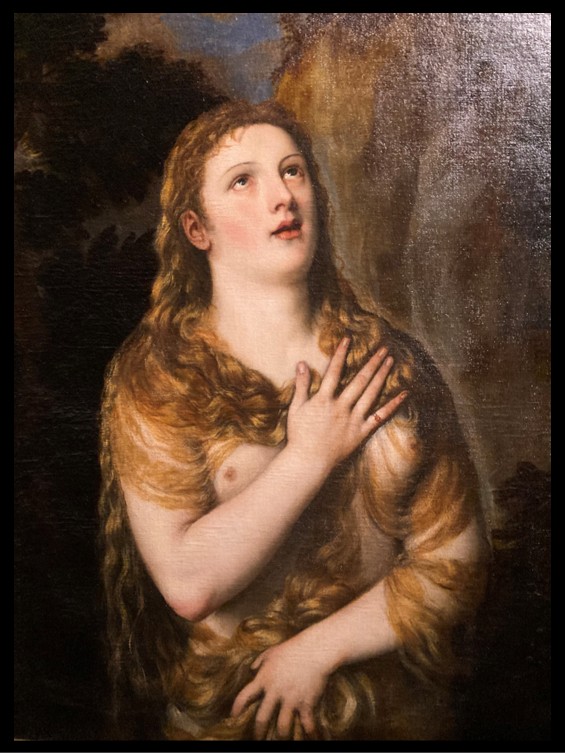
Mary Magdalene, c.1540, Oil on Canvas, 96 x 74 cm, Pinacoteca Ambrosiana, Milan, Italy – Photo Credit: Amalia Spiliakou, 2026
Tucked among the gallery’s rich collection, Titian’s Mary Magdalene at the Pinacoteca Ambrosiana, this small but powerful oil on canvas, draws the eye instantly, not through scale, but through raw emotional intensity.
The Painting: Penitence Rendered in Gold and Flesh
Titian’s La Maddalena depicts the saint at a moment of spiritual reckoning. Her long, wavy auburn hair, rendered in warm, almost luminous ochres, cascades over her shoulders and body, a detail rooted in medieval legend that describes Mary Magdalene living out her final years as a penitent hermit, her hair having grown long enough to serve as her only covering.
Her gaze is lifted toward an unseen heaven, lips slightly parted, eyes glistening with tears. One hand presses to her chest in a gesture of contrition and devotion; the other rests below, grounding the composition. Behind her, a moody, atmospheric landscape, dark foliage on one side, a pale sky breaking through on the other, mirrors the emotional turbulence of the scene.
What makes this work so compelling is Titian’s mastery of chiaroscuro and his ability to convey intense psychological depth through such an economical composition. There is no elaborate narrative scene here, no crowd of onlookers, just Mary Magdalene, alone with her grief and her faith. It is portraiture as prayer.
According to the museum’s own wall label, the painting is fully attributed to Tiziano Vecellio (Pieve di Cadore, 1489/90 – Venice, 1576) and carries the inventory number 208. Notably, the label does not commit to a precise year of execution, though sources suggest a date around 1540. As with many Renaissance works that have passed through centuries of scholarship, exact dating can remain a matter of ongoing art-historical discussion.
A Cardinal’s Gift: The Painting’s Journey to the Ambrosiana
One of the most fascinating details I learned on-site is the painting’s provenance. Mary Magdalene was donated to the Pinacoteca Ambrosiana in 1618 by Cardinal Federico Borromeo, the very same cardinal who founded the Ambrosiana itself in the early 17th century. This means the painting has been part of the collection since almost the gallery’s inception, over 400 years ago.
Borromeo was a passionate collector and patron of the arts, and his personal taste helped shape the identity of the Ambrosiana as one of Italy’s great cultural institutions. Standing in front of this painting, knowing it has hung in Milan since the early 1600s, adds a palpable sense of continuity, you’re viewing the work almost exactly as its earliest custodians did.
Visiting the Pinacoteca Ambrosiana
For anyone planning a trip to Milan, the Pinacoteca Ambrosiana is a must for art lovers who want to step outside the more crowded tourist circuits. Founded by Cardinal Borromeo, the museum houses an extraordinary range of Italian Renaissance and Baroque art, alongside Leonardo da Vinci’s Codex Atlanticus. It’s an intimate setting, you can get remarkably close to the paintings, which makes studying brushwork and detail, like the shimmer of light on Magdalene’s hair, a genuine pleasure rather than a distant glimpse over someone’s shoulder.
Other Titian Magdalenes Worth Knowing
Titian returned to the subject of the Penitent Magdalene more than once across his career, and each version offers its own interpretation of the theme: Palazzo Pitti, Florence, one of Titian’s earliest and most celebrated treatments of the subject, dating to around 1531, and The Hermitage Museum, St. Petersburg, a later variation, showing how Titian continued to revisit and refine this deeply personal religious theme over decades.
Together with the Ambrosiana version, these paintings reflect just how significant the Penitent Magdalene motif was to Titian, and to Venetian religious painting more broadly. The composition proved so influential that later Baroque artists frequently echoed its pose and emotional register in their own depictions of the saint.
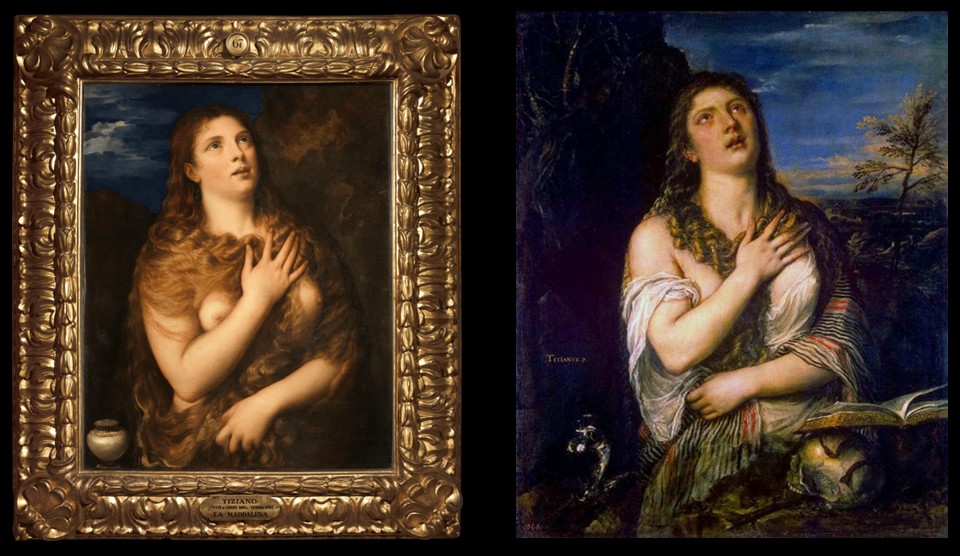
Penitent Magdalene, c. 1531, Oil on Canvas, approx. 85.8 x 69.5 cm, Palazzo Pitti (Palatine Gallery), Florence, Italy
https://www.uffizi.it/en/artworks/saint-mary-magdalene?fbclid=IwY2xjawURzehwZG9mBWV4dG4DYWVtAjEwAGJyaWQRMVFnWmgwe
WV4aUJXdzBkTzlzcnRjBmFwcF9pZBAyMjIwMzkxNzg4MjAwODkyAAEeO_CKASz11vxi3wnGUVDQ-rHcY8fjzfV-6RldRE6QJEEcu2ujZuAsDxn5fZw_aem_e-2VsOPKS0zLQaKNkvA-Bw
Alt Text (SEO-friendly, descriptive)
Titian’s 1531 Penitent Magdalene at Palazzo Pitti Florence, an early version with fully nude torso
Repentant Mary Magdalene, c. 1560s (commonly cited as c. 1565), Oil on Canvas, 119 x 98 cm, State Hermitage Museum, Saint Petersburg, Russia
https://www.wikiart.org/en/titian/penitent-st-mary-magdalene
Final Thoughts
Titian’s Mary Magdalene at the Pinacoteca Ambrosiana is a quiet but unforgettable encounter with one of the Renaissance’s greatest painters. Whether you’re an art history enthusiast or simply a curious traveler, it’s a painting, and a museum, well worth seeking out on your next visit to Milan.
PowerPoint Presentation: Ready to explore the theme further? Download the PowerPoint presentation and discover how Titian represented women through the ideas of pudicitia and voluptas. The presentation is ideal for teaching, discussion, or independent learning. Get the PowerPoint →
Continue Exploring on Teacher Curator: Continue exploring female portraits by Titian with these related Teacher Curator articles: Titian’s Flora and Titian’s Portrait of Isabella d’Este. These articles offer further insight into Renaissance portraiture, Venetian women, and the ways artists represented female beauty and identity.
Sources and further Reading: To learn more about Titian’s female portraits of Mary Magdalene explore these reliable museum sources: Pinacoteca Ambrosiana, the official museum page for Titian’s celebrated painting – https://www.ambrosiana.it/en/pinacoteca-collections/#/dettaglio/79e19477-8813-49da-afb5-587886bd0923, Gallerie degli Uffizi, the official museum page for Titian’s celebrated painting – https://www.uffizi.it/en/artworks/saint-mary-magdalene?fbclid=IwY2xjawURzehwZG9mBWV4dG4DYWVtAjEwAGJyaWQRMVFnWmgweWV4aUJXdzBkTzlzcnRjBmFwcF9pZBAyMjIwMzkxNzg4MjAwODkyAAEeO_CKASz11vxi3wnGUVDQ-rHcY8fjzfV-6RldRE6QJEEcu2ujZuAsDxn5fZw_aem_e-2VsOPKS0zLQaKNkvA-Bw, and the State Hermitage Museum in Saint Petersburg site – https://www.hermitagemuseum.org/digital-collection/32191?lng=en. These sources provide useful background for understanding Titian’s approach to Mary Magdanene’s identity in Renaissance Venice.