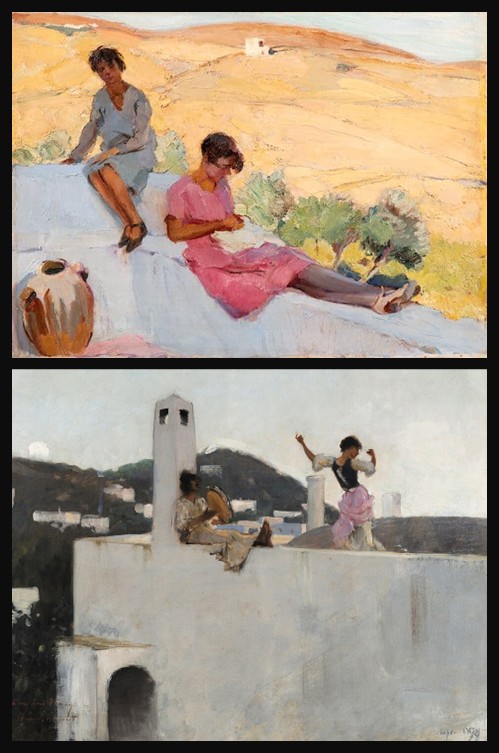
Sur le toit-terrasse, ile de Tinos, 1923-1926, oil on canvas, 66 x 89,5 cm, Private Collection
https://www.bonhams.com/auction/31745/lot/54/nicholaos-lytras-1883-1927-sur-le-toit-terrasse-ile-de-tinos/
John Singer Sargent, American, 1856-1925
Rosina-Capri , 1878, oil on canvas, 19.7 x 25.5 in, Private collection
https://commons.wikimedia.org/wiki/File:Sargent_-_Capri.jpg

What happens when an artist looks at an island from a rooftop? Nicholaos Lytras and John Singer Sargent give us two very different answers. Although they painted in different countries and decades apart, both artists found inspiration in the everyday life, architecture and brilliant light of the Mediterranean.
Lytras painted Sur le toit-terrasse, île de Tinos between 1923 and 1926, while Sargent painted Rosina-Capri in 1878. One takes us to Tinos in Greece, the other to Capri in Italy. Together, the paintings invite us to look beyond the familiar idea of the Mediterranean as a beautiful holiday destination and consider how artists transform a particular place into an artistic experience.
Nicholaos Lytras: A Rooftop in Tinos
Nicholaos Lytras (1883–1927) was an important figure in early 20th-century Greek art. His Sur le toit-terrasse, île de Tinos shows a rooftop terrace on the Cycladic island of Tinos. At first glance, the scene feels relaxed and familiar. The terrace becomes an extension of domestic life, while the surrounding architecture and landscape connect the private world of the home with the wider island.
Lytras was deeply interested in light and colour, and this painting has a distinctly modern feeling. Rather than describing every detail carefully, he uses colour and brushwork to capture the atmosphere of the scene. The architecture gives the composition structure, while the figures and objects bring warmth and movement. There is also something wonderfully quiet about the painting. We are not shown a dramatic event. Instead, Lytras invites us to pause and experience an ordinary moment on a Greek island.
John Singer Sargent: Rosina on a Capri Rooftop
More than four decades earlier, John Singer Sargent (1856–1925) was painting on the Italian island of Capri. Sargent visited Capri in 1878, when he was still a young artist. During his stay, he became fascinated by the island, its people and its intense Mediterranean light. One of the people who particularly captured his imagination was Rosina Ferrara, a young woman from Capri who posed for several of his paintings.
In Rosina-Capri, Sargent places Rosina at the centre of the composition. Her figure, pose and clothing immediately attract our attention, while the rooftop setting creates a sense of place. The painting feels spontaneous and lively. Sargent was interested not only in portraiture but also in the visual experience of a particular moment. Light falls across the scene, surfaces catch the sun, and the informal composition gives the impression that we have arrived just as the artist is observing his subject.
Unlike Lytras’s Tinos, Sargent’s Capri is strongly connected with the figure of Rosina. Yet the rooftop plays an important role in both paintings. It becomes a place from which the artist can observe island life and the Mediterranean environment.
Two Islands, Two Artists, One Mediterranean Light
Placed side by side, these paintings reveal both similarities and differences. Sargent, an American artist working in Italy in 1878, was fascinated by the people and visual character of Capri. Lytras, a Greek artist painting Tinos in the 1920s, approached the Greek landscape from within his own modern artistic culture.
Their approaches to colour and composition are also different. Sargent’s painting feels immediate and focused on the human figure. Lytras gives greater attention to the relationship between architecture, figures, colour and space. Yet both paintings remind us that the Mediterranean is more than blue seas and sunny landscapes. It is also made up of rooftops, terraces, walls, people, shadows and everyday moments. Perhaps that is what makes these two paintings so appealing. From a rooftop in Capri or Tinos, the artist does not simply record a place. He gives us a particular way of seeing it.
PowerPoint Presentation: Ready to Dive Deeper? Download the PowerPoint presentation and explore all artwork by Nikos Lytras, ideal for sharing, discussing, or simply learning more. Get the PowerPoint →
Continue Exploring on Teacher Curator: Expand your understanding of 20th century Greek Art with related articles: Girl on the Beach by Thaleia Flora Karavia and Monemvasia by Konstantinos Maleas.
Sources and further Reading: To explore more paintings by Nikos Lytras, visit the official website of the National Gallery of Greece https://www.nationalgallery.gr/en/artist/lytras-nikos/. For additional information about the artist’s life, artistic style, and his painting ‘Sur le toit-terrasse, ile de Tinos’, see BONHAMS official site https://www.bonhams.com/auction/31745/lot/54/nicholaos-lytras-1883-1927-sur-le-toit-terrasse-ile-de-tinos/.