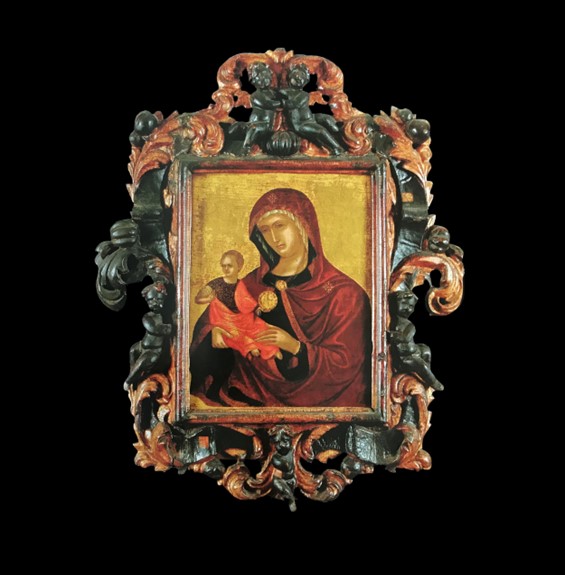
Madre della Consolazione,15th century, tempera on wood, 0.563x0.45 m, Canellopoulos Museum, Athens, Greece

Madre della Consolazione

Madre della Consolazione,15th century, tempera on wood, 0.563x0.45 m, Canellopoulos Museum, Athens, Greece
Madre della Consolazione,15th century, tempera on wood, 0.563×0.45 m, Canellopoulos Museum, Athens, Greece https://camu.gr/en/item/panagia-madre-della-consolazione/

Given this state of affairs and stepping out as though on the royal highway, following as we are the God-spoken teaching of our holy fathers and the tradition of the catholic church – for we recognize that this tradition comes from the Holy Spirit who dwells in her – we decree with full precision and care that, like the figure of the honoured and life-giving cross, the revered and holy images, whether painted or made of mosaic or of other suitable material, are to be exposed in the holy churches of God, on sacred instruments and vestments, on walls and panels, in houses and by public ways, these are the images of our Lord, God and saviour, Jesus Christ, and of our Lady without blemish, the holy God-bearer, and of the revered angels and of any of the saintly holy men. This is how the Council of Nicaea II, in 787 AD described the Restoration of the Holy Icons. The Madre della Consolazione Icon in the Canellopoulos Museum of our Lady without blemish, and the infant God and saviour, Jesus Christ, is a wonderful example of this declaration… https://www.papalencyclicals.net/councils/ecum07.htm

Paul and Alexandra Canellopoulos Museum in Athens has an important collection of Byzantine and post-Byzantine artworks dating from the formative years of the Byzantine era (4th-7th century AD) to the post-Byzantine and Modern periods (1453-1821). The Museum’s collection includes paintings, miniatures, gold and silverwork, wood carvings, and embroidery, as well as jewelry, coins, mosaics, wall paintings, and Patriarchal documents spanning from the 18th and the 19th centuries to the flourishing icon-painting workshops of Mount Athos. Worth noting is that the artwork in the Collection reveals diverse cultural influences that make up the breadth of Byzantine art, resulting in exceptional elegance and originality. https://camu.gr/en/art/byzantine-art/

Going through the Museum’s Collection of Icons I was impressed by the represented high-quality examples of Constantinopolitan, Macedonian, and Cretan styles of Byzantine painting. Particularly impressive is the group of Icons that represents the Post-Byzantine Cretan School. According to the Museum’s experts… almost all the great hagiographers of the Cretan School from the years after the Fall of Constantinople are represented in the Museum, including Nicolaos Tzafouris, Michael Damaskenos, Emmanuel Lambardos, Frangias Kavertzas, Ieremias Palladas, Victor, and Emmanuel Tzanes. https://camu.gr/en/art/byzantine-art/

I was immediately drawn to a 15th-century Icon presenting the Madre della Consolazione. How couldn’t I, when the Eastern Byzantine representational style, harmoniously met and adapted to the novel ideas of the ‘Maniera Greca’ style of 15th century Venice. An added bonus to the overall impression of this remarkable Icon is its Baroque wood-carved frame. High-relief open-work decoration of scrolling leaves and fruits, a ribbon passing between them, and five angels, almost sculpted in the round, create an impression of added opulence, and luxury.

The Canellopoulos Museum Icon is a typical example of an ‘Italo-Cretan’ style ‘Madre della Consolazione’ composition. It depicts the Virgin Mary in the ‘bust’ format, against the traditional Byzantine gold background, holding the infant Jesus on her right arm. Mary is depicted with a serene expression, gazing, with slanted eyes, at the child she affectionately holds. The infant Jesus presents the gold globus cruciger of the world with his left hand, and blesses the viewer with his right.

Inspired by the Byzantine tradition, Mary wears a red maphorion trimmed with elaborate gold embroidery of pseudo-Kufic motifs on its edge and carries the three gold stars (only two are visible), which symbolize chastity, on her forehead and her shoulders. The infant Christ, on the other hand, placed on the right side of the composition, is dressed in a white chiton, a deep blue ‘chemise’ of a Western type, embroidered richly in gold, and an orange himation with gold Byzantine striations.

Superbly crafted, and refined in execution, the Madre della Consolazione composition aims to convey a sense of comfort, solace, and maternal love. The overall mood of the Canellopoulos Museum Icon is one of sweet tenderness and compassion.

For a Student Activity, please… Check HERE!
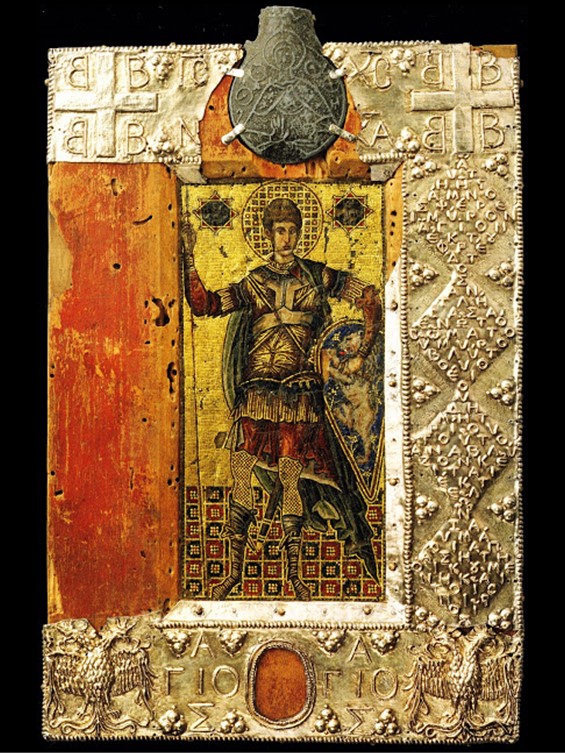
Mosaic Icon of Saint Demetrios at Sassoferrato, Mosaic Icon: 14th or 15th century, Ampulla: 13th or 14th century, Silver Frame: mid-15th century, Mosaic set into wax on a poplar board, paint, silver-gilt (frame), lead (ampulla), 24.3 X 16 cm, Museo Civico, Sassoferrato, Italy

Miniature Mosaic Icon of Saint Demetrios in Sassoferrato

Mosaic Icon of Saint Demetrios at Sassoferrato, Mosaic Icon: 14th or 15th century, Ampulla: 13th or 14th century, Silver Frame: mid-15th century, Mosaic set into wax on a poplar board, paint, silver-gilt (frame), lead (ampulla), 24.3 X 16 cm, Museo Civico, Sassoferrato, Italy
Mosaic Icon of Saint Demetrios at Sassoferrato, Mosaic Icon: 14th or 15th century, Ampulla: 13th or 14th century, Silver Frame: mid-15th century, Mosaic set into wax on a poplar board, paint, silver-gilt (frame), lead (ampulla), 24.3 X 16 cm, Museo Civico, Sassoferrato, Italy https://www.johnsanidopoulos.com/2015/11/a-14th-century-byzantine-icon-of-st.html

One of the inscriptions in the Miniature Mosaic Icon of Saint Demetrios in Sassoferratoinforms us that… This ampulla (at the top of the Icon), bears holy oil drawn from the well in which the body of the divine Demetrios reposes, which gushes here and accomplishes miracles for the entire universe and for the faithful… What a remarkable way to remember Saint Demetrios and celebrate his feast day!

In 1472, Niccolò Perotti (1430-1480), secretary to Cardinal Bessarion and archbishop of Siponto, donated to Sassoferrato, the city of his birth, a collection of reliquaries, including the Mosaic Icon of Saint Demetrios. That was a notable donation considering Niccolò Perotti’s position. As Cardinal Bessarion’s secretary, he was able to travel as far as Trebizond in the East, and acquire a collection of valuable reliquaries, manuscripts, and icons. It has been suggested that the Mosaic Icon of Saint Demetrios was gifted to Perotti by no other than Bessarion himself, known to be the owner of a collection of Late Byzantine Mosaic Icons… but there is no proof for this.  https://www.academia.edu/39903340/Displaying_an_Icon_The_Mosaic_Icon_of_Saint_Demetrios_at_Sassoferrato_and_its_Frame

The Museu Civico in Sassoferrato is fortunate to hold such an important and rare relic of the Palaiologan Renaissance, the final period in the development of Byzantine art. On a poplar board, slightly excavated at its center, rendered in micromosaic, stands Saint Demetrios, patron Saint of Thessaloniki. He is placed against a gold background and a tiled ground. He is in military garb, holds a lance with his righthand, and, with the left, a blue shield decorated with a heraldic white lion against a ground strewn with gold stylized flowers. Based on stylistic analysis, according to Martin Donnert,  the mosaic icon at Sassoferrato was executed in the 14th century as a typical work of Palaiologan art. This date is further confirmed by the radiocarbon analysis dating of the wooden support of the icon to 1279 ± 26 years, which gives a terminus post quem. Byzantium: Faith and Power (1261–1557), Evans, Helen C., ed., with essays by… https://www.metmuseum.org/art/metpublications/Byzantium_Faith_and_Power_1261_1557 pp. 231-233 and https://www.academia.edu/39903340/Displaying_an_Icon_The_Mosaic_Icon_of_Saint_Demetrios_at_Sassoferrato_and_its_Frame

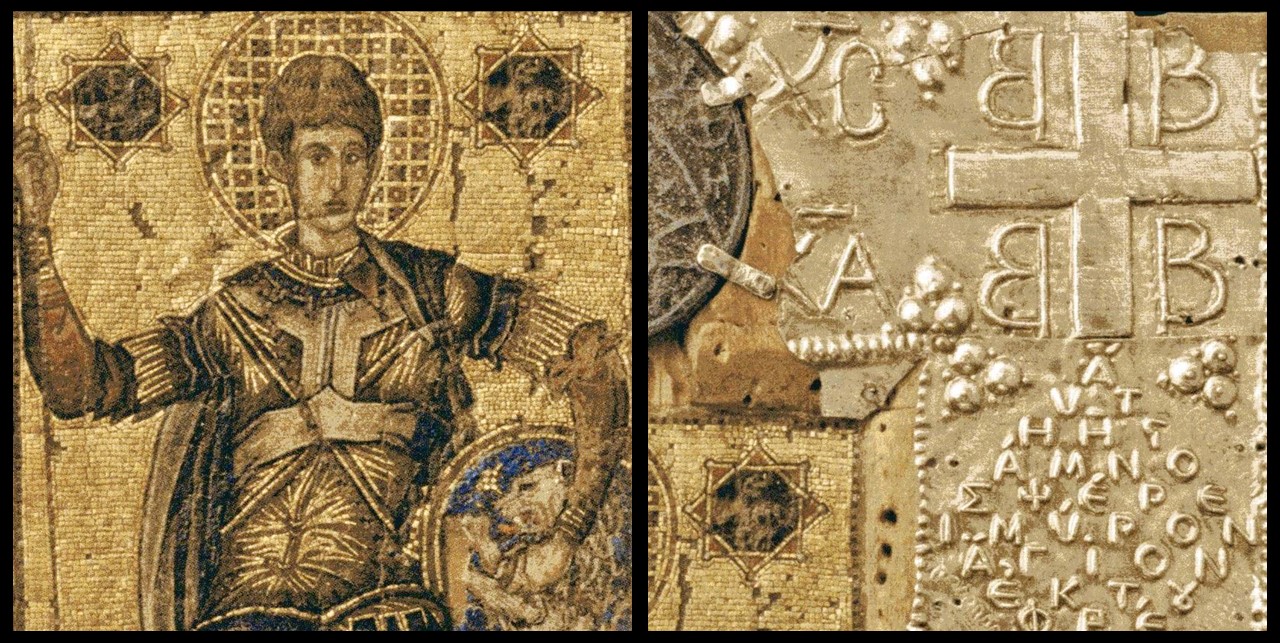
Mosaic Icon of Saint Demetrios at Sassoferrato (details), Mosaic Icon: 14th or 15th century, Ampulla: 13th or 14th century, Silver Frame: mid-15th century, Mosaic set into wax on a poplar board, paint, silver-gilt (frame), lead (ampulla), 24.3 X 16 cm, Museo Civico, Sassoferrato, Italy
Mosaic Icon of Saint Demetrios at Sassoferrato (details), Mosaic Icon: 14th or 15th century, Ampulla: 13th or 14th century, Silver Frame: mid-15th century, Mosaic set into wax on a poplar board, paint, silver-gilt (frame), lead (ampulla), 24.3 X 16 cm, Museo Civico, Sassoferrato, Italy https://twitter.com/byzanzfreiburg/status/1151222386190180352

The ampulla at the top of the Icon’s frame is a wonderful rarity! It turns the Mosaic Icon into a precious reliquary of Saint Demetrios’s cult. The text, on the right side of the Icon’s frame, explains the reasons why the ampulla was added to the Icon’s composition. Prof. Martin Donnert clarifies that …Since the 12th century, the existence of miraculous oil (the Myron) connected with the cult of St Demetrios is well attested in the sources. He also adds that lead ampullae from the late 12th to the 14th centuries that contained the holy Myron for pilgrims to the saint’s tomb, called koutrouvia… were found at various places in northern Greece and the Balkans. One of these ampullae, a cherished relic in itself, is the one incorporated at the top of the icon frame… showing St Demetrios holding a cross on one side, and, on the opposite side, St Theodora, the second myron-giving saint of Thessaloniki. https://www.academia.edu/39903340/Displaying_an_Icon_The_Mosaic_Icon_of_Saint_Demetrios_at_Sassoferrato_and_its_Frame

The silver-gilt frame, dated during the mid-15th century is rich in information. A number of inscriptions within star-shaped cartouches, along with the imperial symbol of the double-headed eagle and the tetrabasileion, may indicate a distinguished member of the Palaiologan family, to be the original commissioner of the Icon. Furthermore, Prof Martin Donnert suggests Demetrios Palaiologos and the Palaiologoi of Montferrat! https://www.academia.edu/39903340/Displaying_an_Icon_The_Mosaic_Icon_of_Saint_Demetrios_at_Sassoferrato_and_its_Frame

For a Student Activity, please… Check HERE!
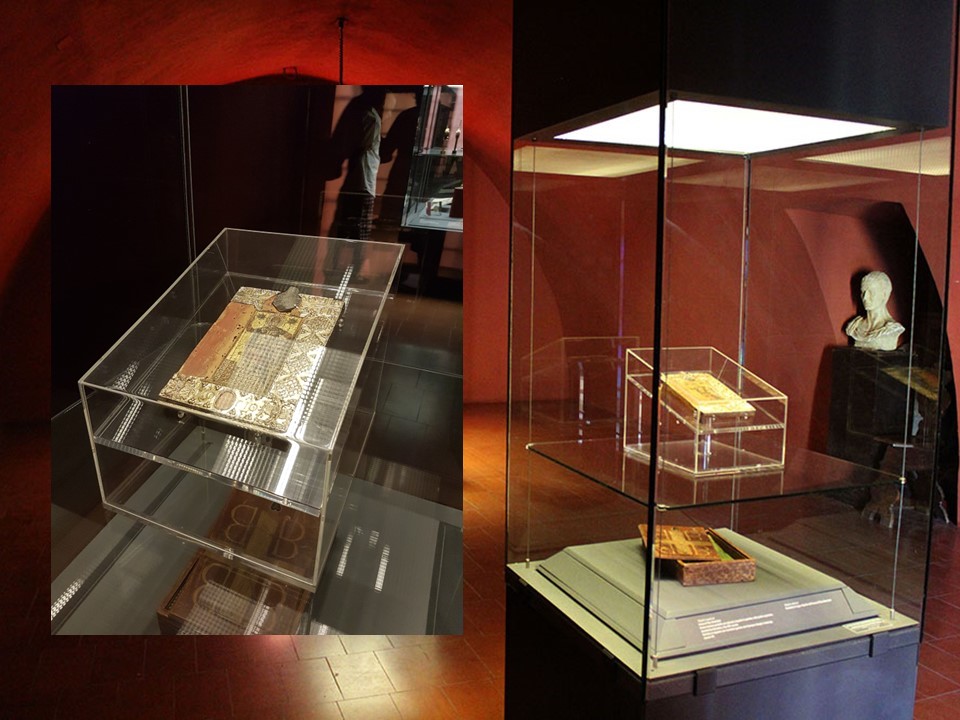
Interesting to read: The Historical Significance of the Mosaic of Saint Demetrius at Sassoferrato byA. A. Vasiliev, Dumbarton Oaks Papers, Vol. 5 (1950), pp. 29+31-39 (10 pages) https://www.jstor.org/stable/1291074