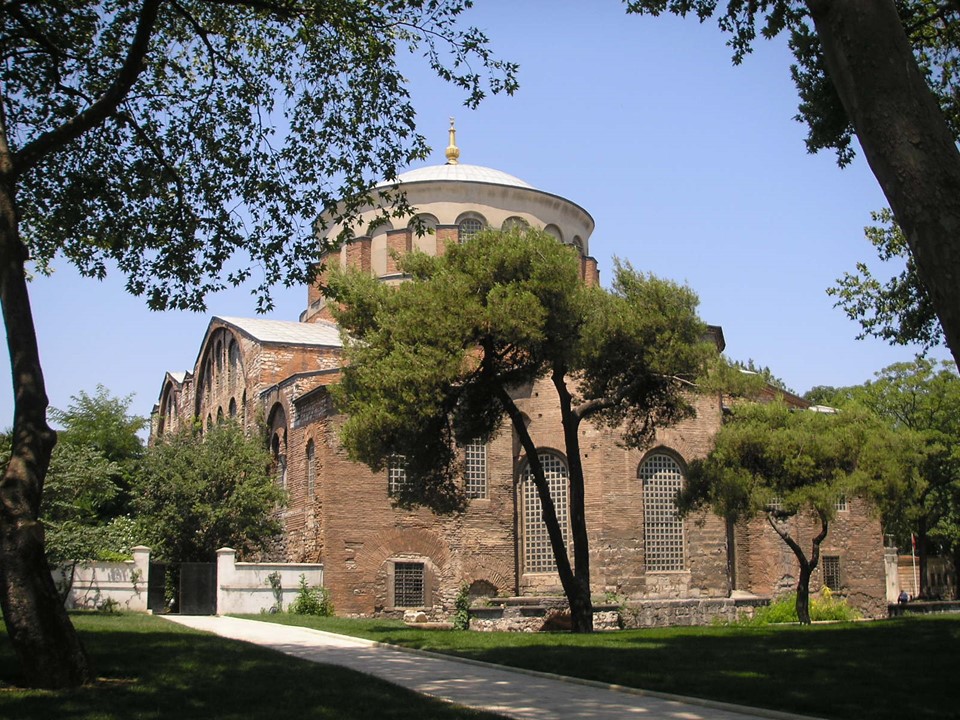
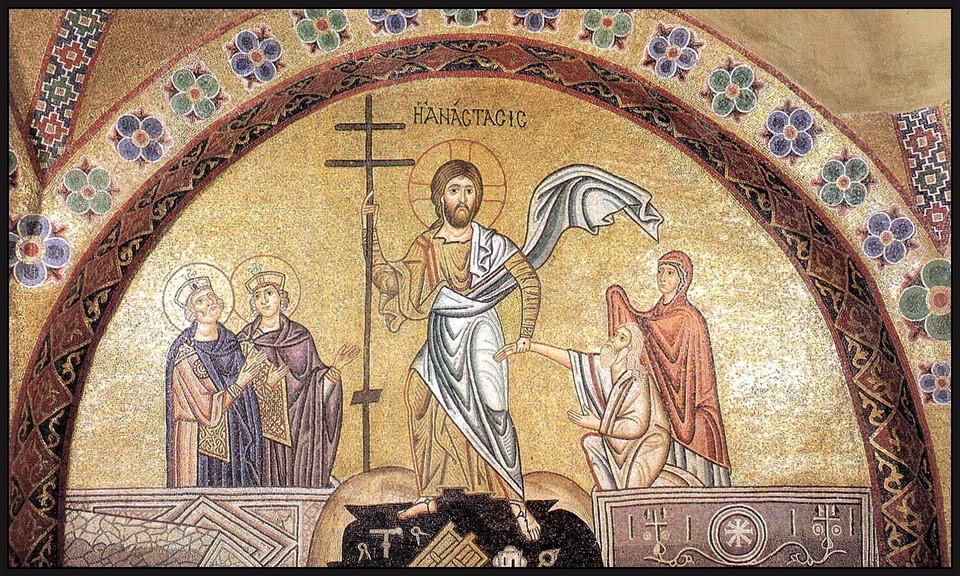
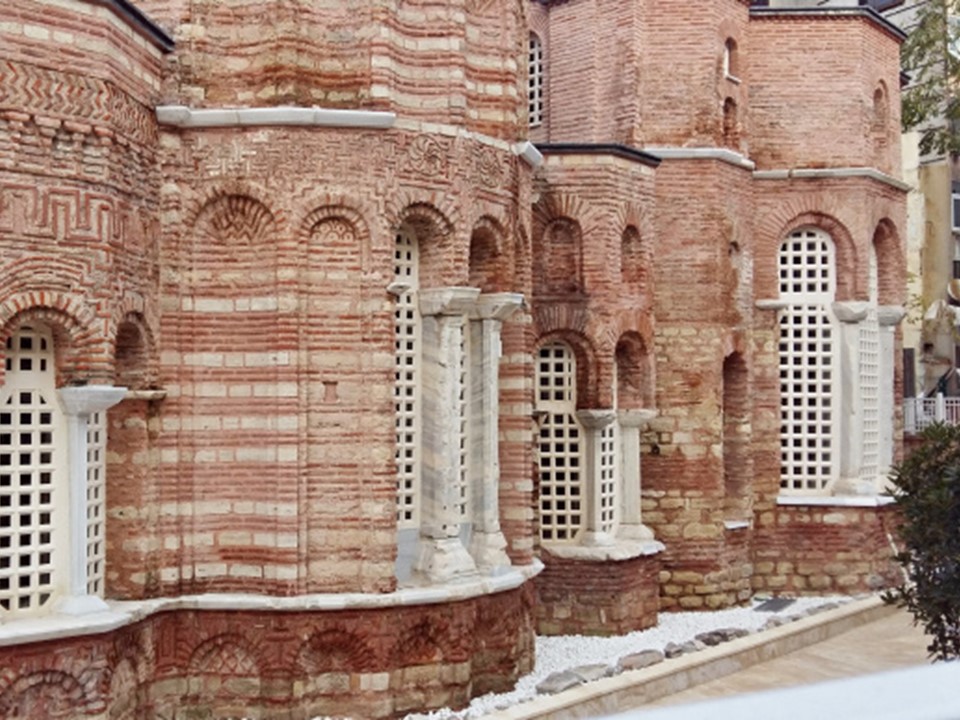
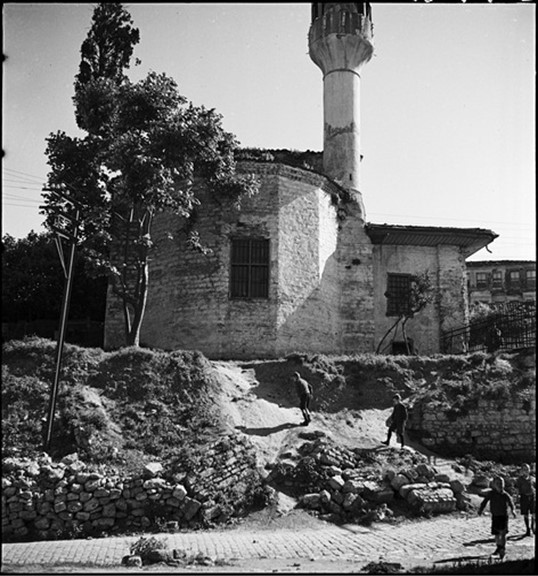
Lips Monastery in Constantinople, East Side of both South and North Churches, 10h and 13h cent., Constantinople. Today the Byzantine Church is a Mosque known as Fenari Isa Cami.

Lips Monastery in Constantinople

Lips Monastery in Constantinople, East Side of both South and North Churches, 10h and 13h cent., Constantinople. Today the Byzantine Church is a Mosque known as Fenari Isa Cami.
Lips Monastery in Constantinople, East Side of both South and North Churches, 10h and 13h cent., Constantinople. Today the Byzantine Church is a Mosque known as Fenari Isa Cami. https://grandeflanerie.com/portfolio/byzantineistanbul/7/

“The frequent fires that have caused such terrible destructions in Constantinople have, in some respect, facilitated archaeological investigation and the study of Byzantine monuments. As is well known, the byzantine churches that have been converted into mosques usually stood tightly surrounded by wooden houses in the center of labyrinthic Turkish quarters. Following the disappearance of these obstructive houses, many Byzantine monuments have emerged as isolated ruins in the midst of wide open spaces… This has been the case with the monastery of Lips to which the Empress Theodora added towards the end of the thirteenth century the church of the Prodromos, intended as a mausoleum for herself and the family of the Palaeoplogi…” writes Theodore Macridy as an introduction to his article… and I am indebted for all the information he provides for the Lips Monastery in Constantinople and the Theotokos Panachrantos Church BLOG POST https://www.jstor.org/stable/1291214?origin=crossref&seq=1#metadata_info_tab_contents
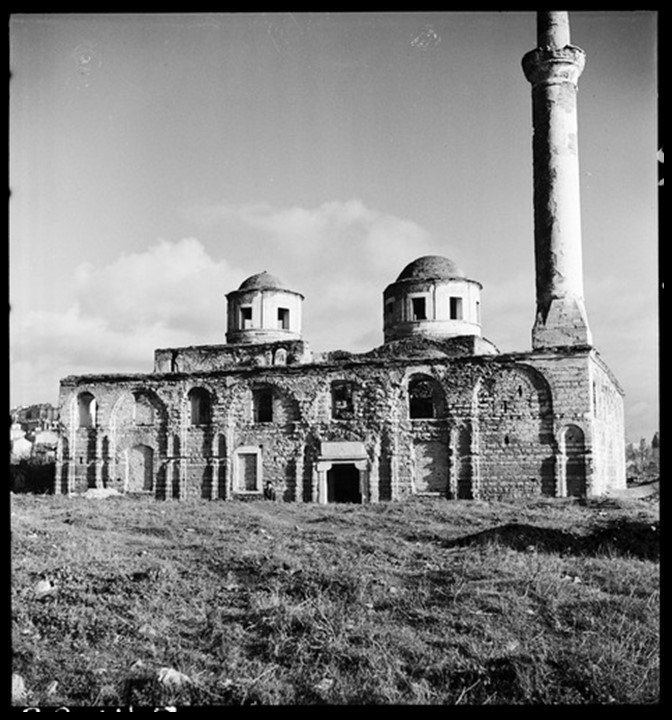
Nicholas V. Artamonoff, 1908-1989
Monastery of Lips, Exterior view from the west, December 1935, Nicholas V. Artamonoff Collection, Image Collections and Fieldwork Archives, Dumbarton Oaks Research Library and Collection
Nicholas V. Artamonoff, 1908-1989
Monastery of Lips, Exterior view from the west, December 1935, Nicholas V. Artamonoff Collection, Image Collections and Fieldwork Archives, Dumbarton Oaks Research Library and Collection http://images.doaks.org/artamonoff/items/show/131

It was a summery June day of 907 (or 908) and Emperor Leo (Leo VI, called the Wise, 866-912) was on his way to the inauguration ceremony of a new Church dedicated to the Mother of God “Πανάχραντος.” The streets were quiet in the Lykos valley where Patrikios Constantinos Lips decided to commission his new Church taking into consideration novel architectural ideas. Constantinos Lips, aristocrat and military official, is at the peak of his career and he wants the Church of Πανάχραντοςto to reflect his status and… ambitions...
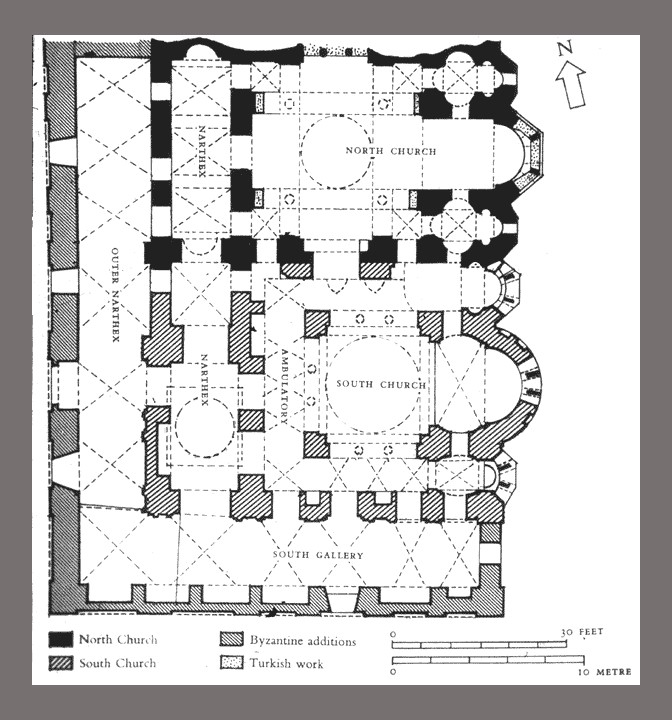
Lips Monastery in Constantinople (Today, Fenari Isa Camii, Istanbul), 10th to 14th century, Architectural Plan
http://projects.mcah.columbia.edu/medieval-architecture/htm/related/ma_theotok_of_lips_01.htm

The Church of Theotokos Panachrantos, or the North Church as is popularly known, is the oldest example of the cross-in-square domed type of Church Architecture in Constantinople. It is also a religious structure with a tripartite sanctuary to the east, and north to the west. The north and south vaults of the church terminate in huge windows that gloriously illuminate the interior of the church. The eastern vault extends over the church’s apse, creates a spacious Bema and is flanked by two tiny but elegant, quatrefoil structures that serve as the Prothesis and the Diakonikon. Apparently, the walls of this impressive church were further enhanced with marble veneering, both inside and outside. The Church of Theotokos Panachrantos was domed but the four columns supporting the vaults are missing, although three column bases survived the church’s probable fire destruction, and remain in their original positions. Equally interesting is the three-bay Narthex of the Church, which culminates, on its narrow sides, in shallow niches. Originally, the Narthex was preceded by a narrow exterior porch that covered the main entrance to the narthex. http://constantinople.ehw.gr/Forms/fLemmaBodyExtended.aspx?lemmaID=10907
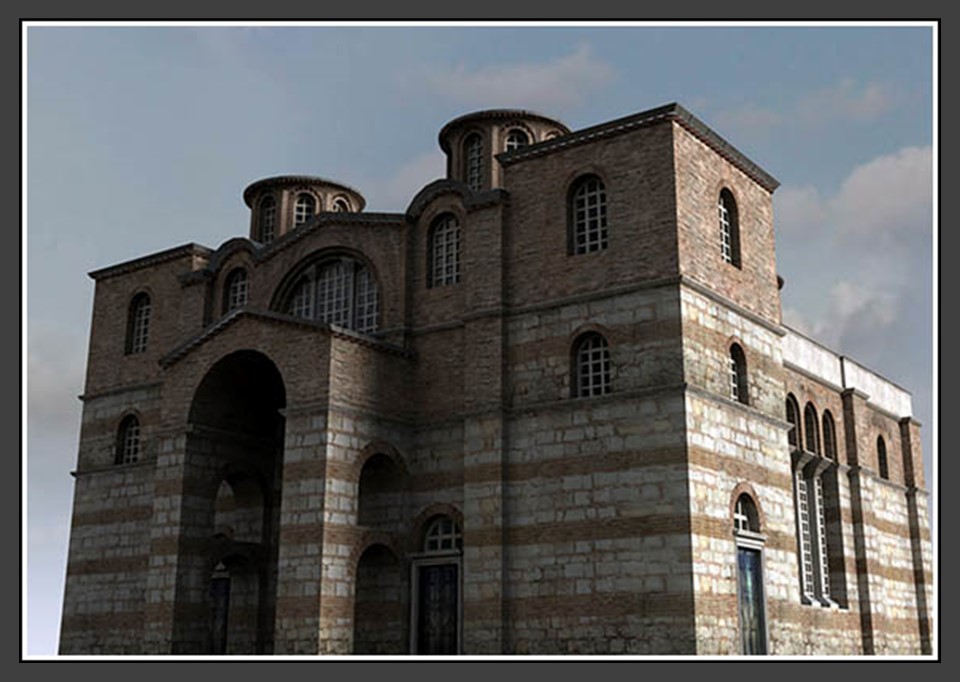
Photo Reconstruction of the North Church by A. Megaw with minor alterations
Photo Reconstruction of the North Church by A. Megaw with minor alterations… https://www.byzantium1200.com/c-lipsos.html

The original Church of the Panachrantos, incorporated in its original design plan, had six additional Chapels. Two of them, single-naved, flanking the Prothesis and Diakonikon, are now lost in their initial state. The North Chapel suffered the most. Today only a part of its apse has been discovered and unearthed as the result of archaeological excavations. The Southern Chapel, on the other hand, located next to the Panachrantos Diakonikon, was partially saved, serving as the Prothesis of the, attached, thirteenth century Church of Saint John. Four more Chapels existed on the roof of the North Church. These Chapels, partialy destroyed during the fire of 1917, were not visible if you were inside the Church. Two of these Chapels, in quatrefoil shape, were situated over the western corner bays of the naos, and two more Chapels, located over the Diakonikon and Prothesis, were to be seen at the east end of the building. Access to the roof was through a staircase inside the tower south of the Narthex. https://www.thebyzantinelegacy.com/lips
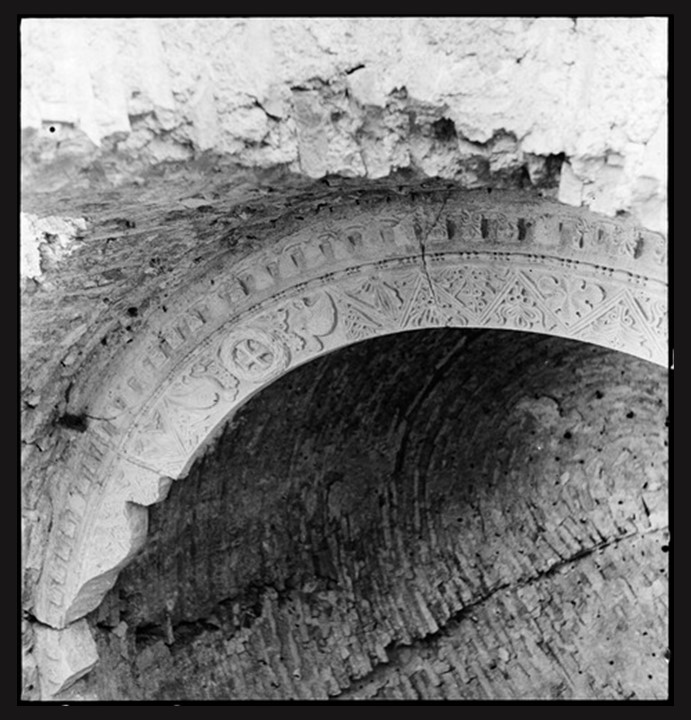
Nicholas V. Artamonoff, 1908-1989
Monastery of Lips, Marble Cornice of the Apse Arch (North Church), May 1937, Nicholas V. Artamonoff Collection, Image Collections and Fieldwork Archives, Dumbarton Oaks Research Library and Collection
Nicholas V. Artamonoff, 1908-1989
Monastery of Lips, Marble Cornice of the Apse Arch (North Church), May 1937, Nicholas V. Artamonoff Collection, Image Collections and Fieldwork Archives, Dumbarton Oaks Research Library and Collection http://images.doaks.org/artamonoff/items/show/131

The North church provides probably the largest and the most “outstanding collection of Middle Byzantine sculptural decoration in Constantinople” write Cyril Mango and Ernest J. W. Hawkins in their 1964 DO article. What survived shows “a wealth of carved ornaments both inside and outside… (unique quality in execution, and the use of) …an endless variety of motifs – highly stylized palmettes, and “bouquets” of different forms, fleurons, stars and crosses (peacocks and eagles) – (that create) a sense of unit on the decoration as a whole.” The style of sculptural rendering is crisp, with sharp ridges that are carefully “smoothed down to the flat background upon which the forward contours of the motifs are repeated.” Mango and Hawkins proceed to an amazing description of amazing discoveries. https://www.jstor.org/stable/1291216?origin=crossref&seq=6#metadata_info_tab_contents, pp. 304-311

The Church Constantinos Lips, built in the early 10th century, survived time, devastating fires and invasions. Attached to it, Empress Theodora, widow of Emperor Michael VIII Palaiologos (r. 1259–1282), established a second Church dedicated to St. John the Baptist known today as the “South Church.” Constantinos’s Church was now part of a prestigious Nunnery, a Xenon and the Burial “ground) of the Paleologean family. (…to be addressed)  

During the Ottoman period the Lips Monastery (South Church) served as a Mescit (a small mosque) and later, in 1636, after a fire in 1633, the South Church was upgraded to Camii while the North Church was converted into a Tekke (a dervish lodge). Two more fires down the path of history…the building was abandoned… but excavations in 1929, and a thorough restoration between the 1950s and the 1960s by the Byzantine Institute of America, gave it new life, so that today, known as Fenari Isa Camii, serves once again as a mosque.

An interesting Video of the exterior of Lips Monastery can be accessed … https://www.facebook.com/watch/?v=1703858606415101

For a Student Activity, please…Click HERE!
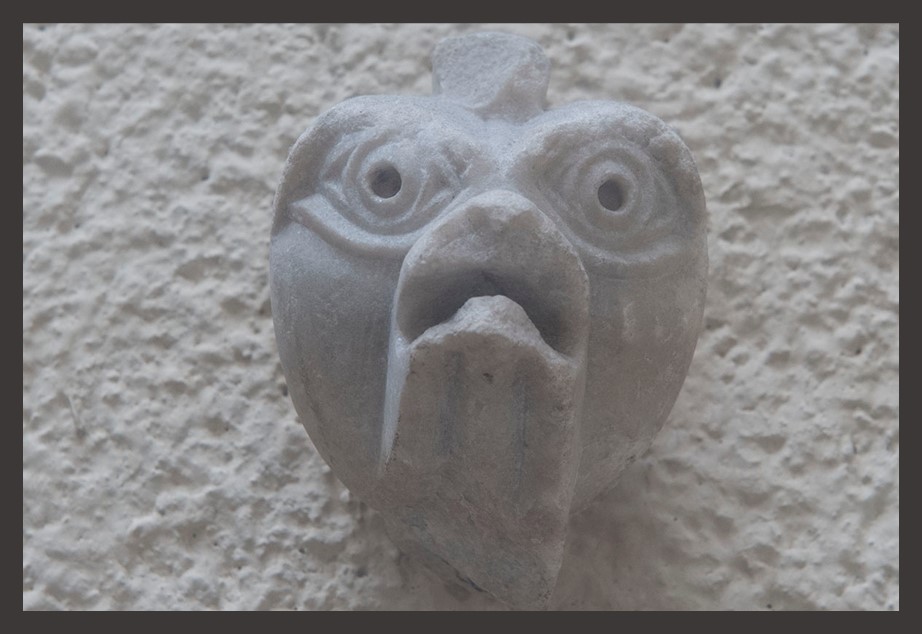
Monastery of Lips: The North Church Sculptural Decoration, early 10th century, Istanbul Archaeological Museum
Monastery of Lips: The North Church Sculptural Decoration, early 10th century, Istanbul Archaeological Museum. Photo Credit: Dick Ossemann, https://pbase.com/dosseman/image/159013722
Nicholas V. Artamonoff, 1908-1989, Kefeli Mosque in Istanbul, Nave and Apse from the south, March 1936, Nicholas V. Artamonoff Collection, Image Collections and Fieldwork Archives, Dumbarton Oaks Research Library and Collection   

Unidentified Byzantine Building in Constantinople known today as Kefeli Mosque

Nicholas V. Artamonoff, 1908-1989, Kefeli Mosque in Istanbul, Nave and Apse from the south, March 1936, Nicholas V. Artamonoff Collection, Image Collections and Fieldwork Archives, Dumbarton Oaks Research Library and Collection   
Nicholas V. Artamonoff, 1908-1989
Kefeli Mosque in Istanbul, Nave and Apse from the south, March 1936, Nicholas V. Artamonoff Collection, Image Collections and Fieldwork Archives, Dumbarton Oaks Research Library and Collection     http://images.doaks.org/artamonoff/items/show/245

The moment was grave… it was the 22nd of July 838, hot and humid, and Emperor Theophilos,  was besieged by the army of Caliph al-Mu’tasim near the hill of Dazimon. Earlier on “while the sky darkened and rain begun to fall in torrents… (he) saw that his opposite wing was in difficulties and (omitting to tell his junior commanders what he was about to do) led 2,000 men round behind the center to reinforce it… his unexpected disappearance immediately gave rise to a rumour that he had been killed. Panic broke out, followed – as always – by flight; and when the rain stopped and the light returned Theophilos realized that he and his men were surrounded.” The moment was grave… but when the Khurramite soldiers in the emperor’s entourage reportedly began planning to surrender the Emperor to the Arabs, Manuel the Armenian, Domestic of the Schools, commander of the elite tagma of the Scholae and de facto commander-in-chief of the entire Byzantine army, seized the Emperor’s horse by the bridle and threatening the confused emperor with his sword, forcibly broke through the Arab lines, and brought Theophilos to safety in the nearby village of Dorylaeum. Although Byzantine military history is not my forte when I researched the history of the Unidentified Byzantine Building in Constantinople known today as Kefeli Mosque and the name of Manuel the Armenian came up, I was intrigued and I did my reading…      John Julius Norwich, Byzantium – The Apogee, 1993 Penguin Books, pp. 48     and     Warren T. Treadgold, The Chronological Accuracy of the “Chronicle” of Symeon the Logothete for the Years 813-845, DOP Vol. 33 (1979), p. 180, 181     https://www.jstor.org/stable/1291437?read-now=1&refreqid=excelsior%3Ae308c8234dcf2fe514aff96de764bb09&seq=23#page_scan_tab_contents
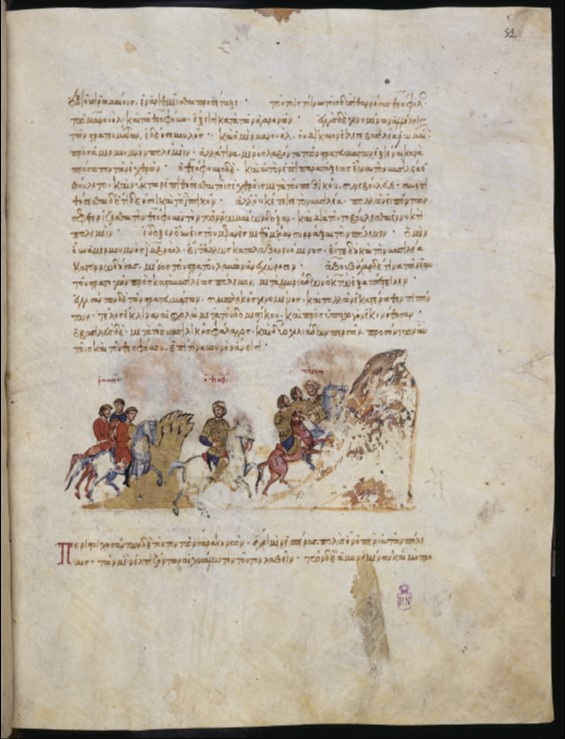
Codex Græcus Matritensis Ioannis Skylitzes or Madrid Skylitzes, The Byzantine army under Emperor Theophilos retreats towards a mountain (detail), fol. 54r, 12th-13th centuries, Biblioteca Nacional de España, Madrid
http://bdh-rd.bne.es/viewer.vm?id=0000022766&page=1

It seems that there is a bit of a controversy between Byzantine Chronographers of what was the fate of the brave general… Some of the Chronographers report that Manuel the Armenian died of wounds that he received in the fateful battle of Dazimon (most probable) and was buried in the Monastery of Manuel in Constantinople, traditionally identified with the Kefeli Mosque. Other chronographers narrate how Manuel survived the battle, returned to Constantinople, took part in the second battle of Dazimon, and died, in the late 850s, a devoted Iconodule, during the reign of Emperor Michael III.     Warren T. Treadgold, The Chronological Accuracy of the “Chronicle” of Symeon the Logothete for the Years 813-845, DOP Vol. 33 (1979), p. 182, 183     https://www.jstor.org/stable/1291437?read-now=1&refreqid=excelsior%3Ae308c8234dcf2fe514aff96de764bb09&seq=23#page_scan_tab_contents
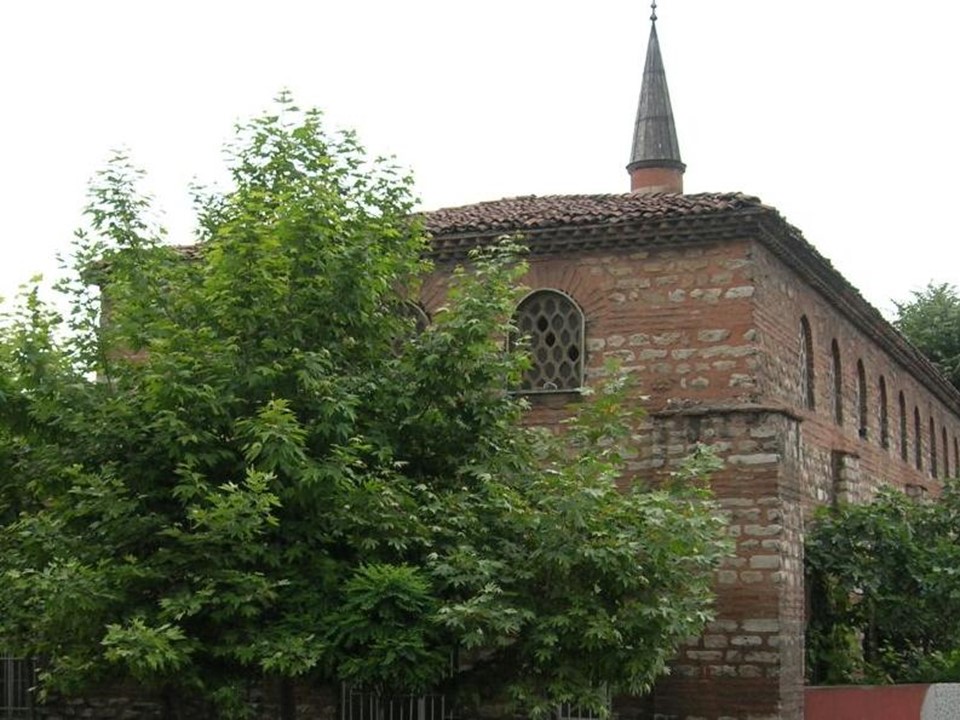
Unidentified Byzantine Basilica Building in Constantinople known today as Kefeli Mosque, 9th century, Istanbul
http://thearthistoryjournal.blogspot.com/2011/07/converted-byzantine-churches-in.html

Kefeli Mosque’s history is intriguing, to say the least. It is not yet established if it was originally part of the Byzantine Monastery of Manuel, founded in the mid 9th century, rebuilt by Patriarch Photius, restored once more by Romanos I Lekapenos and used by Emperor Michael VII to retire after his deposition. Scholars are not even sure if the ΚΤΗΤΩΡ(founder) of the Monastery was indeed Manuel the Armenian, and if the Monastery was founded within Manuel’s residential complex. More importantly, scholars can not be certain if the surviving building was originally a Church or a Monastic refectory. It seems that all scholars agree that it was never the Katholiko of a Monastery.
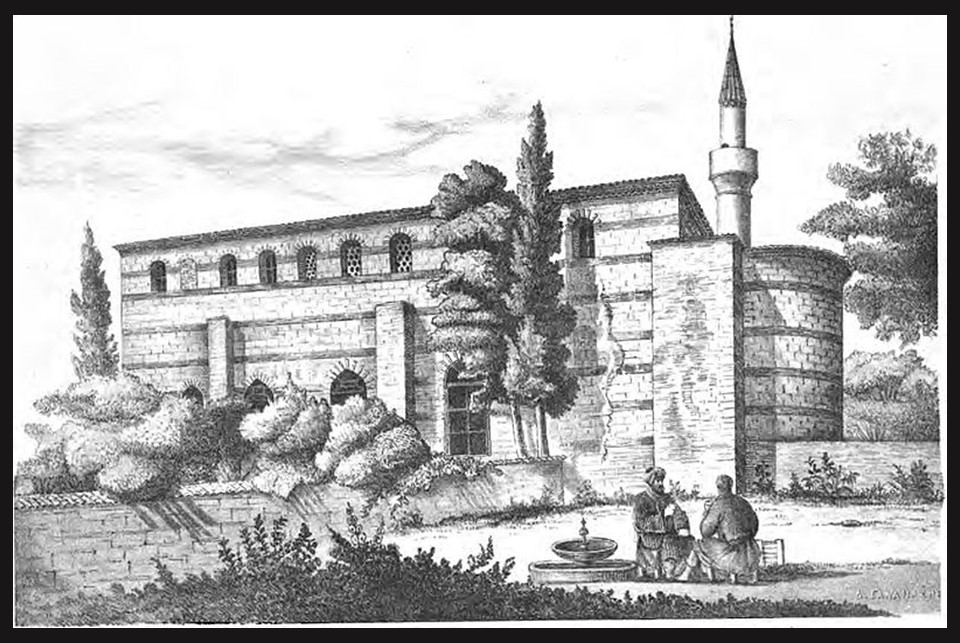
Alexandros Georgiou Paspates, 1814-1891, Byzantinai meletai topographikai, 1877, Constantinople
Alexandros Georgiou Paspates, 1814-1891
Byzantinai meletai topographikai, 1877, Constantinople
https://ia800304.us.archive.org/0/items/vyzantinaimelet00unkngoog/vyzantinaimelet00unkngoog.pdf page 332 and https://commons.wikimedia.org/wiki/File:Moni_tou_Manouil.jpg

The building was a basilica, according to Paspates a “κτίριον δρομικόν” and recent studies describe it as an interesting example of how the early Christian Basilica form developed or adapted during the Middle Byzantine period. It is believed that Kefeli Mosque was a 3-aisled basilica building with an apse (polygonal outside, but semicircular inside with two niches) facing north.

What can be said with certainty, is that the presented Byzantine building successively served the Greek Orthodox population of the city, the Catholics along with the Orthodox Armenians, and since 1630 the Muslim population of Karagümrük neighbourhood in Fatih district of Istanbul. Its name comes from Caffa (Kefe) in Crimea.     https://ia800304.us.archive.org/0/items/vyzantinaimelet00unkngoog/vyzantinaimelet00unkngoog.pdf     and    http://suleymankirimtayif.com/pdf/ByzantineChurchesinIstanbul.pdf     and     http://www.istanbulvisions.com/kefeli_mosque.htm

An interesting Collection of Photographs of Kefeli Mosque can be seen in the ARIADNE – Digital Archaeology in Europe site put together by The German Archaeological Institute (DAI) Istanbul photo archive:     https://arachne.dainst.org/project/fotoistanbul     and     https://arachne.dainst.org/project/fotoistanbul/search?q=%22Kefeli%20Camii%22     In addition, the Nicholas V. Artamonoff Collection, at the Dumbarton Oaks Research Library and Collection – Image Collections and Fieldwork Archives, is equally interesting to explore     http://images.doaks.org/artamonoff/items/show/244

 For a Student Activity, please… Check HERE!
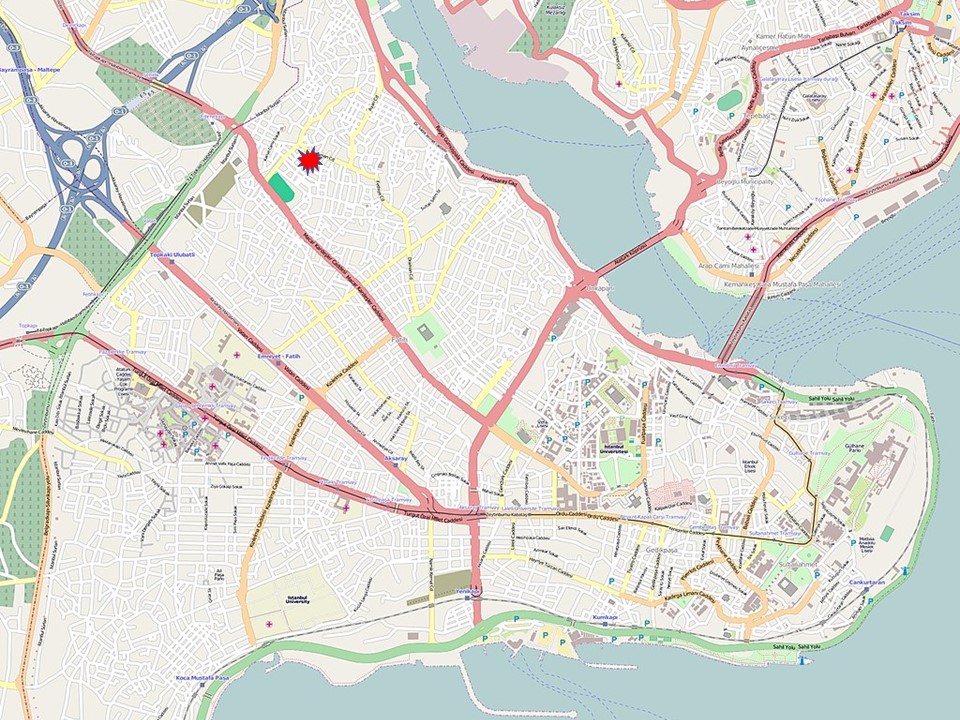
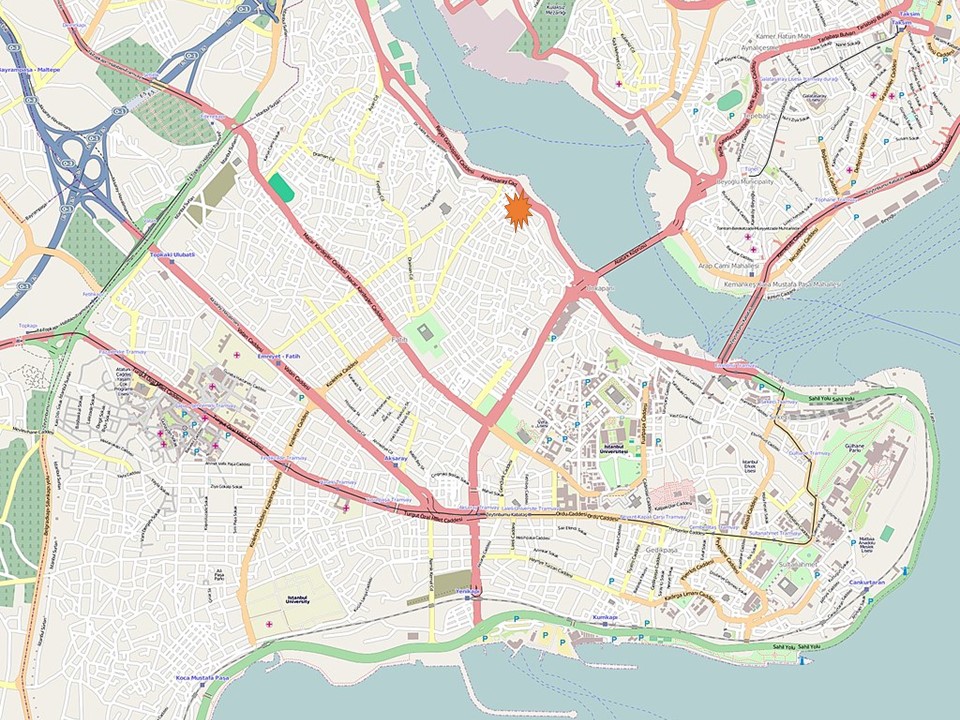
Map of Byzantine Constantinople: The Red star marks the location of Kefeli Mosque
Unidentified Byzantine Church in Constantinople known today as Atik Mustafa Paşa Camii, original Byzantine construction date: 842-867 and Photograph by Dick Osseman, East Façade

Unidentified Byzantine Church in Constantinople known today as Atik Mustafa Paşa Camii

Unidentified Byzantine Church in Constantinople known today as Atik Mustafa Paşa Camii, original Byzantine construction date: 842-867 and Photograph by Dick Osseman, East Façade
Unidentified Byzantine Church in Constantinople known today as Atik Mustafa Paşa Camii, original Byzantine construction date: 842-867
Photograph by Dick Osseman, East Façade, https://pbase.com/dosseman/atikmustafa
East Façade, Analysis of Masonry (after Mathews) https://www.jstor.org/stable/1291520?seq=8#metadata_info_tab_contents

It’s bitter cold, a snowy Sunday in the συμβασιλεύουσα του Βυζαντίου and I enjoy reading “Notes on the Atik Mustafa Paşa Camii in Istanbul and its frescoes” by Thomas F. Mathews and Ernest J. W. Hawkins in Dumbarton Oaks Papers, Vol. 39 (1985), pp. 125-134. My goal is to prepare for a new POST, titled… Unidentified Byzantine Church in Constantinople known today as Atik Mustafa Paşa Camii.     https://www.jstor.org/stable/1291520?seq=1#metadata_info_tab_contents

Unidentified Byzantine Church in Constantinople known today as Atik Mustafa Paşa Camii, original Byzantine construction date: 842-867 Photograph by Dick Osseman
Unidentified Byzantine Church in Constantinople known today as Atik Mustafa Paşa Camii, original Byzantine construction date: 842-867
Photograph by Dick Osseman https://pbase.com/dosseman/atikmustafa

Atik Mustafa Paşa Camii is a historic Byzantine church in Constantinople, an Ottoman Mosque of great importance for the Muslims, and an intriguing building for the expert Art Historians in the academic world. I have to confess I never visited the building and that makes it difficult to talk about it… I rely, however, on Mathews and Hawkins Dumbarton Oaks Paper, the Encyclopedia of the Hellenic World presentation, the Byzantine Legacy report, and the precious photographs taken by Dick Ossemann. This may not be “all-inclusive,” it is the groundwork for my next trip… στην Πόλη!    https://www.jstor.org/stable/1291520?seq=1#metadata_info_tab_contents,    http://constantinople.ehw.gr/forms/fLemmaBodyExtended.aspx?lemmaID=11785,     https://www.thebyzantinelegacy.com/atik     and     https://pbase.com/dosseman/atikmustafa

Unidentified Byzantine Church in Constantinople known today as Atik Mustafa Paşa Camii, original Byzantine construction date: 842-867, drawing of 1877, from A.G. Paspates' Byzantine Topographical Studies
Unidentified Byzantine Church in Constantinople known today as Atik Mustafa Paşa Camii, original Byzantine construction date: 842-867, drawing of 1877, from A.G. Paspates’ Byzantine Topographical Studies

References to early 20th-century bibliography and logical deductions lead Mathews and Hawkins to a first acceptance that the Atik Mustafa Paşa Camii is “the earliest Constantinopolitan example of a cross-domed church (and indeed the first Constantinopolitan church after Iconoclasm).” The authors further studied the articulation of the East End of the building, the design of the Apses (p. 127), the windows in the apses, drew comparisons to many Constantinopolitan churches for plausible similarities and drew the conclusion that the Atik share the most similarities with “the Theotokos of Lips (church) of 907 and the Myrelaion 920-22. With these churches the Atik shares the basic plan of three triple-faceted apses in which surfaces begin to be broken up by windows and niches set at varying levels.” Further comparisons (pp.127-128) on where apse windows were placed and the lack of horizontal cornices enhanced the belief that Atik Mustafa Paşa Camii “while closely related to the Lips and the Myrelaion, seems to represent an earlier stage in the evolution of apse design. Very likely it belongs to the second half of  the ninth century in the new surge of church building known from literary sources to have followed the defeat of Iconoclasm in 842 and the accession of Basil I in 867.”     https://www.jstor.org/stable/1291520?seq=4#metadata_info_tab_contents

The Dumbarton Oaks Paper by Mathews and Hawkins is an inexhaustible source of information I enjoyed reading. Groundwork accomplished, I feel ready for a future trip… στην Πόλη

For a Student Activity, please… Check HERE!

Unidentified Byzantine Church in Constantinople known today as Atik Mustafa Paşa Camii, original Byzantine construction date: 842-867
South Wall Frescoes, https://www.jstor.org/stable/1291520?seq=8#metadata_info_tab_contents
The Church of the Holy Martyr Polyeuctus, built by Anicia Juliana in the 520s, on the northern branch of Constantinople’s Mese, between the Forum Tauri and the Church of the Holy Apostles, today in the Saraçhane area of Istanbul

Church of the Holy Martyr Polyeuktos

The Church of the Holy Martyr Polyeuctus, built by Anicia Juliana in the 520s, on the northern branch of Constantinople’s Mese, between the Forum Tauri and the Church of the Holy Apostles, today in the Saraçhane area of Istanbul
The Church of the Holy Martyr Polyeuctus, built by Anicia Juliana in the 520s, on the northern branch of Constantinople’s Mese, between the Forum Tauri and the Church of the Holy Apostles, today in the Saraçhane area of Istanbul. Photo by Dick Osseman https://pbase.com/dosseman/polyeuktos

“The empress Eudocia, in her eagerness to honour God, was the first to build a temple to the divinely inspired Polyeuktos; but she did not make it like this or so large, not from any thrift or lack of resources—for what can a queen lack?—(5) but because she had a divine premonition that she would leave a family which would know how to provide a better embellishment. From this stock Juliana, bright light of blessed parents, sharing their royal blood in the fourth generation, did not cheat the hopes of that queen, who was mother of the finest children, (10) but raised this building from its small original to its present size and form, increasing the glory of her many-sceptred ancestors.” The Church of the Holy Martyr Polyeuktos has it all… a 6th-century magnificent building, in ruins today, with intricate decoration, a documented 76-line poem in Greek Anthologia (AP 1.10), stories of greed and looting, excavations in the 1960s, extensive Bibliography from around the world and currently, an Archaeological Site, frequently overlooked(?)…https://chs.harvard.edu/CHS/article/display/3263.mary-whitby-the-st-polyeuktos-epigram-ap-1-10-a-literary-perspective     and     https://topostext.org/work/532

Empress Aelia Eudocia? and Portrait of Anicia Juliana flanked by Megalopsychia and Phronesis, Vienna Dioscurides
Empress Aelia Eudocia?, c. 907, coloured stone inlay on marble from Church of Lips Monastery, 66 by 28 cm, Archeological Museum, Istanbul     http://monasticmatrix.osu.edu/figurae/icon-saint-eudokia
Portrait of Anicia Juliana flanked by Megalopsychia and Phronesis, Vienna Dioscurides, Folio 6v, about 515 AD, Byzantine Greek Illuminated Manuscript of De Materia Medica by Pedanius Dioscurides, vellum folios measure 37 by 30 cm, Österreichischen Nationalbibliothek, Vienna     https://en.wikipedia.org/wiki/Anicia_Juliana#/media/File:Wiener_Dioskurides_6v_(portrait_detail).jpg

Empress Eudocia, according to the poem, was the first to build a small Church dedicated to Polyeuktos and Anicia Juliana, great-granddaughter of Eudocia, was the family member “which would know how to provide a better embellishment.” What an interesting family affair! To further elaborate on the early history and topography of the Church… it was constructed between 524 and 527, on the northern branch of Constantinople’s Mese, between the Forum Tauri and the Church of the Holy Apostles, near the Column of Marcian and the Aqueduct of Valens, in near proximity to the Palace of Anicia Juliana.    https://www.thebyzantinelegacy.com/polyeuktos     and     http://constantinople.ehw.gr/Forms/filePage.aspx?lemmaId=11784

Topographical map of Constantinople during the Byzantine period. The Green STAR marks the location of the Church of the Holy Martyr Polyeuktos. 
Topographical map of Constantinople during the Byzantine period. The Green STAR marks the location of the Church of the Holy Martyr Polyeuktos.     https://commons.wikimedia.org/wiki/File:Byzantine_Constantinople-en.png

An accidental discovery in the 1960s, led to excavations in the area Saraçhane of modern Istanbul… which brought to light the foundation of a monumental church while inscriptions on several of the unearthed sculptural blocks, in fact, they were magnificently decorated extracts of the donor’s inscription, allowed Cyril Mango and Ihor Ševčenko to identify the archaeological discovery as the Church of the Holy Martyr Polyeuktos. Excavations on the site of the Church lasted six seasons (1964-69) and it was a joined effort between the Istanbul Archaeological Museum (represented by Nezih Fıratlı) and Dumbarton Oaks, Centre for Byzantine Studies of Harvard University, under the directorship of Professor Martin Harrison.  Mango C., Ševčenko I., Remains of the church of St. Polyeuktos at Constantinople, Dumbarton Oaks Papers, 15, 1961     https://www.jstor.org/stable/i255238     and     https://www.academia.edu/2122854/Martin_Harrisons_Excavations_in_Istanbul

The Church of the Holy Martyr Polyeuctus, built by Anicia Juliana in the 520s, on the northern branch of Constantinople’s Mese, between the Forum Tauri and the Church of the Holy Apostles, today in the Saraçhane area of Istanbul

In the background of this photograph taken in 1968, of the Archaeological Excavation of the Church of the Holy Martyr Polyeuktos is the famous “Aqueduct of Valens”, a bridge that carried water for the Byzantine and Ottoman city…    https://www.academia.edu/2122854/Martin_Harrisons_Excavations_in_Istanbul

At the time she commissioned the Church of St. Polyeuktos, Anicia Juliana, sharing …royal blood in the fourth generation,” was the noblest and the wealthiest woman in the Empire. She lived in a magnificent palace in the area of the Church and raised this building from its small original to its present size and form, increasing the glory of her many-sceptred ancestors.”At the entrance of the church, outside the narthex, archaeologists discovered five more inscribed plaques where we read… “What choir is sufficient to sing the contests of Juliana who, after Constantine, embellisher of his Rome, after the holy all-golden light of Theodosius, (45) and after royal descent from so many forebears, accomplished a work worthy of her family, and more than worthy     /     in a few years? She alone has overpowered time and surpassed the wisdom of the celebrated Solomon, raising a temple to receive God, the richly wrought and gracious splendour of which a great epoch cannot celebrate.”

There is no doubt Anicia Juliana was Emperor Justinian’s political and artistic, if I may add, adversary. Her dedicatory poem at the Church of the Holy Martyr Polyeuktos is a blunt challenge. Her Imperial lineage and wealth was a test to match for Justinian and his ambitions… According to Gregory of Tours, and well-recorded in Byzantine Legacy… “the Emperor Justinian requested the wealthy Juliana to make a contribution to the public treasury. She feigned to be willing to do so and invited the Emperor to visit her in her house after a given period of time during which she might be able to bring her treasure together. Meanwhile, she called in craftsmen, handed them all her gold and directed them to cast it into plaques which were to be affixed to the roof of Hagios Polyeuktos. After this had been done, Juliana invited the Emperor to come and, having taken him to the martyr’s church, pointed to its roof. My poverty is contained in this work. Do with it whatever you please…” she allegedly said, and thus avoided Justinian’s rapacity. What a story…     https://www.thebyzantinelegacy.com/anicia-juliana     and     http://csla.history.ox.ac.uk/record.php?recid=E00655     and     http://www.anastasiaashman.com/anastasiaashman/tag/Gregory+of+Tours

Reconstruction of the Church of the Holy Martyr Polyeuctus 
Reconstruction of the Church of the Holy Martyr Polyeuctus     https://dahabianalog.wordpress.com/2017/08/17/ayios-aziz-polyeuktos-kilisesi/

The Church of the Holy Martyr Polyeuktos was one of Constantinople’s most admired monuments for over five hundred years. “The church was certainly still in use in the 10th century, as it was one of the landmarks visited by the emperor during his Easter procession.” Then… we can only guess… the ornate Church of Anicia Juliana was gradually abandoned and valuable building materials were taken and used in the construction of other Constantinopolitan churches, such as the Pantokrator Monastery. In 1204 the Crusaders seized Constantinople and the Church, abandoned at the time, fell into ruins and many of its decorative architectural pieces were removed to Venice, Barcelona and Vienna.

After the Fall of Constantinople in 1453, “houses and a mosque were built in the now completely flattened space of St Polyeuktos’ church. This occupation of the location lasted until 1940 when the mosque was demolished. In 1960, during construction works in the area, some parts of the architecture of St Polyeuktos were unearthed” and a new period for the history of the Church started as a significant Archaeological Site “both due to the wealth and variety of the findings, and the architectural type of the church discovered.” http://constantinople.ehw.gr/Forms/filePage.aspx?lemmaId=11784

For a Student Activity, please… Check HERE!

Church of the Holy Martyr Polyeuktos, Part II, Architecture and Interior Decoration will follow in January 2021…

The Church of the Holy Martyr Polyeuctus, built by Anicia Juliana in the 520s, on the northern branch of Constantinople’s Mese, between the Forum Tauri and the Church of the Holy Apostles, today in the Saraçhane area of Istanbul
The Church of the Holy Martyr Polyeuctus, built by Anicia Juliana in the 520s, on the northern branch of Constantinople’s Mese, between the Forum Tauri and the Church of the Holy Apostles, today in the Saraçhane area of Istanbul. Photo by Dick Osseman https://pbase.com/dosseman/polyeuktos

Byzantine church, known as Saint Mary of the Mongols in  Constantinople

Saint Mary of the Mongols

Byzantine church, known as Saint Mary of the Mongols in  Constantinople
Nicholas V. Artamonoff Collection from 1930-1947
Image Collections and Fieldwork Archives (ICFA) of Dumbarton Oaks Research Library and Collection
Byzantine church, known as Saint Mary of the Mongols in  Constantinople
Nicholas V. Artamonoff Collection from 1930-1947
Image Collections and Fieldwork Archives (ICFA) of Dumbarton Oaks Research Library and Collection

«The Byzantine church known as Saint Mary of the Mongols, or Theotokos ton Mougoulion, was once the katholikon of the Monastery of the Theotokos tes Panayiotisses. It is situated in the modern quarter of Istanbul known as Fener, and is unique for being the sole Greek Orthodox sanctuary that has served the same function in Christian Constantinople as well as in Muslim Istanbul. Despite its unique status, the building has not received as much scholarly attention as other Byzantine religious monuments of similar historical importance…” writes Edmund C. Ryder, back in 2009/10.     https://journals.sfu.ca/jmh/index.php/jmh/article/view/260/263

My new POST on the surviving Byzantine Churches in Constantinople takes me to Mouchliotissa or Theotokos ton Mougoulion or Saint Mary of the Mongols. The name has an “exotic” appeal upon me, the fact that it is still Greek Orthodox in practice enhanced my interest… the journey… was fascinating. Right from the beginning, I wanted to establish my sources, scant on the church’s architecture, but informative and well written. Η Αρχιτεκτονική της Παναγίας του Μουχλίου στην Κωνσταντινούπολη by Charalambos Bouras      https://ejournals.epublishing.ekt.gr/index.php/deltion/article/viewFile/4126/3901.pdf     and     The Despoina of the Mongols and Her Patronage at the Church of the Theotokos ton Mougoulion by Edmund C. Ryder     https://journals.sfu.ca/jmh/index.php/jmh/article/view/260/263    

I love and use, for the purposes of this POST, the photographs taken by Nicholas V. Artamonoff from 1930-1947. I couldn’t find contemporary photos that surpass the atmospheric ambience of this unique place.  I am grateful to ICFA (Image Collections and Fieldwork Archives), part of the Dumbarton Oaks Research Library and Collection (an Institute of Harvard University located in Washington, D.C.) for making this Collection available to the world… to regard and admire…  http://images.doaks.org/artamonoff/collections/show/27

Byzantine church, known as Saint Mary of the Mongols in  Constantinople
Nicholas V. Artamonoff Collection from 1930-1947
Image Collections and Fieldwork Archives (ICFA) of Dumbarton Oaks Research Library and Collection
Byzantine church, known as Saint Mary of the Mongols in  Constantinople
Nicholas V. Artamonoff Collection from 1930-1947
Image Collections and Fieldwork Archives (ICFA) of Dumbarton Oaks Research Library and Collection

Ch. Bouras describes “The Panaghia Mouchliotissa as a tetraconch, aisleless, domed church with a slightly later tripartite narthex.” Drawings by Poridis reveal that major architectural changes took place, most probably “during the eighteenth century, in order to increase its size to house a larger congregation.” For example, “the south conch and a large part of the narthex were demolished to make way for the addition of a large hypostyle room roofed with Ottoman pointed domes and an exonarthex.” Originally, “the Mouchliotissa was a tetraconch church with a narthex and two unusual features: the size of each conch was increased by opening three smaller niches in the thickness of the wall, and the dome was supported on four arches carried on columns at the four corners of the central square.” These features, Bouras continues, are rare in Byzantine architecture of the time,  “enliven the interior space enhancing its visual interest and imparting a certain originality.”     https://ejournals.epublishing.ekt.gr/index.php/deltion/article/viewFile/4126/3901.pdf

Byzantine church, known as Saint Mary of the Mongols in  Constantinople
Plan for the original church with the narthex added by Maria Paleologina
Plan for the current church. The surviving parts of the original are in bold
http://wwwbisanzioit.blogspot.com/2018/12/maria-paleologina-e-la-chiesa-di-nostra.html

I always felt for the well-bred Byzantine Princesses whose destiny was to play a role in Byzantine diplomacy through marriage. Maria Paleologina was no exception. She was the illegitimate daughter of Michael VIII Palaeologus, the skilful Byzantine Emperor who accomplished in 1261 the dream of all Byzantines: reconquering the City of Cities, Constantinople. The new Emperor needed strong allies in the East and Maria Paleologina (1258/9-1282), barely 8 years old was “dispatched” to marry Khan Hulagu of the  Il-Khanate of Persia, the conqueror of Baghdad, who dreamed of triumphing over the entire Muslim East…

While in Cappadocia, February of 1265, Maria and her magnificent entourage learned of the death of Khan Hulagu and her new proposal to marry Hulagu’s son and successor, Abaqa. Maria continued her journey… arrived in Persia, married the Khan, grew up in the Khan’s harem and succeeded in turning Abaqa into a protector of Christians until his death… Maria Paleologina or “Despina Khatun, for the Mongols, was revered for her kindness, wisdom and strong leadership. Sources portrayed her as leading a pious life and being quite influential in politics…” When her husband died and his brother, the Muslim Tekuder, became the new Khan… “Maria managed to escaped in time from his control and return to Constantinople… (where) unmoved by the pageantry of the court in Constantinople decided to embrace the religious life…” She used her considerable wealth to found the convent of Theotokos Panaghiótissa in 1285, where, as a respected widow, remained until her death.

Melane the Nun in the Deesis Mosaic with donors Isaac Komnenos, Church of the Holy Saviour in Chora, Constantinople
https://en.wikipedia.org/wiki/Maria_Palaiologina

The life of Maria Peleologina is wonderfully presented in Maria Paleologina and the Il-Khanate Khanate of Persia. A Byzantine Princess in an Empire between Islam and Christendom by María Isabel Cabrera Ramos of the Universidad de Granada     https://repositori.udl.cat/bitstream/handle/10459.1/60547/imatem_a2017n11p217.pdf?sequence=1&isAllowed=y

For a Student Activity, please… Check HERE!

Byzantine church, known as Saint Mary of the Mongols in  Constantinople

Unidentified Byzantine Church in Constantinople of the Komnenia period, Vefa Kilise Camii of Istanbul since the 15th century

Unidentified Church in Constantinople known today as Vefa Kilise Camii

Unidentified Byzantine Church in Constantinople of the Komnenia period, Vefa Kilise Camii of Istanbul since the 15th century
Unidentified Byzantine Church in Constantinople of the Komnenia Dynasty (11th or 12th century) with an exonarthex of the Palaiologan period (13th century)
Vefa Kilise Camii of Istanbul since the 15th century

“A former Byzantine church, now known by its Turkish name Vefa kilise camii, stands on Tirendaz Caddesi on the neighborhood of Vefa on modern Istanbul, only a few hundred metres away from the aqueduct of Valens. In the Byzantine period this area was located between the 7th and 10th regions of Constantinople. Several proposals have been put forward the dedication and identification of this church. In the 16th century, Pierre Gilles was the first to suggest that it was a church dedicated to St. Theodore. Other identifications have included a church of the Theotokos, the church of St Procopius τηςΧελώνης, and the monastery of Gorgoepekoos. Vefa kilise camii is one of the least documented monuments of the Ottoman period, and so it is not exactly clear when it lost its function as a Christian church. This event must have occurred before 1494, when it was recorded as having a medrese with fifty students… Excavations at Vefa kilise camii and a partial cleaning of the mosaics were carried in 1937 by Hidayet Fuat Tagay and Miltiadis Nomidis, but their work was published only in 1990 by Cyril Mango.” Writes Haluk Çetinkaya… an informative introduction for my new POST on the Unidentified Church in Constantinople known today as Vefa Kilise Camii.     https://www.persee.fr/doc/rebyz_0766-5598_2009_num_67_1_4834     As promised, my goal is to present short POSTs on all Byzantine Churches of Constantinople. This is my second attempt with lots of unanswered questions!

Unidentified Byzantine Church in Constantinople of the Komnenia period, Vefa Kilise Camii of Istanbul since the 15th century

The first question to address is its Byzantine identification… “Frequently visited and recorded by 19th-century scholars and travellers, the building is sometimes identified as the church of St. Theodore (Ἄγιος Θεοδόρος ἑν τὰ Καρβουνάρια), based on the 16th-century account of Pierre Gilles, who noted a church of that dedication somewhere in this area.” The French natural scientist, topographer and translator, Pierre Gilles “In his four books on the topography of Constantinople, …describes initially the geographical location, the natural environment, the water supply and the climate of the region. He then reviews the city’s mythological and historical past, and subsequently, for each one of the seven hills of the city, describes the monuments, walls, gates and towers. He comes back to the most ancient monuments on every hill and ends with the description of Galata and the Ottoman monuments.”     http://rhegium.tripod.com/vefa.html     and     https://eng.travelogues.gr/collection.php?view=153

Plan of the Unidentified Byzantine Church in Constantinople of the Komnenia period, Vefa Kilise Camii of Istanbul since the 15th century

Identified or not, Vefa Kilise Camii is a Komnenian cross-in-square domed church of moderate size (each side is nine meters long), with an inner narthex and a three-domed exonarthex to the west. Beautifully built in a method described as “recessed brick technique”, the masonry of the building consists of alternate courses of brick and stone. The hidden brick row behind extraordinary thick bedding mortar is the characteristic of this building technique and a dating factor for the church as this construction method was popular from the second half of the 11th century to the end of the 12th century.     https://www.qantara-med.org/public/show_document.php?do_id=838&lang=en     and     https://www.nyu.edu/gsas/dept/fineart/html/Byzantine/index.htm?https&&&www.nyu.edu/gsas/dept/fineart/html/Byzantine/home.htm

Unidentified Byzantine Church in Constantinople of the Komnenia period, Vefa Kilise Camii of Istanbul since the 15th century

In 1937 under the direction of M.I. Nomides and the Ministry of Mosques, mosaics decorating the domes in the exonarthex were revealed, depicting, in the southern dome, the Virgin Theotokos surrounded by prophets and two imperial officers with prophets. Unfortunately, as of 2007, they have disappeared almost completely. Another note to add: Vefa Kilise Camii is one of the least studied Byzantine monuments of present-day Istanbul with the interior of the church proper, never been de-plastered and explored for remnants of its original history and decoration.    https://www.triposo.com/poi/W__110311532     and     http://rhegium.tripod.com/vefa.html     and     https://tarihivefa.blogspot.com/2019/02/vefa-molla-semsettin-gurani-kilise-cami_18.html

For a PowerPoint on the Unidentified Church in Constantinople known today as Vefa Kilise Camii, please… Check HERE!

The Unidentified Byzantine Church in Constantinople known today as Vefa Kilise Camii has been restored and here is a Youtube Video of the end result by The Hidden Face of Istanbul https://www.facebook.com/thehiddenfaceofistanbul/videos/160082956033322

Unidentified Byzantine Church in Constantinople of the Komnenia period, Vefa Kilise Camii of Istanbul since the 15th century
The Pala d’Oro (the altar retable of San Marco in Venice) (detail)

The Monastery of Pantokrator in Constantinople and the Pala d’Oro in Venice

The Pala d’Oro (the altar retable of San Marco in Venice) (detail)
The Pala d’Oro (the altar retable of San Marco in Venice) is an altarpiece with about 250 Cloisonné enamels of different sizes and epochs (10th – 12th century) on sheet gold. It was commissioned in Byzantium by the Venetians. The Archangel Michael is believed to have come from the Monastery of Pantokrator in Constantinople.

“Pala d’Oro (Italian, “Golden Pall” or “Golden Cloth”) is the high altar retable of the Basilica di San Marco in Venice. It is universally recognized as one of the most refined and accomplished works of Byzantine enamel, with both front and rear sides decorated.” Have you ever wondered what the connection might be between The Monastery of Pantokrator in Constantinople and the Pala d’Oro in Venice?     https://www.projectexpedition.com/tour-activity/venice/vip-alone-in-st-marks-basilica-after-hours/36173/

The Monastery of Pantokrator, I wrote a few days earlier, consists of three churches: the South Church, the North Church, and the Middle Church or the “Heroon.” The South Church dedicated to Christ the Pantocrator is the oldest and the largest of the three…     https://www.teachercurator.com/art/the-monastery-of-pantokrator-in-constantinople/

The Monastery of Pantokrator of Constantinople, 12th century
Imperial Church of the Komnenian Dynasty, today Şeyh Süleyman Mescidi of Istanbul
The Monastery of Pantokrator of Constantinople, 12th century
Imperial Church of the Komnenian Dynasty
Şeyh Süleyman Mescidi of Istanbul

The amazing Monastic Complex of Pantokrator, however, built by Emperor John II Komnenos, served a dual purpose… to honour the wishes of Empress Piroska-Eirene, tending to the needs of the “poor, sick, and suffering souls…” and be used as a mausoleum for the Komnenos Imperial family.

Drawing of the Monastery of Pantokrator of Constantinople, 12th century
Imperial Church of the Komnenian Dynasty, today Şeyh Süleyman Mescidi of Istanbul
The Monastery of Pantokrator of Constantinople, 12th century, Les Eglises de Constantinople by Jean Ebersolt, Adolphe Thiers, 1910

As you look at the elegant domes crowning all three Pantokrator Churches, your eyes slowly tumble down to embrace the graceful arches… allow your imagination free to envision the splendour that once graced their interiors, and ponder over the lives of all Byzantine Royals entombed under their stylish vaults.

The North Church, dedicated to Mary Eleousa was built after the death of Empress Piroska-Eirene, between 1124-1136, by Emperor John II Komnenos. The Church, built within the Monastic complex of Pantocrator, was dedicated to services offered by lay clergy but open to a wider congregation and attended by laymen. Smaller in size compared to the South Church, it follows a similar architectural style to the South Church and according to scholars, it was equally resplendent in its interior decoration.     https://www.thebyzantinelegacy.com/pantokrator-monastery

The Monastery of Pantokrator of Constantinople, 12th century
Imperial Church of the Komnenian Dynasty, today Şeyh Süleyman Mescidi of Istanbul

The smaller Middle Church, the last to be built, bridged and opened to the two original, free-standing, side Churches. Dedicated to Archangel Michael, affectionately called the Heroon, the Middle Church was the smallest of the three Pantokrator Churches and served as an Imperial Mausoleum. The architectural style and use of the Heroon, capped by two elliptical domes, was probably inspired by the roughly contemporary, Crusader Martyrium of the Holy Sepulchre in Jerusalem as the arrangement of the Imperial Burials in its interior further testifies. “While several Arcosolia are still evident in the western bay, the identities of their occupants remain unresolved. The only exception is that of Emperor Manuel I (1118-1180), whose black marble sarcophagus was located in the passageway from the South Church to the (middle) Chapel. It is likely that its two domes had two separate functions, the one in the east serving as the liturgical area, and the western one, where the tombs were located, functioning as a funerary space.”     https://www.thebyzantinelegacy.com/pantokrator-monastery     and     http://constantinople.ehw.gr/Forms/fLemmaBodyExtended.aspx?lemmaID=11770

The Emperors and Empresses buried in the Heroon spared no funds in embellishing the Pantokrator Churches with amazing examples of monumental Art as well as items of luxurious Minor Arts. Visitors to the Monastery of our Lord and Saviour Jesus Christ the Pantokrator describe it as impressive in importance, resplendent in its decoration and dazzling in luxury! Unfortunately, “…under Latin rule of the city (1204-1261), the region in which the monastery stood belonged to the Venetians, who transported many of the holy utensils, relics and icons of the monastery to Venice.”  It is most probable “that some of the panels of the Pala D’Oro in San Marco originally came from the Pantokrator Monastery. While it was originally ordered from Constantinople by the doge Ordelaffo Falier in 1102, it was reworked following the Fourth Crusade’s sacked Constantinople in 1204.” http://constantinople.ehw.gr/Forms/fLemmaBodyExtended.aspx?lemmaID=11770

The Monastery of Pantokrator of Constantinople, 12th century
Imperial Church of the Komnenian Dynasty, today Şeyh Süleyman Mescidi of Istanbul
Fragments of the original Mosaic decoration of the Middle Church at the Monastery of Pantocrator in Constantinople.

The Treasury of San Marco, Venice, Basilica di San Marco, The Metropolitan Museum of Art (1984) is informative and Free to Download ONLINE companion Catalogue of the synonymous Exhibition that took place in New York in 1985. Sergio Bettini’s article Venice, the Pala D’Oro, and Constantinople is “illuminating” to say the least, on how the Palla D’Oro is connected to the Monastery of Pantokrator. (Please read pp. 33-64)     https://www.metmuseum.org/art/metpublications/the_treasury_of_san_marco_venice

After Hagia Sofia, present-day Şeyh Süleyman Mescidi or popularly called Zeyrek Camii, is the second-largest religious structure from the Byzantine Empire to survive in Istanbul.

For a Student Activity, please… Check HERE!

The Monastery of Pantokrator of Constantinople, 12th century
Imperial Church of the Komnenian Dynasty, today Şeyh Süleyman Mescidi of Istanbul
Exterior View of the Monastery of Pantokrator in Constantinople (The South Church to the right, the Middle Church to the left)

The Monastery of Pantokrator in Constantinople

The Monastery of Pantokrator of Constantinople, 12th century
Imperial Church of the Komnenian Dynasty, today Şeyh Süleyman Mescidi of Istanbul
The Monastery of Pantokrator of Constantinople, 12th century
Imperial Church of the Komnenian Dynasty
Şeyh Süleyman Mescidi of Istanbul

“The most important imperial foundation from the Komnene age is the Monastery of Pantokrator, which continues to this day to impress both the scholar and the casual visitor. It is as clear to those who visit its three churches, which despite repeated devastation still inspire admiration for the perfection of their construction and the elegance of their decoration, as to those who read its Typicon that John II Komnenos and his empress Eirene spared no cost to erect a splendid monastery complex, which absorbed a number of smaller foundations, mainly in the environs of Constantinople, and to make generous provision for its upkeep and operation…” writes Sofia Kotzabassi in her preface for the 2013 Volume on The Pantokrator Monastery in Constantinople. I couldn’t agree more! https://www.academia.edu/32217856/The_Icon_of_the_Three_Holy_Hierarchs_at_the_Pantokrator_Monastery_and_the_Epigrams_of_Theodore_Prodromos_on_Them

Overlooking the Golden Horn, built on the slopes of the 4th Hill of Constantinople and in the company of such great buildings like the Church of the Holy Apostles and the Aqueduct of Valens, the monastic complex of Pantokrator with its churches, library and hospital, stood formidable and impressive. What an amazing structure… Founded by the Byzantine Emperor Ioannes II Komnenos (1118-1143) and his Hungarian princess-wife Eirene, and built between 1118 and 1137, the Pantokrator Monastery served in various ways the Orthodox Byzantines, the Catholic Venetians during the Latin rule of Constantinople, and since 1491?, converted into a Mosque, it still serves the Moslem Turks, known today as Şeyh Süleyman Mescidi.

The Typikon of the Monastery of Pantokrator (Christ the Almighty), a key document that still survives, helps us understand the importance of the monastic complex, its role in the city’s milieu, and the rites followed by its residents. Reading it, we learned that the Monastery “housed 80 monks, of whom 50 were choir brothers. The monastic complex included a 50-bed hospital with a medical school and a gerokomeion (old-age home) for 24 elderly men.” In addition, the Monastery served a leprosarium constructed at some distance from the main complex. The Monastery of Pantokrator consists of three churches: the South Church, the North Church, and the Middle Church or the “Heroon.” The South Church dedicated to Christ the Pantocrator is the oldest and the largest of the three. This POST will focus on the Pantokrator Church, its architecture and amazing decoration. A second POST, coming up soon, will discuss the “Heroon” and its connection to the Venetian Pala d’Oro.     https://www.thebyzantinelegacy.com/pantokrator-monastery

The Monastery of Pantokrator of Constantinople, 12th century
Imperial Church of the Komnenian Dynasty, today Şeyh Süleyman Mescidi of Istanbul

A characteristic example of late-12th century architecture, the South Church dedicated to Christ the Pantokrator served as the Katholikon (main church) of the monastic complex. It is the largest cross-in-square church in Constantinople, with a central dome originally supported by four columns of red marble, probably spolia (replaced with piers by the Ottomans), a tripartite bema (triple apse), and a narthex. “The dome is supported by a sixteen-sided drum, each side was pierced by a window.  The side aisles had galleries, from which only the southern survived. The narthex, which projects to either side, also had a gallery. It was covered with five groin-vaults, the middle one of which was later altered to a dome. At the same time, the exonarthex was added. The prothesis and the diakonikon are simple square rooms, each with a projecting apse.”     http://constantinople.ehw.gr/Forms/fLemmaBodyExtended.aspx?lemmaID=11770

The Church was beautifully decorated… sparing no expense. What remains is just a glimpse of its original splendor…

The Monastery of Pantokrator of Constantinople, 12th century
Imperial Church of the Komnenian Dynasty, today Şeyh Süleyman Mescidi of Istanbul
The Monastery of Pantokrator of Constantinople, 12th century
Opus Sectile Floor

Wall revetments of yellow, white, porphyry and verd antique marbles decorated the entire church. Stained glass windows, a medium we associate mostly with Western Medieval Art, covered the windows of the Church presenting geometric patterns and full figures. Was that enough of a decoration? NO! The emperors of the Komnenian dynasty and their spouses were such generous donors, the Church was filled with icons and artefacts in gold and enamels, manuscripts and embroidered silk vestments. As for the upper part of the church walls, they were covered with precious and shining mosaics. Finally, the brilliant Opus Sectile floor decoration which included scenes of hunting, bucolic interludes, mythological creatures, but also a disk with the zodiac cycle and aspects from the story of  Samson… Can you imagine its beauty, eight hundred years ago…

The Monastery of Pantokrator of Constantinople, 12th century
Imperial Church of the Komnenian Dynasty, today Şeyh Süleyman Mescidi of Istanbul

Interesting to Read: Notes on Recent Work of the Byzantine Institute in Istanbul by Arthur H. S. Megaw, from Dumbarton Oaks Papers, Vol. 17 (1963), pp. 333-371 Published by: Dumbarton Oaks, Trustees for Harvard University.

For a Student Activity, please… check HERE!

Albenga Baptistery in Albenga, Italy

Albenga Baptistery

Albenga Baptistery in Albenga, Italy
Albenga Baptistery, interior view, early 6th century, Albenga, Italy

“Early Christian Baptisteries were more than simply convenient shelters for liturgical rites. They functioned as symbols in themselves; their shape and decoration reflected and reinforced the theological significance or meaning of the ritual. Whereas the shapes and their furnishings were specially built to accommodate a complex ceremony having regional and indigenous variations, certain details of their design were intended to express the meaning and purpose of the rite…” writes R. Jensen in his 2010 book Living Water. The Albenga Baptistery intends to briefly explore a magnificent example of Early Christian Baptistery Architecture.    https://brill.com/view/book/9789004189089/Bej.9789004188983.i-306_008.xml

Albenga Baptistery in Albenga, Italy

Albenga is an old Italian city with a rich history. Built on the Gulf of Genoa, in the province of Savona in Liguria, Albenga is charmingly nicknamed, City of a Hundred Towers. During the Roman period, Albenga was a busy port town called Albium Ingaunum. Interestingly, the city’s ancient Roman structure survived time, and today, the two Roman main streets, the “Cardo” and “Decumanus” intersect at its modern centre. The city is also famous for the wreck of the Roman ship, exhibited in the Naval Museum. This  Marine Archaeology find is the “largest Roman transport vessel known to date in the Mediterranean, with a load exceeding 10,000 amphorae, and therefore with a net capacity of 450/500 tons. The amphorae contained wine from Campania destined for the markets of southern France and Spain. Along with wine, black-glazed ceramics…” and other types of export pottery were discovered as well.  https://www.scoprialbenga.it/en/roman-naval-museum.htm     In addition to Roman ruins, Albenga boasts splendid Early Christian and Medieval monuments like the city’s 12th-century Cathedral, the famous early 6th-century Baptistery we will further discuss, and “hundred” of Medieval Towers.  

Albenga Baptistery in Albenga, Italy

The Albenga Baptistery was built during the early sixth century AD, when the city, following a perilous period of unrest, was reconstructed by Emperor Flavio Costanzo in his attempt to rebuild the Roman Empire. The Albenga Baptistery can be described as an octagonal room with a baptismal font in the middle and “inner walls articulated in two arcades, one above the other, and originally covered by a dome.” The lower arcade presents eight arches followed by niches, one of both on each of the eight walls. Each niche has a semicircular or rectangular ground plan and a small window for illumination. “Two of the niches, to the south-west and the south-east, have doors connecting the octagonal room with the outside.” The Baptistery’s upper arcade has sixteen arches, seven of which are large windows, one smaller in size, and the rest of the arches, in between windows, simply closed. Interestingly, “while the octagonal shape dominates the inside of the building and also the outside of the upper part, the thicker, lower part has an irregular, decagonal outer shape, probably in order to adapt to surrounding buildings of which little is known.” Bottom line, this is an ambitious Early Christian architectural project “realized through important economic and architectural efforts.”          https://www.academia.edu/14528427/Photomodelling_as_an_Instrument_for_Stratigraphic_Analysis_of_Standing_Buildings_the_Baptistery_of_Albenga_con_Cristian_Aiello_Federico_Caruso_Chiara_Cecalupo_Elie_Essa_Kas_Hanna_in_Rivista_di_Archeologia_Cristiana_90_2014_pp_259_293    

Albenga Baptistery in Albenga, Italy

The Baptistery’s interior was, it is believed, decorated with a bold mosaic pictorial program that covered, most probably, the niches, the walls and the pavement surrounding the baptismal font of the Baptistery. Today, the only part covered with mosaics is the barrel vault over the northeastern interior niche. Reading Nathan S. Denis’s Visualizing Trinitarian space in the Albanga Baptistery, we learn that “the early sixth-century baptistery in Albenga, Italy, contains one of the earliest attempts to render the Christian Trinity in pictorial form.”

This mosaic is made of two parts. The bigger part of the two presents “a tripartite group of interlocking Chi-Rho monograms imprinted upon an equally tripartite gradient-blue nimbus” of golden-yellow and white marble tesserae for the Chi-Rho and a circular field of light-blue glass mosaic for the nimbus. “Surrounding the monogram are twelve white doves; immediately above the monogram is a small orb containing a golden cross; and… eighty-six eight-pointed white stars against a deep, lapis-coloured background…” The smaller of the two is on the lunette above the window and shows two lambs flanking a jewelled cross in a paradisiacal landscape of green and blue background.

Albenga Baptistery in Albenga, Italy

Both compositions are framed by a thick rinceaux border on a striking white background. There is a second border, both geometric and floral, on the underside of the window arch flanking a white anchor, and again, over the entrance to the niche, flanking an inscription that reads “NOMINAMVS QVORVM HIC RELIQVIAE SVNT,” or “We call upon [them] whose relics are here.” The inscription is accompanied by the names of  “Sts. Stephen, John the Evangelist, Lawrence, Nabor, Protasius, Felix, and Gervasius, with the two missing names on the lowest register generally believed to have been St. Victor and Sixtus I.”    

On Albenga’s Baptistery, an article worth reading: https://www.academia.edu/37328427/Bodies_in_Motion_Visualizing_Trinitarian_Space_in_the_Albenga_Baptistery

For a Student Activity, please… check HERE!

Albenga Baptistery in Albenga, Italy