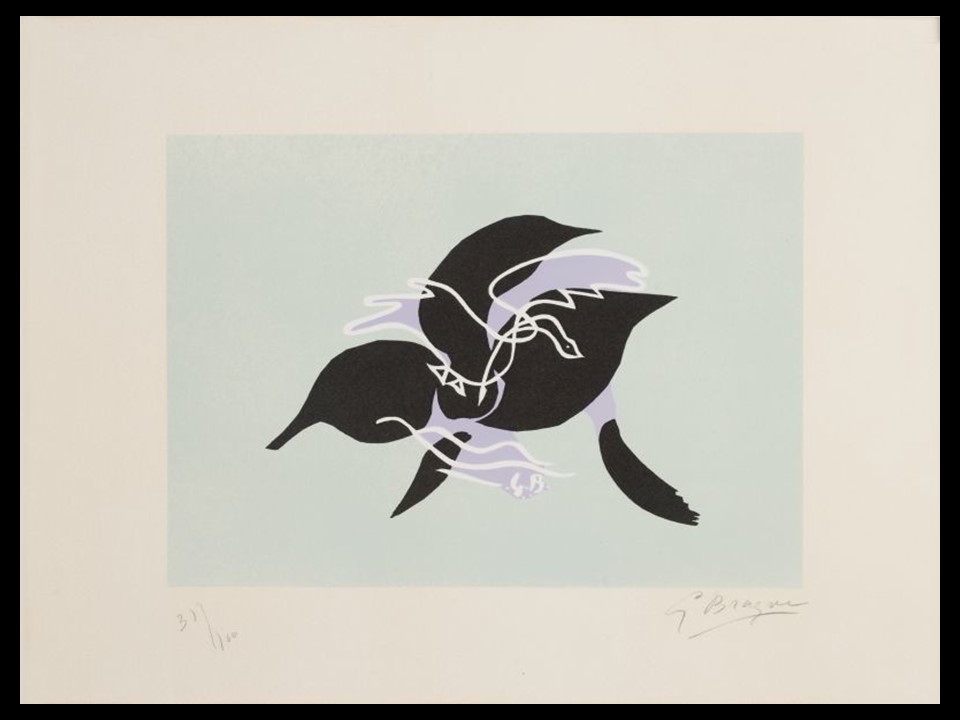
Georges Braque, Essor (The Flight) I

The Flight

Georges Braque, Essor (The Flight) I
Georges Braque, 1882 – 1963, Essor (The Flight) I, 1961, Coloured Lithograph on Arches paper, 31/100, 48 × 65.5 cm, Published by Adrien Maeght, Paris, Basil & Elise Goulandris Foundation, Athens
https://goulandris.gr/el/artwork/braque-georges-flight-1

There is a small Georges Braque Lithograph, at the Basil & Elise Goulandris Foundation in Athens, titled The Flight. It caught my attention and my thoughts ran wild. I saw a soft lilac bird run, a heavy black duck dancing and a white bird, beautifully outlined over the black one, fly… away! It reminded me of Nietzsche’s idea of …dancing before flying and I felt good, content and accomplished. Please don’t ask why, this small Lithograph felt like a monumental accomplishment, like steps to freedom.

For George Braque, experimenting with the motif of birds in flight, started in1949 and never ended. He even visited the famous bird sanctuary in Camargue, in the south of France. This experience, as you can read, broadened his interest in birds flying, and led to his “metamorphose” bird motif “afresh.”

“One summer, few years ago, I was in the Camargue. I saw some huge birds flying above the waters. From that vision I derived aerial forms. Birds have inspired me, and I try to make the best use of them that I can in my paintings. While they interest me as living animal species, I have to burry in my memory their natural functions as birds. This concept, even after the shock of inspiration which has brought them to life in my mind, must be deleted, so that I can draw closer to my essential preoccupation: the construction of pictorial art. Painting alone must impose its presence on what relates to it, and metamorphose it afresh; everything that goes to make up the picture must be integrated in this presence, and must efface itself before it.”

More on Braque’s fascination with Birds, “Apropos another bird painting, Braque talked to me about his visits to the Camargue, where our mutual friend the ornithologist Lukas Hoffmann… had established a vast bird reserve, La Tour du Valat. …Braque told me how the apparition of a heron flying low above the marshes had inspired his large 1955 Bird Returning to Its Nest, of all the late paintings the one that meant the most to him. Maybe because I shared his feelings for the Camargue, Braque gave me an oil study for this haunting work. I remember him saying how, on still, grey days, the sky seemed to reflect the lagoons rather than the other way round, and the birds seemed to swim through the air… ”

The Art Book Tradition in Twentieth-Century Europe, Edited by Kathryn Brown, Tilburg University, The Netherlands, 2013 by Ashgate Publishing, page 54 https://books.google.gr/books?id=zEMrDwAAQBAJ&pg=PA54&lpg=PA54&dq=Braque+and+Camargue&source=bl&ots=sLPlE6IiJu&sig=ACfU3U29l5ZOfxZgXeBAxTBGDRKti-F73g&hl=el&sa=X&ved=2ahUKEwigrvj2lcLmAhVNKuwKHZkyDkIQ6AEwAXoECAkQAQ#v=onepage&q=Braque%20and%20Camargue&f=false

Inside the Artist Studio of Georges Braque by John Richardson, November 13, 2019, The Sorcerer’s Apprentice. Copyright © 1999 by John Richardson Fine Arts Ltd. Published by Knopf on November 12th with a new introduction by Jed Perl https://lithub.com/inside-the-artist-studio-of-georges-braque/

A PowerPoint of my favourite paintings of Birds and Flying, by George Braque… HERE!

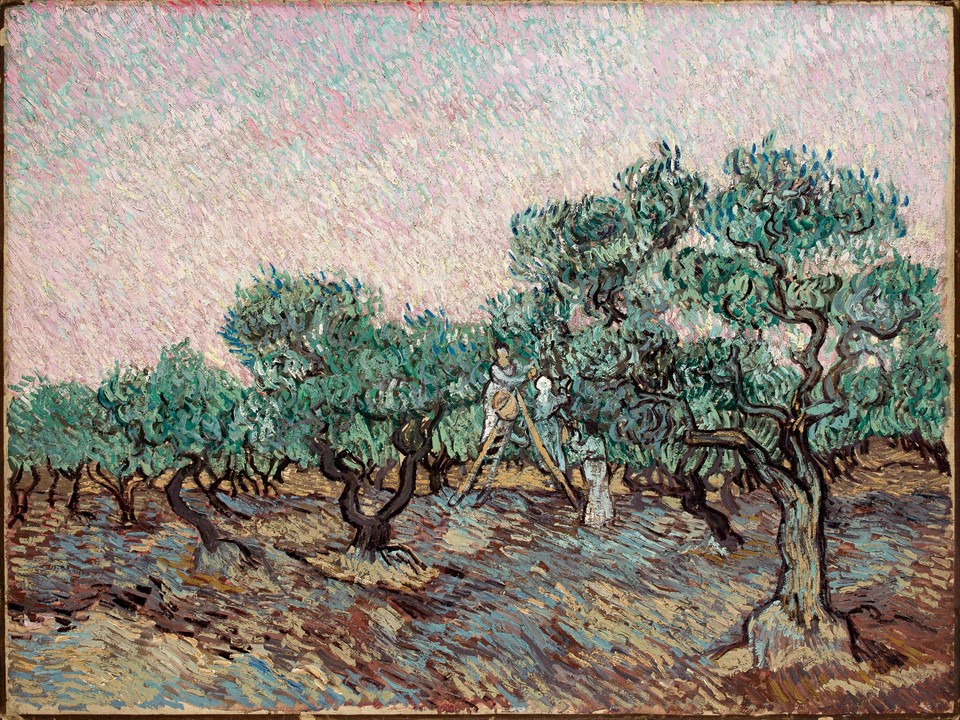
A Vincent Van Gogh painting titled Olive Picking.

The Magic of the Olive Tree

A Vincent Van Gogh painting titled Olive Picking.
Vincent Van Gogh, 1853-1890
Olive Picking, 1889, oil on canvas, 73.5 × 92.5 cm, Basil & Elise Goulandris Foundation, Athens

The Magic of the Olive Tree inspired so much Vincent Van Gogh that while in Saint-Remy-de Provence in 1889, he painted at least 15 paintings depicting their beauty! The same magic inspired our wonderful Pinewood Kindergarten Teacher… who organized a Unit to remember!

“The Kindergarten theme on Olives began with the intention of it being a transdisciplinary unit so that the children would learn many facets about it. It was introduced in a simple way – when the children reached the letter O in the English alphabet they decided to remember this letter sound by saying ‘O is for olive’… From there they learned that olives are fruit and that they grow on Olive Trees in Greece. Inspired by short videos showing how olives are picked in late Autumn, the children took a sheet, a stick and a basket and went olive picking on the school grounds. They hit the branches of the school Olive Trees and collected the fruit that fell… So enthusiastic about what they did they decided to capture their experience by making their very own olive tree grove Bulletin Board.”

Pinewood Kindergarten students “listened in awe as they travelled back into mythological times, to when Athena bestowed the gift of an Olive Tree to the Athenians. This helped the children understand what a treasure the Olive Tree is because of all the various gifts that it gives: wood (for heat, furniture), oil ( for cooking, eating, light, fuel) and soap… They tasted both green and black olives, they washed their hands with olive soap, they lit an oil-lamp with olive oil and they made olive bread… They created olive wreaths by counting card leaves and plasticine olives to a given number and learned that in ancient times an olive wreath, just like the ones they had made, were placed on the heads of champion athletes.”

Finally, students “realized how thankful they are for this humble fruit and all it provides. So when it came to Thanksgiving Day the children chose to honour the Olive Tree by writing their messages of thanks inside their olive wreaths and entitling their display, ‘In Greece, we are thankful for Olive Trees’.”

Kindergarten student Bulletin Board Art photographed by Kostas Papantoniou

“O is for Olive” is the amazing Lesson Plan prepared by the school’s Kindergarten Teacher, Mrs. Anna Maria Mathias, with assistance provided by Mrs. Kathy Lekkas. The PowerPoint photos that follow HERE! were taken by the school’s photographer, Mr. Kostas Papapatoniou.

For the purposes of this BLOG, The Magic of the Olive Tree, “teachercurator” put together a PowerPoint on Van Gogh and paintings of Olive Trees… please check HERE!

The new Basil and Elise Goulandris Foundation in Athens has a wonderful Vincent Van Gogh painting of Olive Picking from his 1889 period. Apparently, Van Gogh painted “three versions of this picture. He described the first as a study from nature “more coloured with more solemn tones” (in the Goulandris Collection) and the second as a studio rendition in a “very discreet range” of colours (National Gallery of Art, Washington, D.C.).” The third painting is at the Metropolitan Museum in New York, and accordingly is “the most resolved and stylized of the three.” The third painting was “intended for his sister and mother, to whom Van Gogh wrote: “I hope that the painting of the women in the olive trees will be a little to your taste—I sent [a] drawing of it to Gauguin… and he thought it good… ” https://www.metmuseum.org/art/collection/search/436536 and https://goulandris.gr/en/artwork/vincent-van-gogh-olive-picking

Three paintings by Vincent Van Gogh all depicting Olive Picking.
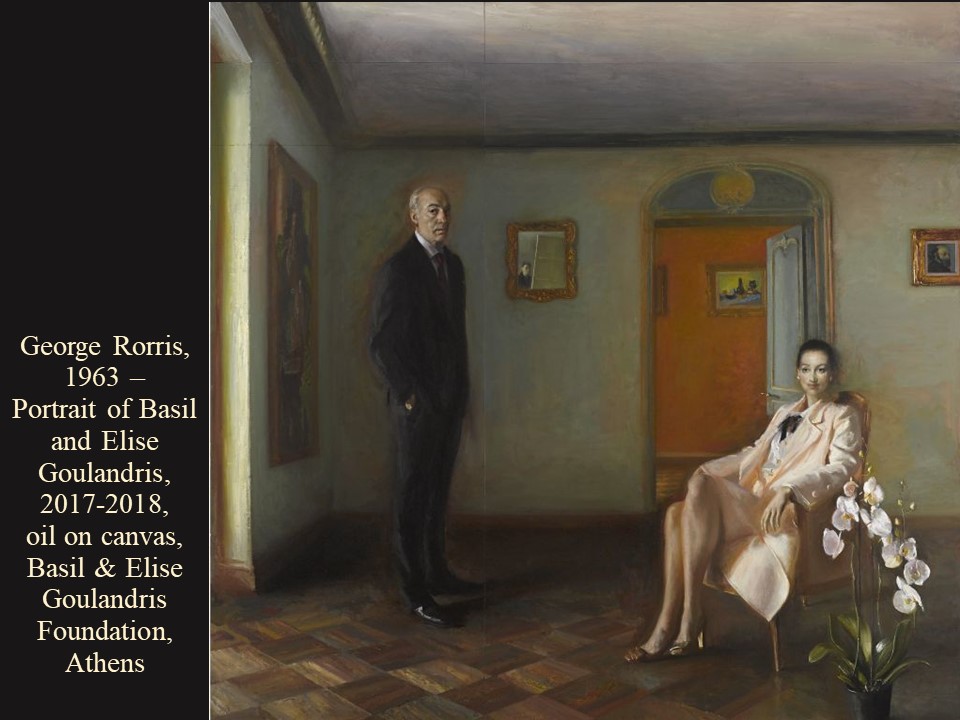
Portrait of Basil and Elise Goulandris by George Rorris.

“Bourgeois” Portrait

Portrait of Basil and Elise Goulandris by George Rorris.

Your tour of the new Basil and Elise Goulandris Foundation in Athens should start from the 4th floor… recommends the helpful Museum operator, and I hesitantly followed his recommendation. I was pleasantly surprised! An impressive “Bourgeois” Portrait of Basil and Elise Goulandris welcomed me, setting the tone for what I was about to experience.

Painted four years after Basil Goulandris’s passing, this eye-catching Portrait of the famous art collectors by George Rorris introduces you to the “atmosphere” that prevails in the latest cultural addition to the Athens Museum circuit! It’s grand, elegant yet understated. Basil Goulandris, clad in a dark suit, stands tall and aloof, staring at you intensely. Elise on the other hand, wearing the softest of pink, sits charmingly on an armchair and looks beyond you. They are surrounded by three favourite paintings from their legendary collection and a mirror that holds a secret worth exploring!

Little information is unfortunately provided by the Foundation on the “whats, the hows and the whys” of this painting. I hope, as time progresses, part of their “Permanent Collection” site will get richer with short descriptions and information on each and every one of their paintings. https://goulandris.gr/en/collection/works-of-art and https://goulandris.gr/en/artwork/rorris-george-portrait-of-basil-and-elise-goulandris

Basil and Elise Goulandris were known for their passionate love of the arts. They were avid collectors, famous for their superb “taste” and acute “eye.” ‘I spent months at a time with Basil and Elise when I was a child,’ says Fleurette Karadontis ‘they had no children of their own — they looked on the paintings as their children. The works were a genuine presence in their lives, a constant part of the conversation. Basil might suddenly say: look there, I never realised that the colour of the shirt in that painting is the same as the wall behind that still life. Or he would look at some cubist painting and ask: how many people do you see in it because I think there are three.’ https://www.christies.com/features/A-gift-to-Greece-the-Goulandris-Foundation-10209-1.aspx

For High School level student Activities on the George Rorris “Bourgeois” Portrait of Basil and Elise Goulandris… Click HERE!