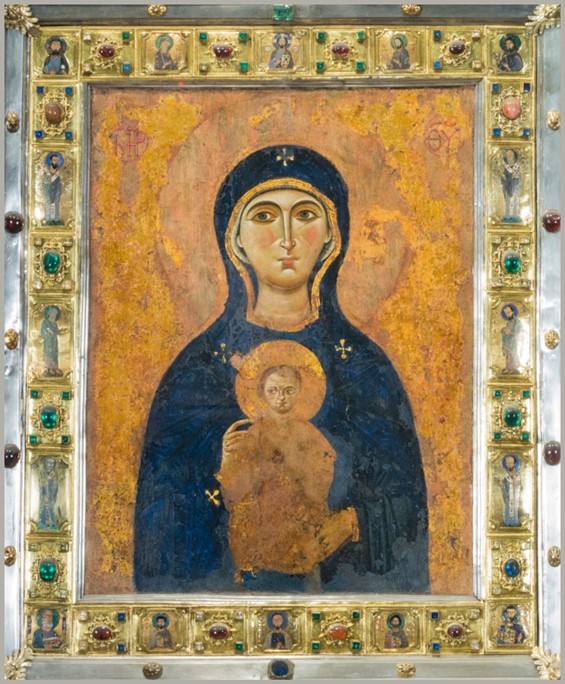
Interceding Theotokos - Virgin Hagiosoritissa Relief, Middle Byzantine, mid-eleventh century, Marble, 104 cm x 40 cm x 7 cm, Dumbarton Oaks Museum, Washington, DC, USA

The Interceding Theotokos at Dumbarton Oaks

Interceding Theotokos - Virgin Hagiosoritissa Relief, Middle Byzantine, mid-eleventh century, Marble, 104 cm x 40 cm x 7 cm, Dumbarton Oaks Museum, Washington, DC, USA
Interceding Theotokos – Virgin Hagiosoritissa Relief, Middle Byzantine, mid-eleventh century, Marble, 104 cm x 40 cm x 7 cm, Dumbarton Oaks Museum, Washington, DC, USA https://www.doaks.org/resources/bliss-tyler-correspondence/art/bz/BZ.1938.62.jpg/view

“…denuded of all help, and deprived of human alliance, we were spiritually led on by holding fast to our hopes in the Mother of the Word, our God, urging her to implore her Son, invoking her for the expiation of our sins, her intercession of our salvation, her protection as an impregnable wall for us, begging her to break the boldness of the barbarians, her to crush their insolence, her to defend the despairing people and fight for her own flock…” writes Patriarch Photius in the second of his two homilies on the siege of Constantinople by the Rus’ and  Sirarpie der Nersessian, in his 1960 Dumbarton Oaks Papers article titled Two Images of the Virgin, quotes him. I couldn’t find better introductory remarks for a BLOG POST on the marble Icon of The Interceding Theotokos at Dumbarton Oaks. https://www.jstor.org/stable/1291145?seq=15#metadata_info_tab_contents page 72 and https://www.doaks.org/resources/bliss-tyler-correspondence/art/bz/BZ.1938.62.jpg/view

The Dumbarton Oaks Museum is my favourite temple of the Muses in Washington DC! It breathes history, scholarship elegance and class… Its collection of Byzantine Art is top quality, the ways and the hows this collection was acquired fascinates me, the scholarship involved, I believe, is more than appreciated by everyone who loves Byzantium. https://www.academia.edu/3585132/_Royal_Tyler_and_the_Bliss_Collection_of_Byzantine_Art_in_James_N_Carder_ed_A_Home_of_the_Humanities_The_Collecting_and_Patronage_of_Mildred_and_Robert_Woods_Bliss_Washington_D_C_Dumbarton_Oaks_Research_Library_and_Collection_27_50?email_work_card=view-paper “Royal Tyler and the Bliss Collection of Byzantine Art,” in James N. Carder, ed., A Home of the Humanities: The Collecting and Patronage of Mildred and Robert Woods Bliss, Washington, D.C.: Dumbarton Oaks

Dumbarton Oaks Museum – Byzantine Gallery
https://www.doaks.org/visit/museum/explore/byzantine-gallery

I confess, I first noticed The Marble Interceding Theotokos in the collection of Dumbarton Oaks when I visited the grand Metropolitan Museum Exhibition The Glory of Byzantium back in 1997. Exhibited then, along with the Lips Monastery Icon of Saint Eudokia from the Archaeological Museum of Istanbul, the two marble Icons “opened my eyes” in the genre of Sculpted Marble Icons from the Byzantine era. Ever since I seek them out, and when I visit the Museum of Byzantine Culture in my hometown Thessaloniki, I always pay my respects to the marble ΜΗ(ΤΗ)Ρ Θ(ΕΟ)Υ(=Mother of God) Icon in Room 4, where artefacts of the Macedonian and Komnenian dynasties are presented. https://www.metmuseum.org/art/metpublications/The_Glory_of_Byzantium_Art_and_Culture_of_the_Middle_Byzantine_Era_AD_843_1261 and https://www.mbp.gr/en/object/marble-icon-praying-virgin

Icon with Saint Eudokia, early 10th century, Marble, inlaid with coloured glass, 66x28 cm, Archaeological Museum of Istanbul, Turkey
The Interceding Theotokos - Virgin Hagiosoritissa Relief, Middle Byzantine, mid-eleventh century, Marble, 104 cm x 40 cm x 7 cm, Dumbarton Oaks Museum, Washington, DC, USA
Praying ΜΗ(ΤΗ)Ρ Θ(ΕΟ)Υ(=Mother of God), 11th century, Marble, 135x70 cm, Museum of Byzantine Culture, Thessaloniki, Greece
Icon with Saint Eudokia, early 10th century, Marble, inlaid with coloured glass, 66×28 cm, Archaeological Museum of Istanbul, Turkey
The Interceding Theotokos – Virgin Hagiosoritissa Relief, Middle Byzantine, mid-eleventh century, Marble, 104 cm x 40 cm x 7 cm, Dumbarton Oaks Museum, Washington, DC, USA
Praying ΜΗ(ΤΗ)Ρ Θ(ΕΟ)Υ(=Mother of God), 11th century, Marble, 135×70 cm, Museum of Byzantine Culture, Thessaloniki, Greece
https://www.johnsanidopoulos.com/2016/08/saint-eudocia-empress-wife-of-emperor.html
https://www.doaks.org/resources/bliss-tyler-correspondence/art/bz/BZ.1938.62.jpg/view
https://www.mbp.gr/en/object/marble-icon-praying-virgin

One more confession… the title of this BLOG POST was a decision that troubled me. At Dumbarton Oaks Museum the marble Icon of the Theotokos is presented as Virgin Hagiosoritissa Relief. The Glory of Byzantium Exhibition Catalogue uses a similar name Icon of the Virgin Hagiosoritissa. I thought, this is it…until I started reading Sirarpie der Nersessian article Two Images of the Virgin in the Dumbarton Oaks Collection, and I changed my mind! The author presents in detail the different styles, whereabouts and use of Interceding Theotokos Icons in every medium! Bottom line… I was not convinced the Marble Icon of the Theotokos is of the Hagiosoritissa type… and the title changed to The Interceding Theotokos at Dumbarton Oaks.

For a Student Activity on The Interceding Theotokos at Dumbarton Oaks, please… check HERE!

Villa Poppaea Plan: Room 16 marks the Viridarium area

Villa Poppaea Viridarium Frescoes

Second Pompeian Style painting on the walls surrounding the Viridarium (small garden) of the Villa Poppaea at Oplontis (Italy), 1st century AD
Photo credit: Carole Raddato published on 06 May 2020
Second Pompeian Style painting on the walls surrounding the Viridarium (small garden) of the Villa Poppaea at Oplontis (Italy), 1st century AD
Photo credit: Carole Raddato published on 06 May 2020
https://www.ancient.eu/article/1552/a-visitors-guide-to-oplontis-stabiae–boscoreale/

I wish I were standing in the middle of Villa Poppaea’s central sitting room (Room 18 on the plan), gazing at “the portico in front of the swimming pool and its surrounding garden… the large window (behind me, that opens) onto the principal garden of the villa… (more) windows, (on my sides) opening into rooms richly-painted with garden scenes, and (further beyond those) into tiny ‘garden’ courtyards, again decorated with garden frescos. Trees, greenery, flowers, birds and water (are) visible in every direction, both painted and real, with nature being brought into the interiors. …It’s hard not to imagine the building filled with …peace, …accompanied by the twittering of birds and the wind in the grass and leaves.” Villa Poppaea Viridarium Frescoes have a strange effect on me!     https://www.italyheaven.co.uk/campania/villa-oplontis.html

Villa Poppaea Plan: Room 16 marks the Viridarium area

Villa Poppaea, built on a plateau fourteen meters above sea level, took advantage of all the scenic pleasures of the Bay of Naples, the latest trends in architecture and the art of fresco painting. Rooms, one hundred of them, were in such a way organized so that its residents and their guests would be able to enjoy the open air and the dramatic view of the sea in an environment of the utmost luxury. Walls decorated with sumptuous frescos further enhanced the effect this Villa probably had on its residents and visitors. Please allow me to explain why exploring the fresco decoration in just one Room in Villa Poppaea, makes your trip to Oplontis, worth your time…

Digital model of the current state of the Villa’s Viridarium (Room 16 in plan)
Photo Credit: © King’s College London, 2011
https://www.kvl.cch.kcl.ac.uk/oplontis03.html

Back in the late 19th century, the German archaeologist August Mau (1840–1909), delineated and described a system of dividing Pompeian Frescoes into four distinct Styles. It is amazing how in Villa Poppaea visitors can see fine examples of the latter three of these four Fresco Styles by just walking from room to room. The amazing frescoes in the small Viridarium area (Room 16 in our Villa Plan) of Villa Poppaea are incredible!

The Viridarium is described as an indoor garden sitting room, decorated with frescoes depicting plants and birds. Room 16 in our Villa Plan is one such Viridarium beautifully embellished with what scholars describe as “Garden Painting,” a very precise genre that is distinct from landscape painting. Garden Paintings give viewers an interesting glimpse of the relationship that existed between architecture and landscape in the ancient world. Exploring the frescoes of Villa Poppaea I read OPLONTIS: VILLA A (“OF POPPAEA”) AT TORRE ANNUNZIATA, ITALY by John R. Clarke and Nayla K. Muntasser, and particularly Chapter 6: Wilhelmina Jashemski and Garden Archaeology at Oplontis, by Kathryn Gleason. The information provided in this presentation is the result of an enjoyable weekend of seeking more and more data…     https://quod.lib.umich.edu/cgi/t/text/text-idx?cc=acls;c=acls;idno=heb90048.0001.001;node=heb90048.0001.001:21.7.2;rgn=div1;view=text

Second Pompeian Style painting on the walls surrounding the Viridarium (small garden) of the Villa Poppaea at Oplontis (Italy), 1st century AD
https://commons.wikimedia.org/wiki/File:Viridaria_Villa_Poppaea_30.JPG

The delightful frescoes in Room 16, the Villa’s Viridarium, display arrangements of evergreen foliage of arbutus, laurels and branches of roses, artfully shaped alone or around a decorative fountain. Hues of red and yellow, powerful primary colours, serve as a striking background. Birds twittering and drinking water from the fountains give an extra sense of joyful life. Kathryn Gleason describes them as Topiarii and continues presenting Ars Topiaria, as the art of creating displays of foliage and shrubs by clipping plants, the pruning and dwarfing of large trees… to the training of ivy into ornate patterns in small peristyle gardens.  https://quod.lib.umich.edu/cgi/t/text/text-idx?cc=acls;c=acls;idno=heb90048.0001.001;node=heb90048.0001.001:21.7.2;rgn=div1;view=text

I found of particular interest the site of The Oplontis Project, a collaboration of John R. Clarke and Michael L. Thomas of the University of Texas at Austin and the Soprintendenza Speciale per i Beni Archeologici di Napoli e Pompe, along with the Visual Restorations of King’s Visualisation Lab, in the Department of Digital Humanities at King’s College London, by Martin Blazeby.     http://www.oplontisproject.org/     and     http://www.oplontisproject.org/index.php/visualization/

For a PowerPoint on Villa Poppaea Viridarium Frescoes, please… Click HERE!

Second Pompeian Style painting on the walls surrounding the Viridarium (small garden) of the Villa Poppaea at Oplontis (Italy), 1st century AD
https://historyandarchaeologyonline.com/ancient-roman-gardens/
Domenicos Theotokopoulos, The Concert of the Angels, c. 1608-1614 and The Annunciation, 1614

Angelic Musicians

Domenicos Theotokopoulos is in my heart. I find him an attractive personality in every aspect… talented, educated, ambitious, curious, adventurous, persistent…  Art is everywhere you look for it, hail the twinkling stars for they are God’s careless splatters…” he wrote and I think of his Angelic Musicians, shining like flickering stars, in the National Gallery in Athens. http://elgreco.net/el-greco-quotes.jsp and https://www.nationalgallery.gr/en/painting-permanent-exhibition/painting/domenicos-theotokopoulos-el-greco/the-concert-of-the-angels.html

Domenicos Theotokopoulos was a Cretan Greek, born in Handaka-Candia, present-day Herakleion, part, at the time, of the thriving Republic of Venice. Archival research in Venice showed that between 1526-28 his family relocated from Chania to Handaka where in 1541 Domenicos was born. His orthodox-Greek family belonged to the upper-middle class, as his father, Giorgos Theotokopoulos, worked for the government of the Venetian Republic, most probably as a merchant and a tax collector. Very little is known of  Domenicos’s mother and early childhood. He was undoubtedly talented, and his father, realizing it, placed him as an apprentice in a painter’s workshop to learn this profitable trade. The name of his teacher is unknown, but judging from Domenicos’s earliest paintings, he was a great master of the Post-Byzantine Cretan School. Crete at the time was the center of a thriving artistic community and understanding the artist’s early influences and style is important in decoding his later work! https://www.historical-museum.gr/webapps/elgreco/xronologio.php?lang=en

By 1567/8 Theotokopoulos travelled to Venice, by 1570, he was in Rome, by 1576 he moved to Spain and in 1577 the artist settled in Toledo, where he found his spiritual home and remained for the rest of his life. He died on the 7th of April 1614, admired for his unique fluid style, temperamental character and humanist education. One of his friends and admirers, Hortensio Félix Paravicino y Arteaga (1580-1633) the Spanish poet, preacher and a member of the Trinitarian Order, wrote for the artist “O Greek divine! We wonder not that in thy works / The imagery surpasses actual being.” Paravicino also wrote, foreseeing Theotokopoulos’s legacy “Future generations will admire his strange genius, but for centuries he will not be imitated.” http://www.nccsc.net/essays/spanish-style  

I would like the reader of this BLOG POST, titled Angelic Musicians, to focus on two paintings. One of them is in Athens and is titled The Concert of the Angels, the other is in Madrid, and is an Annunciation scene. Now imagine them together and you will see one of the last, if not the last painting, the artist created but never finished. The original painting, an Annunciation scene, was commissioned for the Chapel of the Hospital of St. John the Baptist outside the walls of Toledo. Today, separated, the product of 19h century vandalism, may look slightly odd, but still, enthral the viewer with their unique “beauty.”

Domenicos Theotokopoulos, 1541-1614, The Concert of the Angels, c. 1608-1614
Domenicos Theotokopoulos, 1541-1614
The Concert of the Angels, c. 1608-1614, oil on canvas, 115-217 cm, National Gallery – Alexandros Soutsos Museum – Evripidis Koutlidis Foundation, Athens
https://www.nationalgallery.gr/en/painting-permanent-exhibition/painting/domenicos-theotokopoulos-el-greco/the-concert-of-the-angels.html

The Concert of the Angels in Athens is for me a wonderful depiction of an imaginary, celestial concert, full of energy and vibrato. Domenicos Theotokopoulos, the so-called El Greco, loved music and treated it with respect. The painting in Athens shows a musical ensemble with seven “ecstatic” angels, reading music, singing or playing the spinet, a harp, a flute and a viola da gamba. I wonder what kind of music Domenico enjoyed most, and which musician of his time he favoured… https://www.nationalgallery.gr/en/painting-permanent-exhibition/painting/domenicos-theotokopoulos-el-greco/the-concert-of-the-angels.html

The artist uses swift brushwork and swaying movement in postures and robes to create excitement in his composition. Like tongues of fire, his swirling figures look more like spiritual beings than real bodies…

The colour palette that the artist uses is another distinctive characteristic of his mannerism. The colours are iridescent but bold. He uses oranges in red and green and yellow/gold in blue. Tints and shades are juxtaposed. Values of high or low intensity are treasured. Theotokopoulos’s final Annunciation was never finished but whether you see its upper part in Athens or the actual Annunciation part in Madrid, its expressive power is unquestionable.

For a PowerPoint on Theotokopoulos’s paintings of the Annunciation, please … Click. HERE!

The National Gallery – Alexandros Soutsos Museum – Evripidis Koutlidis Foundation in Athens has uploaded a wonderful (in Greek) Video to watch… https://www.facebook.com/watch/?v=316373302403183  

Domenicos Theotokopoulos, 1541-1614, The Annunciation, 1614
Domenicos Theotokopoulos, 1541-1614
The Annunciation, 1614, oil on canvas, 2.940,00×2.090,00 mm, Banco Santander, Spain
https://el.m.wikipedia.org/wiki/%CE%91%CF%81%CF%87%CE%B5%CE%AF%CE%BF:Domenikos_Theotokopoulos,_El_Greco_-_The_Annunciation_-_Google_Art_Project.jpg
Odilon Redon, 1840-1916, Pandora, 1910/1912

Odilon Redon and Pandora’s Box

Odilon Redon, 1840-1916, Pandora, 1910/1912
Odilon Redon, 1840-1916
Pandora, 1910/1912, oil on canvas, 143.5 x 62.9 cm, NGA, Washington DC, USA https://www.nga.gov/collection/art-object-page.46531.html#bibliography

It is nature also who orders us to obey the gifts she has given us. Mine have led me to dreams; I submitted to the torments of imagination and the surprises she gave me under my pencil; but I directed and led those surprises in accordance with the laws of the organism of art which I know, which I feel, with the single goal of producing in the spectator, by sudden attraction, the whole evocation, and the whole enticement of the uncertain within the confines of thought… writes Odilon Redon in his journals To Myself: Notes on Life, Art, and Artists… and I think of Odilon Redon and Pandora’s Box in Washington DC, at the National Gallery. https://www.goodreads.com/author/quotes/288740.Odilon_Redon

Odilon Redon is one of my favourite artists. As a student, I knew little of him. As a young teacher of Art History I hardly ever used his work… until, preparing for a Lesson Plan on the Myth of Pandora, I rediscovered his Pandora painting at the NGA and the Museum’s wonderful suggestions for Student Activities. My students responded positively to his imaginary world… and I was hooked!

Odilon Redon, 1840-1916, Self-Portrait, 1880
Odilon Redon, 1840-1916
Self-Portrait, 1880, oil on canvas, 33.3×52 cm, Palais des Beaux-Arts de Lille, France https://www.wikiart.org/en/odilon-redon/self-portrait-1880

I like how Odilon’s work is described at ARTSY… “Known for his unique blend of artistic naturalism and symbolic subject matter, Odilon Redon was highly influential among the late 19th century French avant-garde circle. Working in charcoal, pastel, oil, and lithography, Redon created imaginative scenes that, while often based in the supernatural, were nonetheless executed in a highly representational manner. Redon considered this descriptive accuracy essential, writing “every time that a human figure does not give the illusion that it is … about to come out of the picture frame to walk, act or think, the drawing is not a truly modern one.” Redon was influenced by the poetry of Charles Baudelaire and Stéphane Mallarmé and admired by the painters Gustave Moreau and Gustave Klimt—as such he is often remembered as a Symbolist, though Redon preferred autonomy and never actually considered himself part of the group.” What more could I add… https://www.artsy.net/artwork/odilon-redon-ari

My students and I are captivated by the Myth of Pandora and the elusive way Odilon presents her story… Off-centre, Pandora stands in front of an atmospheric background, misty and hazy, luminous, ethereal and a touch, mysterious. The power of the artist’s mind creates organic forms, indistinct and intangible. The colours the artist uses are subtle, understated, yet joyous, warm and earthy. The box in Pandora’s hands is small, easily discerned buts not ostentatious… http://www.hellenicaworld.com/Art/Books/en/BeyondTheVisibleTheArtOfOdilonRedon.html

Painted by: The Niobid Painter, The Creation of Pandora, 460BC-450 BC
Painted by: The Niobid Painter
The Creation of Pandora,
460BC-450 BC, Attic Red Figure Calyx krater, attributed to the Niobid Painter, Archaic period, British Museum https://www.britishmuseum.org/collection/object/G_1856-1213-1

The myth of Pandora is beautifully told by the experts of the National Gallery of Art in Washington DC… According to Greek mythology, in the beginning the earth was free from toil and misery. The land was covered with flowers and the rivers flowed with milk and honey. Earth was inhabited only by men, who had been created by Prometheus. He made them of clay and modeled them after the gods, which angered Zeus, the king of the gods. When Prometheus offended Zeus again by stealing fire from heaven to give to man, Zeus exacted revenge. He ordered Hephaestus, the god of the forge, to create Pandora, the first woman. The gods gave her many traits including beauty, curiosity, charm, and cleverness. Hence her name “Pandora,” meaning “all gifted” or, alternately, “a gift to all.” Before he left Pandora on earth, Zeus handed her a beautiful box saying, “This is my own special gift to you. Don’t ever open it.” As Zeus anticipated, Pandora’s curiosity got the best of her, and she opened the box, ending earthly paradise. From the small chest flew troubles and woes—sorrow, disease, vice, violence, greed, madness, old age, death—to plague humankind forever. However, Zeus did not realize that hope had been secretly added to the box by Promethesus. When Pandora opened the box and released trouble and woe into the world, hope was there to help people survive. https://www.nga.gov/education/teachers/lessons-activities/origin-myths/pandora.html

For interesting Student Activities, please click and explore the NGA site… https://www.nga.gov/education/teachers/lessons-activities/origin-myths/pandora.html

The myth of Pandora’s box by Iseult Gillespie at TEDEd is worth exploring… https://ed.ted.com/lessons/the-myth-of-pandora-s-box-iseult-gillespie

For a PowerPoint on the Myth of Pandora Teacher Curator prepared, please… Click HERE!

Odilon Redon, 1840–1916, Pandora, 1914
Odilon Redon, 1840–1916
Pandora, 1914, oil on canvas, 143.5 x 62.2 cm, the MET, NY https://www.metmuseum.org/art/collection/search/437383

The Labours of the Months: April

By an unknown Venetian artist…
The Labours of the Months: April, about 1580
By an unknown Venetian artist…
The Labours of the Months: April, about 1580, oil on canvas, 13.6 x 10.6 cm, National Gallery, London
https://www.nationalgallery.org.uk/paintings/italian-venetian-the-labours-of-the-months-january#painting-group-info

Whan that Aprill with his shoures soote:   When April with its sweet-smelling showers  /  The droghte of March hath perced to the roote,  Has pierced the drought of March to the root,   /  And bathed every veyne in swich licour  And bathed every vein (of the plants) in such liquid  /  Of which vertu engendred is the flour;   By the power of which the flower is created;  /  Whan Zephirus eek with his sweete breeth   When the West Wind also with its sweet breath,  /  Inspired hath in every holt and heeth   In every holt and heath, has breathed life into  /  The tendre croppes, and the yonge sonne   The tender crops, and the young sun  /  Hath in the Ram his half cours yronne,   Has run its half course in Aries,  /  And smale foweles maken melodye,  And small fowls make melody,  /  That slepen al the nyght with open ye   Those that sleep all the night with open eyes  /  (So priketh hem Nature in hir corages),   (So Nature incites them in their hearts)… Geoffrey Chaucer first line for The Canterbury Tales refers to April…   for The Labours of the Months: April cer/gp-aloud.htm

In London, at the National Gallery there are 12 small pictures, “painted on canvas and then each glued to a wooden panel. It is possible that they were made to decorate the recessed panels of a pair of doors. The paintings seem to have been planned in pairs with the figures facing each other and are currently displayed in two frames in groups of six. They show the ‘labours of the months’ – the rural activities that take place each month throughout the year.” This set of painted Doors combines simplicity in execution and extravagance in visual effect! https://www.nationalgallery.org.uk/paintings/italian-venetian-the-labours-of-the-months-january#painting-group-info

The painting that may represent “sweet-smelling” April, shows  a cooper making a wooden barrel. “He raises his mallet ready to strike the tool in his other hand. The work must be physically hard as he has tied a band of white cloth around his forehead to keep the sweat out of his eyes. The barrel will be used to store wine made from the grapes we see being pressed in September.”     https://www.nationalgallery.org.uk/paintings/italian-venetian-the-labours-of-the-months-april

By an unknown Venetian artist…
The Labours of the Months: April, about 1580
By an unknown Venetian artist…
The Labours of the Months: April, about 1580, oil on canvas, 13.6 x 10.6 cm, National Gallery, London
https://www.nationalgallery.org.uk/paintings/italian-venetian-the-labours-of-the-months-january#painting-group-info

Coopers were important craftsmen during the Middle Ages and the Renaissance. They created wooden barrels to store wine, spirits and salted meats, buckets to draw and carry water, wooden bowls and plates for daily use, pails, churns and tubs for various agricultural or home-industry needs. Coopers, like the one depicted in the small London painting, were respected and valued Renaissance professionals.

Depicting the Labours of the Months was a popular artistic theme that was frequently used in the decoration of Cathedrals and Churches, Castles and  Palaces, Psalters, Breviaries and Books of Hours across Europe during the Medieval and Early Renaissance period. Each month, depicting popular activities of peasants or/and the gentry throughout the year were sometimes paired with the Signs of the Zodiac circle. They would be either simple and small in size or large and elaborate, crafted in stone, wood, stained glass, painted in murals or often enough, painted in parchment. Many great Monuments and Libraries in Europe display fine examples of such artefacts for art lovers to enjoy.  http://www.livingfield.co.uk/ages/labours-of-the-months/

For a PowerPoint on The Labours of the Months at the National Gallery in London, please… Check HERE!

Nikiforos Lytras, 1832-1927, Kanaris Burning the Turkish Flagship, 1873

Kanaris Burning the Turkish Flagship

Nikiforos Lytras, 1832-1927, Kanaris Burning the Turkish Flagship, 1873
Nikiforos Lytras, 1832-1927
Kanaris Burning the Turkish Flagship, 1873, oil on canvas, 143×109 cm, Averoff Gallery, Metsovo, Greece     https://www.averoffmuseum.gr/kanaris-burning-the-turkish-flagship/?lang=en

“Mais le bon Canaris, donc un ardent sillon  /  Suit la barque hardie,  /  Sur les vaisseaux qu’il prend, comme son pavillon,  /  Arbore l’incendie !          But good Kanaris, whose daring boat  /  Is followed by a burning wake,  /  On the vessels he seizes, as his ensign,  /  Displays the blaze!” Writes Victor Hugo inspired by the daring deeds of Konstantinos Kanaris (anglicised as Constantine Canaris), distinguished as a brave fire ship captain. In 1873, Nikiforos Lytras painted Kanaris Burning the Turkish Flagship, honouring the great man.     https://poesie.webnet.fr/lesgrandsclassiques/poemes/victor_hugo/canaris     and     https://www.crwflags.com/fotw/flags/fr_canar.html

Averoff Gallery, Metsovo, Greece     

Every time I travel to Metsovo, in the Epirote mountains of Pindos, in Northern Greece, I visit the Averoff Gallery and stop in front of Nikiforos Lytras’s painting Kanaris Burning the Turkish Flagship. You cannot miss it… It is one of the most captivating 19th-century Greek paintings. https://www.averoffmuseum.gr/

Kanaris Burning the Turkish Flagship is an amazing departure from what Nykiforos Lytras studied in the Münchner Akademie der Bildenden Künste under the tutelage of Karl Theodor von Piloty (1826-1886). An influential Art School, the Münchner Akademie, attracted and trained artists from around the world to become leading painters, able to combine in their style, academic realism, baroque colourism and dark chiaroscuro. The artists of the Akademie were committed to monumental history paintings, landscapes, ethnography, portraits and still life. Naturalism in its depiction of human emotions was not among the School’s greatest artistic pursuits. http://www.artmag.gr/art-history/art-history/item/270-i-sxoli-you-monaxou

Konstantinos Kanaris (1793 – 1877), Greek and Philhellene Fighters in the Greek Revolution of 1821, Portraits of the German officer and Philhellene Karl Krazeisen
Konstantinos Kanaris (1793 – 1877)
Greek and Philhellene Fighters in the Greek Revolution of 1821, Portraits of the German officer and Philhellene Karl Krazeisen
This is a rare series of the lithographs of Krazeisen, which are hand-painted.
https://www.eefshp.org/en/portfolio-item/konstantinos-kanaris-1793-1877/

Lytras’s painting on the heroic deed by Konstantinos Kanaris is a historic painting with a twist! The artist moves away “from the romantic tendency that prevailed in the School of Piloty to a more naturalistic one in which the genre element played the dominant role.” According to the description provided by the Averoff Museum “Lytras` anthropocentric painting… was not concerned so much with the historical event per se. More so it was the projection of the heroic act carried out by brave persons worthy of emulation. The flaming ship is thrust into the distance to form the backdrop for the human action that is played out on a plane close to the viewer. Thus, in contrast to the ambiguous treatment of the background, where the ship disappears half-hidden by the smoke, the realistic rendering of the Psarians with Kanaris in the boat gives the work the immediacy and truth that interested the artist.”     https://www.averoffmuseum.gr/kanaris-burning-the-turkish-flagship/?lang=en

Nikiforos Lytras, the painter of Kanaris Burning the Turkish Flagship in Metsovo, was born in Pyrgi, on the Cycladic island of Tinos, the son of a marble sculptor. An exceptional talent, Lytras studied at the Athens School of Art from 1850 until 1860 and then, as the recipient of a state scholarship, he continued his studies at the Munich Academy, in the class of Karl von Piloty. In 1866 Lytras was back in Greece and was appointed professor at the Athens School of Fine Arts, a position he held for 38 productive years. A conscientious teacher, but interested to experience new ideas and always open to new trends, Nikiforos Lytras became the leading Greek artist of his time, popular with the people and honoured by his students and fellow artists.

Nikiforos Lytras, 1832-1927, Self-Portrait, 19th century
Nikiforos Lytras, 1832-1927
Self-Portrait, 19th century, oil on canvas, 51,5 x 43,5 cm, National Gallery of Athens      

There are two paintings on the theme of Kanaris Burning the Turkish Flagship. The earliest, chronologically, was painted by Nikiforos Lytras and today is exhibited in the Averoff Museum at Metsovo, one of my favourite Art Museums in Greece. The second painting, by  Ivan Konstantinovich Aivazovsky, was painted in 1881 and is part of the E. Koutlidis Collection and is exhibited in Athens at the National Gallery. For a Student “Compare and Contrast” Activity, paintings, please… Check HERE!

Ivan Konstantinovich Aivazovsky, 1817-1900, The Burning of the Turkish Flagship
Ivan Konstantinovich Aivazovsky, 1817-1900
The Burning of the Turkish Flagship, 1881,oil on canvas, 162×223 cm, National Gallery of Athens     https://commons.wikimedia.org/wiki/File:The_Burning_of_the_Turkish_Flagship_by_Kanaris_-_Ivan_Aivazovsky,_1881.png

If you wish to learn more about the Greek War of Independence and the Bicentennial Celebrations in 2021, please VISIT the official Greece 1821-2021 Bicentennial site http://www.greece2021.gr, Twitter, https://twitter.com/Greece_2021, Facebook, https://www.facebook.com/Greece2021/, and Instagram, https://www.instagram.com/greece2021/?hl=el

Johann Georg Christian Perlberg, 1806-1884, Drums for the War of Independence - Young Drummer in Missolunghi

Celebrating the Greek Revolution of 1821

Johann Georg Christian Perlberg, 1806-1884, Drums for the War of Independence - Young Drummer in Missolunghi
Johann Georg Christian Perlberg, 1806-1884
Drums for the War of Independence – Young Drummer in Missolunghi, oil on canvas, 48.5 x 34.5 cm, Private Collection
https://www.dorotheum.com/en/l/2897144/      and     http://ellas2021.eu/gallery.html

It was for these children that we fought… paraphrasing the words of Yanni Makrigianni, 1794-1864, Greek Revolutionary Fighter of 1821! Celebrating the Greek Revolution of 1821 and remembering the children who probably suffered the most.

Messolonghi… View of the location where Lord Byron died, 1848
ESTOURMEL, Joseph d’, Comte. Album du Journal d’un Voyage en Orient, Paris, Hellenic Library - Alexander S. Onassis Public Benefit Foundation
Messolonghi… View of the location where Lord Byron died, 1848
ESTOURMEL, Joseph d’, Comte. Album du Journal d’un Voyage en Orient, Paris, Hellenic Library – Alexander S. Onassis Public Benefit Foundation
http://eng.travelogues.gr/item.php?view=39968

“The torch that was Missolonghi shed its light as far as Vasiladhi and Klisova and over the whole plain, and even reached us. The flashes of gunfire looked like a host of fireflies. From Missolonghi we heard the shrieks of women, the sound of gunfire, the explosion of powder magazines and mines, all combined in an indescribably fearful noise. The town was like a roaring furnace” remembers Nikolaos Kasomoulis (1795 – 1872), who took part, fought and survived the Exodus. I hope Perlberg’s Young Drummer Boy, so romantically groomed, successfully survived the tragedy…     https://books.google.gr/books?id=GhCLDwAAQBAJ&pg=PA26-IA16&lpg=PA26-IA16&dq=%22The+flashes+of+gunfire+looked+like+a+host+of+fireflies.%22&source=bl&ots=sDTZ6TqHS3&sig=ACfU3U1jIfv4avEDAVvPpC9AfvJbcVkRmQ&hl=el&sa=X&ved=2ahUKEwiE8qvu2bvvAhWDO-wKHTb_A5MQ6AEwAnoECAEQAw#v=onepage&q=%22The%20flashes%20of%20gunfire%20looked%20like%20a%20host%20of%20fireflies.%22&f=false

For our Youngsters… the National Historical Museum in Athens

National Historical Museum of Greece
National Historical Museum of Greece – The building was designed by Francois Boulanger to serve as the first Greek Parliament. Construction began in 1858 and ended in 1875. It served as the Nation’s Parliament until 1935 and became a museum in 1960.     https://www.greece-is.com/national-historical-museum/

For celebratory mood and quality time with your youngster, you can VISIT the National Historical Museum site http://www.nhmuseum.gr/en and then go to     http://www.nhmuseum.gr/el/ekpaideysi/ekpaideytiko-yliko/.

This is a “Colouring Page” Activity (in Greek BUT easy to understand and DO) on famous figures of the Greek War of Independence. It was inspired by the Exhibition The 1821 Greek War of Independence Retold in… Playmobil! The Activity is very EASY!     http://www.nhmuseum.gr/el/ekpaideysi/ekpaideytiko-yliko/

To do the Colouring Activity Press on each picture you wish your child to colour – download it – print it – DONE! You can choose between heroes and heroines of the Greek War of Independence and celebrate an important moment in Greek History. From top to bottom, the Colouring Page Figures are: Theodoros Kolokotronis, Odysseas Androutsos, Laskarina Bouboulina, Konstantinos Kanaris, Manto Mavrogenous, Germanos, Metropolitan Paleon Patron, Andreas Lontos, Asimo Goura, Ioannis Makrigiannis, Domna Visvizi, Christos Kapsalis, Andreas Pipinos, Dimitrios Papanikolis

For our Youngsters… a List of Student Activities on the Greek Revolution of 1821 prepared by Greek Museums and Foundations… HERE!

Student work... Foustaneloforoi
Student work… Foustaneloforoi!

For an easy to print Celebrating the Greek Revolution of 1821 Worksheet, please… Click HERE!

If you wish to learn more about the Greek Revolution of 1821 and the preparation for the Bicentennial Celebration in 2021, please VISIT the official Greece 1821-2021 Bicentennial site: https://www.greece2021.gr/en/ and/or https://www.greece2021.gr/

Spero Vassiliou, 1903-1985, Clean Monday Feast, 1950

Clean Monday Feast

Spero Vassiliou, 1903-1985, Clean Monday Feast, 1950
Spero Vassiliou, 1903-1985
Clean Monday Feast, 1950, oil on wood, 125×78, Municipality of Rhodes Museum of Modern Greek Art
https://paletaart.wordpress.com/2012/08/06/%CE%B2%CE%B1%CF%83%CE%B9%CE%BB%CE%B5%CE%AF%CE%BF%CF%85-%CF%83%CF%80%CF%8D%CF%81%CE%BF%CF%82-spyros-vassiliou-1903-1985/#jp-carousel-4424

Could Isaiah (Isaiah 1:1–20) introduce us to the theme of Clean Monday with his Old Testament verses? “Wash yourselves; make yourselves clean; remove the evil of your doings from before my eyes; cease to do evil, learn to do good; seek justice, rescue the oppressed, defend the orphan, plead for the widow. Come now, let us argue it out, says the Lord: though your sins are like scarlet, they shall be like snow; though they are red like crimson, they shall become like wool. If you are willing and obedient, you shall eat the good of the land; but if you refuse and rebel, you shall be devoured by the sword; for the mouth of the Lord has spoken.” Are the following Matthew verses (Matthew 6:14–21)  indicative of the Greek Orthodox festive, springtime atmosphere of Clean Monday? “When ye fast, be not, as the hypocrites, of a sad countenance: for they disfigure their faces, that they may appear unto men to fast. Verily I say unto you, They have their reward. But thou, when thou fastest, anoint thine head, and wash thy face, that thou appear not unto men to fast, but unto thy Father which is in secret…” I like to think that the painting Clean Monday Feast by Spero Vassiliou embodies Matthew’s recommendations and presents the glorious Greek Clean Monday at its best!     https://bible.oremus.org/?passage=Isaiah%201:1%E2%80%9320&version=nrsv     and     https://bible.oremus.org/?passage=Matthew%206:14%E2%80%9321&version=nrsv

Austerity and Affluence… two words that best describe, in my humble opinion, Vassiliou’s painting Clean Monday Feast in the Municipality of Rhodes Museum of Modern Greek Art. Let me explain…

Austerity… in the green, tripod, metal table, centrally displayed, full of traditional νηστίσιμα(fasting foods) humble delicacies that mark the beginning of Lent… for the day, Clean Monday, when relatives and friends celebrate the upcoming period of humility, self-criticism and mutual forgiveness. Vassiliou’s green coloured table displays a piece of Lagana, the unleavened popular bread of the day, Throubes, sun-dried black olives, crunchy spring onions, the grocer’s halva with tasty almonds, the heart of tender lettuce, a deep yellow plate full of crisp, local “greens,”  a white plate with salty, but so tasty red fish roe, and retsina, the Greek resinated white wine, popular in Greece for at least 2,000 years.

Affluence… in the love the artist held for the simple things of everyday life, insignificant at first sight, yet eloquent, meaningful and deeply moving for all the initiates of Greek Clean Monday rituals. Spero Vassiliou’s family tradition for Clean Monday was to invite his friends for a day’s feast on the roof(ταράτσα) of his house, below the Acropolis of Athens! The 1950 painting, titled Clean Monday Feast, is glowingly colourful, brightly sunny, gloriously festive!

Spero Vassiliou “studied painting at the “School of Arts” (later Athens School of Fine Arts) from 1921 to 1926. He was among the students who struggled for the reorganization of the School and who attended the studio of the newly elected professor, Nikos Lytras.” An active member of the Greek Artists Association, Vasiliou put together solo exhibitions as early as 1929, participated in creating stage design and costumes for about 140 plays, and won the prestigious Academy of Athens Award for designing the frescoes in the church of Saint Dionysius Areopagites in Athens. By the late 1940s, Vassiliou was an active member of the Greek intelligentsia representing a style linked to surrealism or pop art with a dominant dose of “aspects of contemporary Greek life in a picturesque and vivid way, sometimes inspired by folklore forms…”     http://dp.iset.gr/en/artist/view.html?id=1080

Municipality of Rhodes Museum of Modern Greek Art - The original Historic Building in Symi Square
Municipality of Rhodes Museum of Modern Greek Art – The original Historic Building in Symi Square
https://www.rodos-palace.gr/discover-rhodes/510/Museums-and-Antiquities/

The painting Clean Monday Feast by Spero Vassiliou is part of the Collection of the Municipality of Rhodes Museum of Modern Greek Art. The driving force behind the creation of the Municipality Museum was Andreas Ioannou, “a distinguished scholar of modern Greek art, writer and prefect of Dodecanese.” He foresaw the leading role Rhodes could play as a cultural center of international fame and decided, back in the 1950s, to create an emblematic Museum of Modern Greek Art. “For this reason he came in contact with the leading Greek artists, acquired their emblematic works and housed them in the historic building of Symi Square at the entrance of the Medieval City of Rhodes, which is now a UNESCO World Heritage Site.”     https://www.mgamuseum.gr/el/to-mouseio/  

Today, the Municipality Museum has 4 very distinct Art Galleries. The original Historic Building on Symi Square is the center where Engravings of the 19th – 20th centuries, Publications and Posters will be exhibited. The “Nestorideion Melathron” houses the Museum’s permanent collection of 20th century Modern Greek Art, including Vassiliou’s Clean Monday Feast. The Modern Art Centre, situated at the main thoroughfare in the Medieval Town “Palaio Syssitio,” has been chosen as the center for the first permanent exhibition dedicated to the famous and characteristic Rhodesian Ceramic Art. Finally, in 2010, the Museum inaugurated a new center dedicated to the cultural activities of the island.     https://www.mgamuseum.gr/el/to-mouseio/

Get enthused by Spero Vassiliou’s Painting Clean Monday Feast and prepare a Student Activity inspired by the depicted Kites! Use a List of ONLINE sites to find out what best suits your students! Click HERE!

Andrea Mantegna, 1431-1506, Camera degli Sposi, The West Wall: The Meeting, (detail of the left panel), 1465-74

Teaching with Andrea Mantegna

Andrea Mantegna, 1431-1506, Camera degli Sposi, The West Wall: The Meeting, (detail of the left panel), 1465-74
Andrea Mantegna, 1431-1506
Camera degli Sposi, The West Wall: The Meeting, (detail of the left panel), 1465-74, Walnut oil on plaster, Camera degli Sposi, Palazzo Ducale, Mantua
https://commons.wikimedia.org/wiki/File:Andrea_Mantegna_075.jpg?uselang=it

“How great is the effect of reward on talent is known to him who labors valiantly and receives a certain measure of recompense, for he feels neither discomfort, nor hardship, nor fatigue, when he expects honor and reward for them; nay, what is more, they render his talent every day more renowned and illustrious. It is true, indeed, that there is not always one to recognize, esteem, and remunerate it as that of Andrea Mantegna was recognized. This man was born from very humble stock in the district of Mantua; and, although as a boy he was occupied in grazing herds, he was so greatly exalted by destiny and by his merit that he attained to the honorable rank of Chevalier, as will be told in the proper place…” This is how Giorgio Vasari introduces Andrea Mantegna, the artist who was is “seen to have been wrought with much art and diligence.” Teaching with Andrea Mantegna is a set of student activities and worksheets inspired by the great Italian artist I admire. To visit Andrea’ Camera degli Sposi in the Palazzo Publico in Mantua was for years an unreachable dream. In 1988 along with a group of students/friends my dream came to fruition and I was finally, in the middle of this amazing room… moved, I confess, and emotional.     http://www.travelingintuscany.com/art/giorgiovasari/lives/andreamantegna.htm

Andrea Mantegna, 1431-1506, The presentation of Christ in the temple (detail-Probably Self-portrait), 1465-1466
Andrea Mantegna, 1431-1506
The presentation of Christ in the temple (detail-Probably Self-portrait), 1465-1466, tempera on canvas, 86×67 cm, Gemäldegalerie, Berlin
https://commons.wikimedia.org/wiki/Category:Portraits_of_Andrea_Mantegna#/media/File:Andrea_Mantegna_049_detail_possible_self-portrait.jpg

When the time comes for me to introduce my students to Mantegna’s oeuvre I start with Giorgio Vasari’s final words. “Andrea was so kindly and praiseworthy in all his actions, that his memory will ever live, not only in his own country, but in the whole world; wherefore he well deserved, no less for the sweetness of his ways than for his excellence in painting…” and continue with the artist’s tutelage under Squarcione, who “made him practise much on casts taken from ancient statues and on pictures painted upon canvas which he caused to be brought from diverse places, particularly from Tuscany and from Rome. By these and other methods, therefore, Andrea learnt not a little in his youth…” I finish my presentation of Andrea Mantegna’s contribution to world art with his reaction to Squarcione’s criticism that “his pictures resembled not living figures but ancient statues of marble or other suchlike things.” My students are intrigued and a discussion takes place by how “This censure piqued the mind of Andrea; but, on the other hand, it was of great service to him, for, recognizing that Squarcione was in great measure speaking the truth, he set himself to portray living people, and made so much progress in this art, that, in a scene which still remained to be painted in the said chapel, he showed that he could wrest the good from living and natural objects no less than from those wrought by art. But for all this Andrea was ever of the opinion that the good ancient statues were more perfect and had greater beauty in their various parts than is shown by nature, since, as he judged and seemed to see from those statues, the excellent masters of old had wrested from living people all the perfection of nature, which rarely assembles and unites all possible beauty into one single body, so that it is necessary to take one part from one body and another part from another.”     http://www.travelingintuscany.com/art/giorgiovasari/lives/andreamantegna.htm

Andrea Mantegna, 1431-1506, The San Zeno Polyptych (detail), 1457-60
Andrea Mantegna, 1431-1506
The San Zeno Polyptych (detail), 1457-60, Tempera on panel,  480 x 450 cm, San Zeno, Verona
https://commons.wikimedia.org/wiki/Category:Details_of_Pala_di_San_Zeno_by_Andrea_Mantegna#/media/File:Andrea_Mantegna_024.jpg

Teaching with Andrea Mantegna References – References, a PowerPoint and Activities…

For the List of ONLINE References on Andrea Mantegna TeacherCurator put together, please… Click HERE!

For my PowerPoint on Andrea Mantegna, please… Click HERE!

I always feel confident discussing an artist with my students when I prepare my 7 Steps to Success Lesson Plan Outline

7Steps to Success Plan

For Student Activities (5 Activities), please… Click HERE!

I hope that Teaching with Andrea Mantegna will prove easy and helpful. Do you think it justifies my BLOG name Teacher Curator?

Andrea Mantegna, 1431-1506, Ceiling decoration of the Camera degli Sposi (detail), 1465-74
Andrea Mantegna, 1431-1506
Ceiling decoration of the Camera degli Sposi (detail), 1465-74, Walnut oil on plaster and fresco, Camera degli Sposi, Palazzo Ducale, Mantua
https://commons.wikimedia.org/wiki/Category:Camera_picta_-_Ceiling#/media/File:Andrea_mantegna,_camera_degli_sposi,_1465-74,_volta,_oculo,_07.jpg

By an unknown Venetian artist… The Labours of the Months: March, about 1580

The Labours of the Months: March

By an unknown Venetian artist… The Labours of the Months: March, about 1580
By an unknown Venetian artist…
The Labours of the Months: March, about 1580, oil on canvas, 13.6 x 10.6 cm, National Gallery, London
https://www.nationalgallery.org.uk/paintings/italian-venetian-the-labours-of-the-months-march

Dear March – Come in – / How glad I am – / I hoped for you before – / Put down your Hat – / You must have walked – / How out of Breath you are – / Dear March, how are you, and the Rest – / Did you leave Nature well – /Oh March, Come right upstairs with me –/I have so much to tell –     /     I got your Letter, and the Birds – / The Maples never knew that you were coming – / I declare – how Red their Faces grew – / But March, forgive me – / And all those Hills you left for me to Hue – / There was no Purple suitable – / You took it all with you –     /     Who knocks? That April – / Lock the Door – / I will not be pursued – / He stayed away a Year to call / When I am occupied –  / But trifles look so trivial / As soon as you have come     /     That blame is just as dear as Praise / And Praise as mere as Blame –   Dear March, Come in!, a poem by Emily Dickinson, is about the love and joy it brought to her… She personifies March as if he were a friend… and I find it a fitting introduction to the new POST The Labours of the Months: March!     https://poets.org/poem/dear-march-come-1320     and     https://www.poetryfoundation.org/poets/emily-dickinson

Church of Panagia Gorgoepikoos, or Hagios Eleftherios or Mikri Mitropolis, 12th or 15th century, Athens
http://www.religiousgreece.gr/athens-attica/-/asset_publisher/lpcrESlL5iOO/content/panagia-gorgoepekoos

Depicting The Labours of the Months in works of art is a tradition that goes back to ancient Greek times. The charming Church of Hagios Eleutherios in Athens, also known as the Panagia Gorgoepikoos or the Mikri (Small) Metropolis, made up entirely of spolia of both ancient and Christian monuments, is a good example to start with. Above the main entrance to the Church and under the roof cornice, the builders of this extraordinary church placed “a frieze of Pentelic marble, which shows the months of the Attic Calendar, some festivals, and the complete circle of the Zodiac.” This ancient frieze “attempts to put together and coordinate the lunar calendar (Attic months and festivals) and the solar calendar (the signs of the Zodiac).” Amazing…     https://hellenismo.wordpress.com/2012/12/01/the-frieze-of-the-attic-calendar/

Calendar Frieze at the Church of Panagia Gorgoepikoos or Hagios Eleftherios or Mikri Mitropolis (Date of the Calendar Frieze: 2nd century BC- Date of the Church: 12th or 15th century) Athens
Photo credit: http://surprisedbytime.blogspot.com/2011/10/cyriaco-and-little-metropolis.html
Drawings of the Calendar Frieze in the Church of Panagia Gorgoepikoos or Hagios Eleftherios or Mikri Mitropoli (Date of the Calendar Frieze: 2nd or 15th  century BC- Date of the Church: 12th century) Athens

Drawings of the Calendar Frieze in the Church of Panagia Gorgoepikoos or Hagios Eleftherios or Mikri Mitropoli (Date of the Calendar Frieze: 2nd or 15th  century BC- Date of the Church: 12th century) Athens
https://hellenismo.wordpress.com/2012/12/01/the-frieze-of-the-attic-calendar/

Olga Palagia, Professor of Classical Archeology at the National and Kapodistrian University of Athens, argues that the Calendar Frieze, in most probability,  was created in Athens for the Great Panathenaic festivities of the year 142/3. If this small Attic Calendar Frieze, Palagia still argues, is tied to Herodes Atticus, who presented Athens with a number of public buildings…if this Calendar Frieze was part of the grand Athenian marble Panathenaic Stadium complex, built entirely at the expense of Herodes Atticus for the Great Panathenaia that fell in 142/3… well,  makes it most interesting evidence of public Calendar representation… but in the realm of pure speculation!     The date and iconography of the calendar frieze on the little metropolis, Athens, JdI 123, 2008, by Olga Palagia,     https://www.academia.edu/843544/The_date_and_iconography_of_the_calendar_frieze_on_the_little_metropolis_Athens_JdI_123_2008

SO… The Calendar of the Months during Antiquity and the Labours of the Months later in history attracts our attention in Calendar works of Art adorning public buildings, Churches and Cathedrals of the time, striking Vitreaux Windows, amazingly colourful manuscripts, and paintings, monumental, like the eleven surviving panels in Torre Aquila I presented in 2020 (check: https://www.teachercurator.com/?s=torre%20aquila&cat=plus-5-results), or small, like the paintings in the National Gallery, in London, we will explore in 2021… month by month…     https://archive.org/details/labormonth00webs/page/n9/mode/2up Webster, James Carson – 1905-1989, The labors of the months in antique and mediaeval art to the end of the twelfth century, 1938, Evanston, Ill., Northwestern University,     and      https://www.nationalgallery.org.uk/paintings/italian-venetian-the-labours-of-the-months-march

By an unknown Venetian artist…
The Labours of the Months: March (detail) , about 1580
By an unknown Venetian artist…
The Labours of the Months: March (detail) , about 1580, oil on canvas, 13.6 x 10.6 cm, National Gallery, London
https://www.nationalgallery.org.uk/paintings/italian-venetian-the-labours-of-the-months-march

For the Venetian Month of March at the National Gallery, we have yet another outdoor scene. “A bearded man wearing a yellow tunic trims vines that have been trained to grow up two trees. The branches of the vine are bare, while the trees have a few brownish leaves. Pruning vines is an activity carried out in Italy in winter, when the plant is dormant, and in spring when the new leaves have started to grow.” Once more, young farmers need to bundle up and take care of the daily chores…     https://www.nationalgallery.org.uk/paintings/italian-venetian-the-labours-of-the-months-march

For a PowerPoint on The Labours of the Months at the National Gallery in London, please… Check HERE!

By an unknown Venetian artist… The Labours of the Months: March, about 1580, and Calendar Frieze at the Church of Panagia Gorgoepikoos, Hagios Eleftherios or Mikri Mitropoli (Date of the Calendar Frieze: 2nd century BC- Date of the Church: 12th or 15th century) Athens  
By an unknown Venetian artist…
The Labours of the Months: March, about 1580, oil on canvas, 13.6 x 10.6 cm, National Gallery, London     https://www.nationalgallery.org.uk/paintings/italian-venetian-the-labours-of-the-months-march
Calendar Frieze at the Church of Panagia Gorgoepikoos, Hagios Eleftherios or Mikri Mitropoli (Date of the Calendar Frieze: 2nd century BC- Date of the Church: 12th or 15th century) Athens     http://surprisedbytime.blogspot.com/2011/10/cyriaco-and-little-metropolis.html