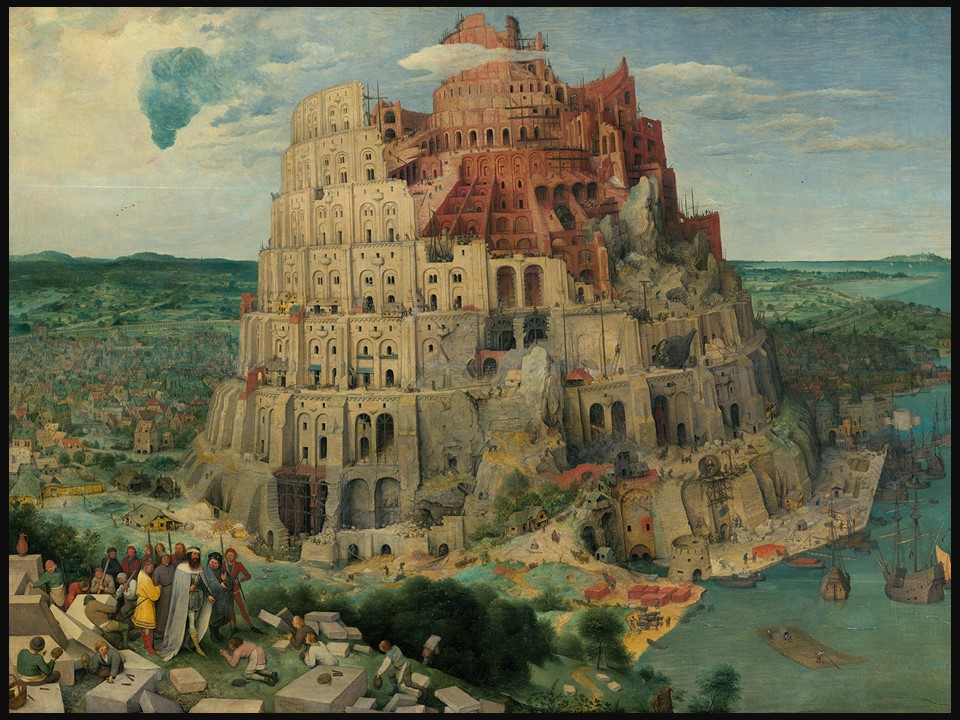
The Tower of Babel, 1563, Oil on Panel, 1,140×1,550 mm, Collection
Kunsthistorisches Museum, Vienna, Austria https://www.bruegel2018.at/en/the-tower-of-babel/
11 Now the whole world had one language and a common speech. 2 As people moved eastward,[a] they found a plain in Shinar[b] and settled there. / 3 They said to each other, “Come, let’s make bricks and bake them thoroughly.” They used brick instead of stone, and tar for mortar. 4 Then they said, “Come, let us build ourselves a city, with a tower that reaches to the heavens, so that we may make a name for ourselves; otherwise we will be scattered over the face of the whole earth.” / 5 But the Lord came down to see the city and the tower the people were building. 6 The Lord said, “If as one people speaking the same language they have begun to do this, then nothing they plan to do will be impossible for them. 7 Come, let us go down and confuse their language so they will not understand each other.” / 8 So the Lord scattered them from there over all the earth, and they stopped building the city. 9 That is why it was called Babel[c]—because there the Lord confused the language of the whole world. From there the Lord scattered them over the face of the whole earth. This is how the construction of the Tower of Babel is described in Genesis 11:1–9. The Tower of Babel by Pieter Bruegel the Elder, the painting in the Kunsthistorisches Museum in Vienna, portrays this description within the context of Netherlandish Art. https://www.biblegateway.com/passage/?search=Genesis%2011%3A1-9&version=NIV
Pieter Bruegel the Elder, a prominent Netherlandish Renaissance artist, lived from around 1525 to 1569. Known for his distinctive style and masterful compositions, Bruegel excelled in depicting scenes of everyday life, landscapes, and complex narrative paintings. His works often showcased a keen observation of human behavior and a meticulous attention to detail. The Tower of Babel, The Peasant Wedding, and The Hunters in the Snow are among his notable paintings. Bruegel’s contributions to art extended beyond mere technical skill; he played a significant role in influencing subsequent generations of artists, leaving a lasting impact on the Northern Renaissance.
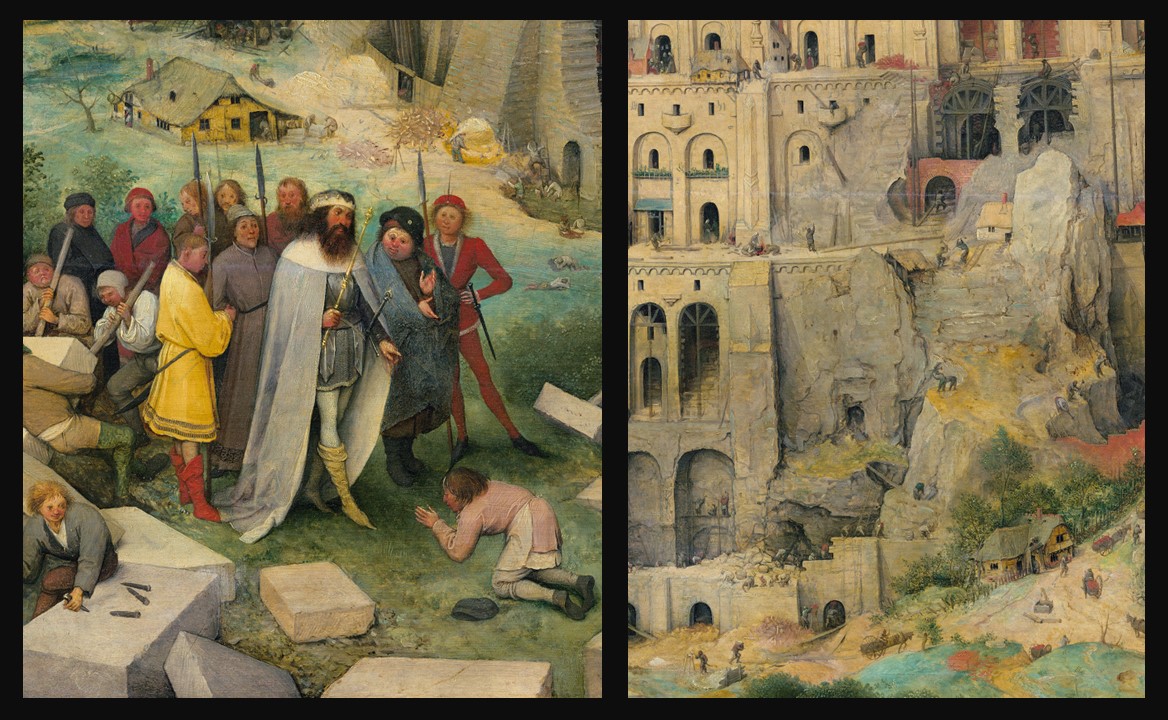
The Tower of Babel (details), 1563, Oil on Panel, 1,140×1,550 mm, Collection
Kunsthistorisches Museum, Vienna, Austria https://www.bruegel2018.at/en/the-tower-of-babel/
Among the artist’s many notable paintings, The Tower of Babel in Vienna vividly captures the viewer’s imagination. The composition is a bustling panorama of a colossal tower in progress, set against a sprawling landscape that showcases Bruegel’s meticulous attention to detail. The architectural marvel dominates the canvas, with countless workers toiling at various tasks, creating a bustling scene of organized chaos. The painting skillfully combines elements of biblical storytelling with a keen observation of human behavior, portraying the futility of human arrogance and the inevitable consequences of divine intervention. Bruegel’s use of color, texture, and intricate details adds depth and complexity to the narrative, making The Tower of Babel a masterpiece that continues to captivate viewers with its rich storytelling and artistic brilliance.
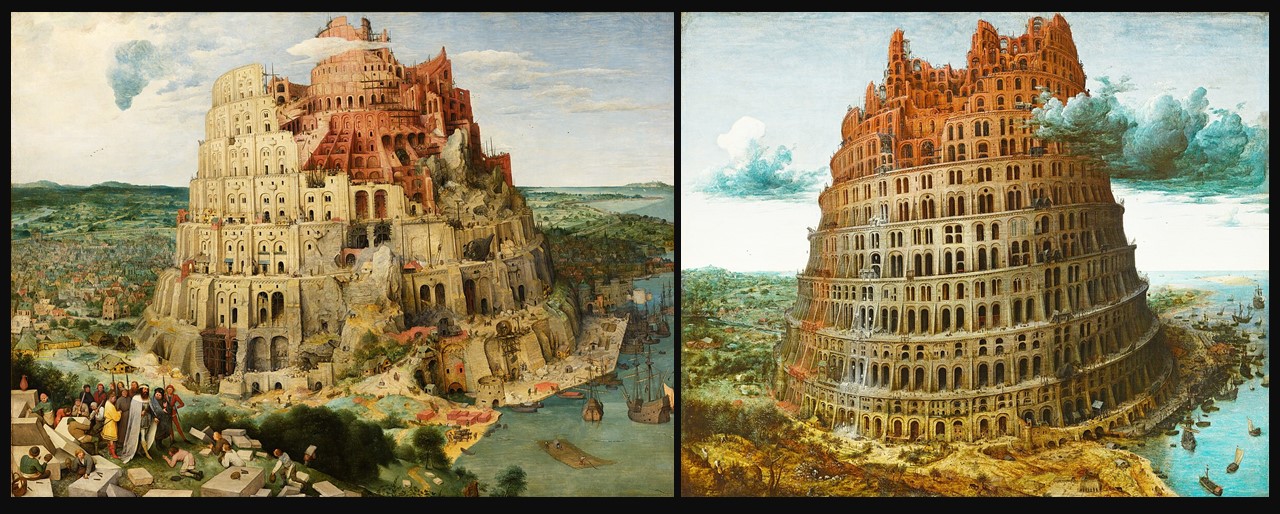
The Tower of Babel, 1563, Oil on Panel, 1,140×1,550 mm, Collection
Kunsthistorisches Museum, Vienna, Austria
The building of the tower of Babel, circa 1568, Oil and Wood, 59.9×74.6 cm, Museum Boijmans Van Beuningen, Rotterdam, the Netherlands
https://en.wikipedia.org/wiki/The_Tower_of_Babel_(Bruegel)
The Renaissance artist painted two versions of the Tower of Babel. One is in Vienna, my favourite, and the other is housed in the Museum Boijmans Van Beuningen, in Rotterdam. Seen side by side, the two paintings may depict the same subject in a similar setting, but there are a number of important differences between the two compositions. The most obvious difference is the size of the Vienna panel, which is almost four times bigger than that of the Tower in Rotterdam – but if we were able to enter the compositions, we would realize that the Tower in Rotterdam is in fact 250 % bigger than the one in Vienna. https://www.bruegel2018.at/en/the-tower-of-babel/
Pieter Bruegel the Elder’s two renditions of The Tower of Babel, exhibit subtle yet significant distinctions. In the Vienna painting, the tower commands a central and meticulously detailed position, with a slender design featuring a distinctive spiral staircase. The foreground is bustling with a multitude of workers engaged in various construction tasks, contributing to a sense of organized chaos. On the other hand, the Rotterdam version offers a slightly elevated perspective, showcasing a more massive and block-like tower positioned towards the left side. The architectural structure differs, and the foreground activity, while still busy, is less intricately detailed, allowing for a broader view of the expansive landscape. These variations in composition, architectural design, foreground activity, and atmospheric elements highlight Bruegel’s nuanced approach to depicting the same biblical narrative, providing viewers with unique visual experiences in each rendition.
For a Student Activity, inspired by Pieter Bruelel’s paintings, titled The Tower of Babel, please… Check HERE!